





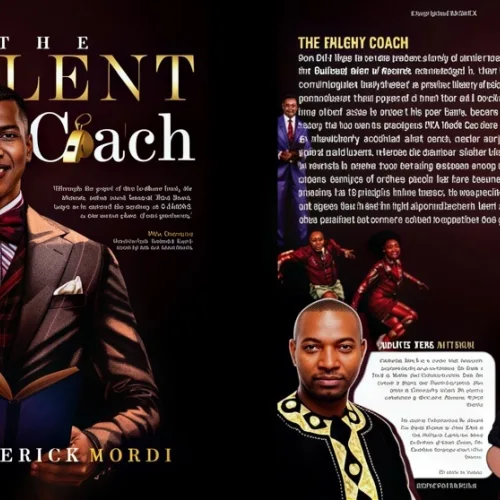
Frederick Mordi (2023), The Talent Coach. Ibadan: New Africa Book Publishers. ISBN: 978-978-60191-0-9. Pp 190
Very few books offer the reader options for where to start. The Talent Coach offers a 12-page workbook that the perceptive reader will do well to consider beginning with. The workbook is at the end, but it is so useful that it would guide the reader to a deeper and active appreciation of the 12 lessons.
The 12-page workbook section is a valuable addition, transforming passive reading into active self-reflection. Questions such as “What talent do you have?” and “Are you using your talent wisely?” prompt readers to apply the lessons to themselves.
The reader of The Talent Coach will benefit from the wide canvass already covered in the area. One of the most instructive counsels is Stephen Covey’s Habit 2: Begin with the End in Mind in The 7 Habits of Highly Effective People. At its core, it is based on a single, profound principle: All things are created twice. The First Creation is mental (the blueprint, the vision, the design). The Second Creation is physical (the actual building, execution, and action).
The Talent Coach reinforces the primacy of the mental or first creation. The cases and examples reinforce the criticality of thinking in the deployment of talent.
Talent is a timeless subject. The treatment of the subject in this book with its encyclopaedic references sustains and refreshes the debate. It takes a gifted writer applying enormous talent to ensure the subject has continued resonance.
Synopsis
The Talent Coach (2023) by Frederick Mordi is a motivational nonfiction work presented as a lively, interactive seminar. The central character is Dr Joe Jordan, a charismatic African American talent expert, bestselling author, and advisor to CEOs and heads of state. Hosted in Lagos by the fictional Aurum Bank as a corporate social responsibility event, the seminar unfolds in a large hall before a mixed Nigerian audience of students, parents, professionals, and executives.
Through an engaging dialogue format, The Talent Coach explores the nature of talent, how to discover it, and how to deploy it effectively for success in life.
The book comprises twelve thematic chapters, each addressing a critical aspect of talent development:
1. Everybody Has Talent – Establishes that every person possesses at least one unique talent and explores how societal and parental pressures often prevent people from discovering and pursuing their true gifts.
2. Nature or Nurture? – Examines the debate between genetic inheritance and environmental influence, using examples like the Polgár sisters (chess prodigies) and football legends Pelé and Maradona.
3. Remain in Your Field – Argues that success comes from staying in one’s natural area of giftedness, using examples of writers who left their original professions (John Grisham, Arthur Conan Doyle).
4. Talented People and the Icarus Paradox- Explores why talented individuals sometimes fail, using the Greek myth of Icarus to illustrate the dangers of overconfidence, indiscipline, and pride.
5. Practice Makes Perfect – Emphasises the importance of deliberate practice, featuring stories of Demosthenes, Winston Churchill, and James Earl Jones, who overcame speech impediments through relentless rehearsal.
6. Dealing With The Impostor Syndrome – Addresses the psychological phenomenon where high achievers doubt their accomplishments and feel like frauds.
7. What Is Your Adversity Quotient? – Discusses how adversity can reveal hidden talents and build character, featuring Handel’s composition of “Messiah” and Derek Redmond’s Olympic moment.
8. Do You Have The X-Factor? – Explores the “extra something” that sets exceptional individuals apart.
9. What Is Your Excuse? – Uses inspiring stories of disabled individuals like John Foppe (born without arms) to challenge readers to overcome their limitations.
10. Waiting For The ‘Perfect’ Opportunity – Warns against procrastination and encourages seizing opportunities as they arise.
11. If You Could Turn Back The Clock – Reflects on common regrets and the importance of work-life balance.
12. Do What You Love – Concludes by urging readers to pursue their passions and find fulfilment.
Dr Jordan draws heavily on the biblical Parable of the Talents (Matthew 25:15). Nigerian cultural context is woven throughout: parental insistence on medicine, law, or engineering over music or the arts; passion for the English Premier League and stars like Jay- Jay Okocha; social-media addiction (“nomophobia”); and everyday economic realities.
Global examples (Michael Jackson, Bill Gates, Churchill, Demosthenes, Michael Jordan, East African marathoners) sit alongside local ones (Fela Anikulapo-Kuti, the Dafinone family
of accountants).
The book ends with reflective worksheets for each chapter and a further reading list featuring Malcolm Gladwell’s Outliers, Rick Warren’s The Purpose Driven Life, Mihaly Csikszentmihalyi’s Flow: The Psychology of Optimal Experience, and classic self-help titles.
Highpoints, Strengths, and Weaknesses
Highpoints
The seminar format is the book’s greatest strength. Mordi turns abstract ideas into vivid, memorable conversations. Audience members challenge Jordan on career pressures, the value of “mickey-mouse” courses, and whether genius is born or made; he responds with stories, humour, and practical counsel. Moments such as a young girl named Hope declaring she wants to be a musician (and the subsequent parental backlash) and the lively debate over Pele versus Maradona feel authentic and entertaining. The integration of Nigerian references with universal principles makes the advice feel both local and global.
Strengths
– Highly readable and engaging. The dialogue style keeps the momentum high; readers feel as if they are sitting in the hall.
– A balanced and realistic treatment of nature and nurture. Jordan refuses to choose one side, showing how genes and environment interact and how deliberate practice can amplify natural gifts.
– Practical and action-oriented. Chapters end with clear takeaways, and later worksheets invite personal reflection.
– Culturally resonant. The book speaks directly to African (especially Nigerian) parents, students, and professionals navigating the tension between prestige careers and passion.
– Motivational without being naïve. It acknowledges obstacles—impostor syndrome, adversity, excuses, and procrastination—while insisting on personal responsibility.
-Engaging and fluent narrative that reads like an action novel.
Weaknesses
– Occasional thinness on depth. Psychological concepts such as impostor syndrome or adversity quotient are introduced clearly but not explored with the nuance found in specialised literature.
– Heavy reliance on celebrity and historical exemplars. While effective, the parade of famous names can feel formulaic at times. Familiar motivational territory. Many of the core messages (practice makes perfect, seize opportunity, do what you love) echo well-worn self-help tropes; readers of motivational literature will find little that is radically new.
– Idealised seminar. The audience is almost uniformly attentive and quick to supply perfect answers or examples; real-life Q&A is rarely this polished. Mordi’s The Talent Coach is highly readable, engaging, and wide-ranging. It covers a broad scope in a breezy manner.
The Talent Coach succeeds as an accessible, culturally grounded introduction to talent development. It is particularly valuable for young adults, parents, and mid-career professionals seeking clarity and encouragement rather than dense academic theory.
Suggested Readings
– Long Walk to Freedom by Nelson Mandela – adversity quotient and purposeful living on a grand scale.
– Start with What You Have by Sam Adeyemi -practical career guidance.
– Outliers by Malcolm Gladwell (already on the book’s further-reading list) – the 10,000-hour rule and the role of opportunity.
– Grit by Angela Duckworth – perseverance and passion as predictors of success.
– Mindset by Carol Dweck – growth versus fixed mindset.
– Flow by Mihaly Csikszentmihalyi (also listed by Mordi) – the psychology of optimal experience.
– Atomic Habits by James Clear – practical systems for deliberate practice.
– The Talent Code by Daniel Coyle – how deep practice builds skill.
– Thinking for a Change by John C. Maxwell (referenced in the text) – leadership and personal development.
-Emotional Intelligence: Why It Can Matter More Than IQ, by Daniel Goleman. A groundbreaking book that redefined what it means to be smart.
Readers who enjoy the interactive, story-driven style of The Talent Coach will find these titles either reinforce its core messages with greater depth or supply complementary frameworks for turning talent into sustained achievement.
Dr Frederick Mordi deserves commendation for this highly readable and practical book. Mordi is a writer and corporate communications practitioner. He won a Commonwealth Short Stories Award for his The Familiar Stranger and Other Stories.


Comments
Start the conversation about this story.