






Among his contemporaries, Sir Victor Uwaifo stood out as an enigmatic and charismatic performing artiste. Having unparalleled skills on the guitar, a feat that no other artistes possessed, he remains an inspiration to many, even in death. This is aside from his intellectual prowess as a sculptor and university teacher. He is, no doubt, an unforgettable hero; SUNNY IDACHABA writes.
Sir Victor Efosa Uwaifo who died in August 2021 was, indeed, very versatile. For instance, he was a musician, writer, sculptor of note, musical instrument inventor, university lecturer and the first Commissioner for Arts, Culture and Tourism in Nigeria.
He was the winner of the first ‘Gold Disc’ in Africa for his music, ‘Joromi’ in 1965 and seven others for ‘Guitar boy’, ‘Arabade’, ‘Ekassa series’ and ‘Akwete music.’
Of all the performing artistes that had emanated out of Nigeria, he was the most educated, with a Ph.D in Architectural Sculpture.
He studied Graphics at Yaba College of Technology and graduated in 1963 at the age of 22. He followed it up with a bachelor’s degree, a first-class honours (valedictorian) in 1997 at the age of 54. At 56, he bagged a master’s degree from the University of Benin where he studied Fine and Applied Arts with specialty in sculpture before he went for his Ph.D in Architectural Sculpture.
He began to play guitar when he was just 12 years old. At St. Gregory’s College, Lagos, where he attended secondary school, he continued to play music. With a contemporary in the person of Segun Bucknor, they were both among the leading Lagos high school band leaders at that time. During holidays and weekends, he would join Victor Olaiya’s ‘All Stars Band’ to perform.
After his secondary school, he also jammed it with E.C Arinze’s highlife. Uwaifo also briefly worked with Stephen Osadebe and Fred Coker before he formed his own band, ‘Melody Maestros’ in 1965 and released ‘Joromi’, which became a hit, not only in Nigeria but in other parts of West Africa.
Much later, the band went on tour of various Nigerian cities where Uwaifo experimented with a new rhythm that was similar to soul music. He, however, left it for ‘Ekassa’, a sort of traditional Benin sound.
He also delved into the hospitality industry, setting up the Joromi Hotel in 1971 in Benin City. He went further to establish a television studio. From there, he produced a number of weekly music and culture programmes.
Until he died at the age of 80, he had travelled to many countries to perform, including the United States, Russia, Japan, United Kingdom, Bulgaria, Romania, Germany, Hungary, Italy, Ghana, Ivory Coast (Côte d’Ivoire), Togo, Benin Republic, Spain, Canada and France.
In appreciation of his talents and contributions to the entertainment industry in Nigeria, the federal government, way back in 1983, honoured him with a National Honors Merit Award of the Member of the Niger (MON), the first professional musician to be so honoured.
Writing about Uwaifo, a poet, writer, Professor of Literature and African Studies, and Director of the Institute of African Studies at Carleton University, Canada, Nduka Otiono, stated: “As the news about the death of Sir Victor Efosa Uwaifo filtered through social media on Saturday, August 28, 2021, I remembered the first and last opportunity I had to see the ‘Ekassa King’ and legendary ‘Guitar Boy’ who was the first Nigerian artiste to earn a gold record play live at a concert in the early 1990s.
“The occasion was the grand opening ceremony of Chief Francis Aiyegbeni’s impressive D’Rovans Hotel, now Wallan Hotel, on Ring Road, Ibadan. Although there was an exciting line-up of musical artistes, including D’Rovans Band, I was particularly keen on seeing the performance of multi-instrumentalist Sir Victor Uwaifo and his highlife contemporary, Eddy Okonta.
“Though my friends and writers, Ogaga Ifowodo and Sanya Osha had joined me to see Eddy Okonta play a few times at a lounge on Adelabu Street in Surulere, Lagos, prior to that D’Rovans date, I had never seen Sir Uwaifo on stage. So, my expectations were high.
“True to his reputation, Sir Uwaifo who, in 2017, was named a Human Living Treasure by the United Nations Educational, Scientific and Cultural Organisation (UNESCO), stole the show that evening with his legendary handling of the guitar which has been compared to the electrifying skills of Jimmy Hendrix.”
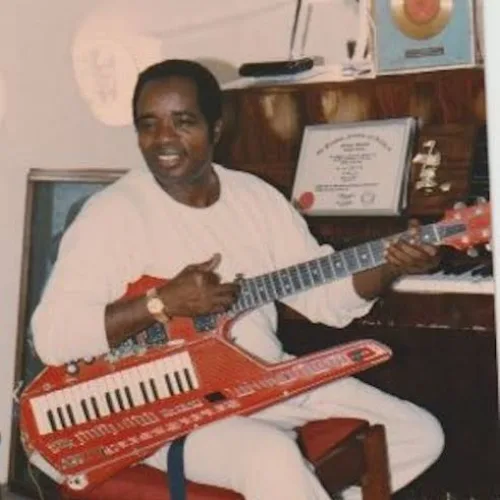
Continuing, stating that, “That night in Ibadan, Uwaifo performed the magic for which he was famous: playing the guitar with his teeth. He switched guitars, at some point while playing the all-time hit Joromi, with his trademark, self-invented revolving ‘magic guitar’, which doubled as a hand piano.”
, “That single experience of seeing Sir Victor Uwaifo live on stage has stayed with me. Just recently when I had the opportunity to serve as peer reviewer of an essay on his works by Kola Eke and Edafe Mukoro titled, ‘The Benin Minstrel and Praise Poetry: The Example of Sir Victor Uwaifo’, I did not miss the opportunity.
“To the surprise of Uyilawa Usuanlele, the Professor of History and editor of the journal, I returned the review of the journal expressly. The exercise was personal to me, having agonised over the absence of scholarship on the significance of our disappearing cultural icons such as Uwaifo.”
Writing in the same vein, one who simply described himself as ‘Jungle Journalist’ stated that, “Victor Uwaifo is not half as celebrated as he ought to have been, as the man is like over 50 geniuses put in one. No matter what area you may need him, he is there to show an enviable degree of excellence.
“Sir Uwaifo is complete in the arts: a sculptor, painter, artist, singer, writer and so many other things. He was an inventor, having mastered the art of guitar strumming, and having invented two types of guitars, the double-necked guitar, and the revolving one which comes with a keyboard and named after his great hit, ‘Joromy.’”
Giving account of Uwaifo’s museum in Benin, a journalist, Osa Amadi, wrote that, “As a team of journalists led by Otunba Runsewe, we set out early that morning from the Benin metropolis and drove several miles down the countryside where the music legend built his mansion and a museum – trust Uwaifo; he preferred to live outside the city, away from noise and synthetics.
“We went straight to his private museum which was by the side of his mighty house. At the entrance of the museum stood a large monument of a 1969 photograph taken by Don McCullin. The following words were written on top of the picture, ‘Biafra 1969: The pains of the civil war.’
“When the Igbos of Eastern Nigeria declared themselves independent in 1967, Nigeria blockaded their fledgling country – Biafra. In three years of war, more than one million people died, mainly of hunger, in famine. Children who lacked protein often got the disease kwashiorkor, which caused their muscles to waste away and their bellies to protrude. War photographer, Don McCullin, drew attention to the tragedy.
“The museum was designed by Uwaifo himself – a massive aircraft he used cement to sculpt, with rooms and compartments inside it. The rooms had different sculptured and carved images, telling the story and ancient history of the Benin kingdom.
“Our guide took us into the different rooms inside the sculptured aircraft containing different historical Benin artworks created by Uwaifo himself. Few people knew that Victor Uwaifo, apart from being one of the greatest musicians Africa has ever produced, was such an accomplished visual artist.
“Inside one of the rooms, we saw a sculptured scene of the 1890s encounter between an Oba of Benin and a British colonist. There were also quite a number of awe-striking scenes of the primordial Benin monarch, the chiefs and their subjects.
“After touring the museum, Prof. Uwaifo hosted us inside his massive mansion. His living room was grand and almost as large as a Lawn Tennis ground. The walls were lined with golden and platinum discs which he won with his smashing hits like ‘Joromi.’
Following his death, the then President Muhammadu Buhari, former Edo state governor, Godwin Obaseki, the Chief Whip of the Senate, Orji Kalu and the Performing Musicians Association of Nigeria (PMAN), condoled with the family of the late music maestro.
The late president, in particular, through a statement by his erstwhile spokesman, Femi Adesina, said, “The president joins the Nigerian music industry and performing artistes, home and abroad, in mourning the first commissioner for arts, culture and tourism (Edo state) who was also the first musician and instrumentalist to be given a national honours merit, Member of the Order of the Niger, in 1983.
“The president believes the renowned musician, with global appeal and recognitions, lived for many firsts, which include an invitation to the State House by four presidents and Heads of State and winner of a gold disc in Africa for his song, ‘Joromi’, released in 1965 at the age of 24.”
Just recently, the Deputy Governor of Edo state, Mr. Dennis Idahosa, backed plans by the Edo Music Elders Forum to honour the late music legends in the state.
He said the state government appreciated the forum’s efforts to preserve the legacy of veteran musicians and promote Edo’s cultural heritage. He also promised to reach out to the management of the Victor Uwaifo Creative Hub over the forum’s request to use the facility for its remembrance programme scheduled for August 28 subject to the venue’s availability.
Earlier, the chairman of the forum, Roland Igbinigie, said the maiden edition would commemorate the late Uwaifo and other deceased Edo music icons. He appealed for approval to use the Victor Uwaifo Creative Hub for the event.
For the numerous roles the late Uwaifo played while on earth, he remains an unforgettable hero.
Comments
Start the conversation about this story.