





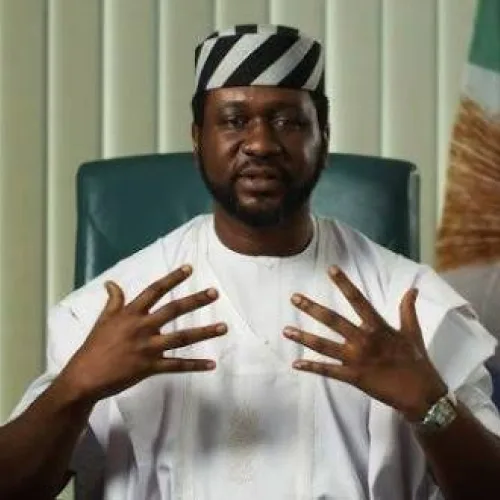
The All Progressives Congress (APC) House of Representatives candidate for Kwande/Ushongo Federal Constituency, Terseer Ugbor, in this interview with JOHN SHIAONDO in Makurdi, speaks on his re-election bid, constituency projects, insecurity, President Bola Ahmed Tinubu’s reforms and the future of Benue state.
The Independent National electoral Commission (INEC) has officially published the names of candidates for the 2027 National Assembly elections. What does your emergence as the APC candidate for Kwande/Ushongo Federal Constituency mean to you?
Thank you very much. I am indeed very happy because the Independent National Electoral Commission (INEC) has officially published the names of candidates for the National Assembly elections across the country. By the grace of God, my name has been published to confirm my victory at the primaries as the duly nominated candidate of the All Progressives Congress (APC) for Kwande/Ushongo Federal Constituency.
I consider this a great honour and a renewed call to service. I felt it was important to meet my people, celebrate this milestone with them, and re-assure them that my assignment is far from over. The mandate they entrusted to me has not been fully accomplished, and I remain committed to completing it.
Over the past three and a half years, we have recorded remarkable progress, but there is still much work to be done. If re-elected, I will consolidate on the gains we have made and ensure that the people enjoy even greater dividends of democracy.
What are some of the key projects you intend to complete if you return to the National Assembly?
There are several strategic projects that are already at advanced stages and must be completed. The Technology Incubation Centre is almost finished and will soon become operational.
We also have the National Open University study centre, which has already received the federal government’s approval. Work will continue on the proposed Federal Medical Centre, while the Comprehensive Healthcare Centre in Turan, Jato-Aka, will also be completed.
In addition, we are constructing a comprehensive primary school with teachers’ quarters and doctors’ accommodation. There are many other projects spread across the constituency, including the one billion naira bridge project recently approved by the federal government.
That bridge project is the biggest constituency project ever approved for Kwande/Ushongo and, perhaps, one of the largest attracted by any member of the House of Representatives in Benue state. It will significantly improve transportation, boost economic activities, and open up rural communities.
Beyond infrastructure, what other interventions have you undertaken for your constituents?
We have focused heavily on improving the quality of life of our people. We have constructed 17 motorised boreholes across various communities and rehabilitated about 20 hand-pump boreholes. We are also working to restore water supply to the General Hospital in Adikpo so that patients and healthcare workers can have access to clean water.
Agriculture has equally received significant attention. We have organised about 10 agricultural empowerment programmes, distributed large quantities of fertilisers and herbicides, and provided training and capacity building for farmers.
These interventions have contributed to one of the highest farming yields our constituency has witnessed in recent years. We have also supported our youths through employment opportunities and skills development initiatives, and we intend to expand these programmes in the coming years.
Looking back, what has been your greatest challenge as a federal lawmaker?
It has not been an easy journey. One of the biggest challenges is that Kwande/Ushongo has never had the advantage of producing a ranking member in the House of Representatives. Every election cycle, we end up sending first-time legislators to Abuja.
As a result, the constituency has not fully benefitted from the institutional influence and legislative experience that come with seniority. Ranking lawmakers naturally have greater opportunities to attract projects, influence national policies and secure strategic interventions for their constituencies.
That is why I am appealing to the people to remain steadfast and support me once again. If I return as a ranking member, we will finally break that long-standing barrier and position Kwande/Ushongo to benefit even more from the opportunities available at the National Assembly.
Insecurity remains a major concern in your constituency. During your previous visit to Jato-Aka after attacks on communities, you requested the establishment of a military forward operating base. With the approval of the Nigerian Army’s 5 Division Headquarters for Benue state, how does this fit into your security strategy?
I was genuinely one of the happiest people when I heard that the federal government had approved the establishment of the Nigerian Army’s 5 Division Headquarters in Benue state. That decision demonstrates that President Bola Ahmed Tinubu is a listening leader who understands the peculiar security challenges facing Benue and other parts of the country.
Even before approving the Division, the president had authorised the deployment of a military battalion to Jato-Aka. That deployment has significantly improved security in the area and reduced incidents of attacks.
I have interacted with the military personnel on the ground and have seen first-hand the commitment they are bringing to the assignment. The local communities themselves have acknowledged that security has improved considerably since their arrival.
Beyond that, the National Assembly has approved the State Police Bill transmitted by the president. The bill will now proceed to the states for concurrence. Once it becomes law, Nigeria will enter a new era of decentralised policing.
Our people have always had a tradition of community policing through traditional institutions. That system worked effectively before it was abolished, leaving a major gap in local security. State policing will help bridge that gap by allowing communities to play a more active role in safeguarding lives and property.
It will also create employment opportunities for young people recruited into the security services while strengthening peace and security across the country.
From a national perspective, do you believe President Bola Tinubu has done enough to deserve a second term in office, particularly from the standpoint of Benue state?
Yes, I do. I believe President Bola Ahmed Tinubu is a reform-minded leader who has shown courage in taking difficult, but necessary decisions aimed at changing the direction of our country.
His administration has introduced far-reaching reforms, including local government autonomy, the State Police initiative and the removal of fuel subsidies, which had become a huge burden on the nation’s economy. These are bold decisions that previous administrations were reluctant to make.
There are also on-going discussions on state-creation, local government creation and the restoration of constituencies. Under this administration, Benue has already benefited from the restoration of several constituencies, and we are hopeful that additional constituencies within Kwande will also be restored to improve representation.
Another major achievement is the substantial increase in resources available to state governments. Today, governors have greater financial capacity to undertake infrastructure development and improve the welfare of their citizens.
With these increased allocations, there should no longer be any justification for the non-payment of workers’ salaries. State governments must complement the president’s reforms by investing heavily in human capital development, youth empowerment, women and vulnerable groups.
Education has remained a priority in your legislative work. What more should be done?
Education remains one of the most powerful tools for reducing poverty. I would like to see further improvements to the student loan programme, while grants and scholarship schemes should also be revived, particularly in Benue state.
As the chairman of the House Committee that worked extensively on the student loan initiative, I played an active role in shaping many of the reforms that are now benefiting Nigerian students.
I am pleased that over 25, 000 students from Benue state have already benefited from the programme. That is something I am proud to have contributed to, and I believe even more can be achieved.
Finally, what is your overall assessment of the federal government’s interventions in Benue state?
A great deal has been achieved with the support of President Tinubu and the encouragement of our leader, the Secretary to the Government of the Federation, Senator George Akume. Numerous infrastructure projects are on-going across Benue state. We have seen investments in roads, healthcare, and other critical sectors. The newly approved Infectious Disease Hospital, which will serve the entire North-central region, is another landmark intervention by the federal government.
A new bridge is currently under construction across the River Benue at the Buruku crossing point. The Tinubu administration is also constructing several dams across Benue state to boost irrigation farming and enhance agricultural productivity. In addition, the dualisation of the Makurdi–Enugu road is progressing, alongside several other infrastructure projects being executed by the federal government under President Bola Ahmed Tinubu’s administration.
These projects demonstrate that the president recognises the strategic importance of Benue state and understands the challenges confronting our people. We appreciate his support and encourage him to continue implementing policies that will reduce poverty, create jobs, improve security, and enhance the quality of life of Nigerians. I am confident that, working together, we can build a safer, more prosperous and more inclusive future for Benue state in particular and Nigeria as a whole.
Comments
Start the conversation about this story.