





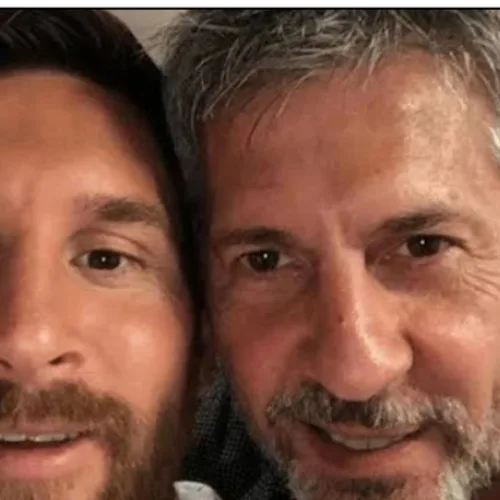
Jorge Messi, the father and long-time representative of Argentina and Inter Miami star Lionel Messi, has died at the age of 68.
Jorge reportedly died at about 10pm on Friday at a sanatorium in Rosario, Argentina, following a prolonged illness. Argentine media outlet Infobae reported his death, with Spanish newspaper MARCA also confirming the development on Saturday.
Jorge was a hugely influential figure in Lionel Messi’s life and football career, particularly during the difficult early years that eventually saw the Argentine become one of the greatest footballers of all time.
Born in Argentina, Jorge was married to Celia Cuccittini and had four children: Lionel, Rodrigo, Matias and Maria Sol.
Although he largely stayed away from the public spotlight, Jorge played a critical role in helping his son overcome the challenges he faced as a young footballer.
Lionel began his football journey at Newell’s Old Boys in Rosario, where his talent quickly became evident.
However, his development was complicated by a growth hormone deficiency that required expensive medical treatment.
After efforts to secure the necessary treatment in Argentina proved unsuccessful, Jorge helped explore opportunities abroad.
That search eventually led the family to Barcelona, where Lionel moved at the age of 13 to continue his football development and receive the medical treatment he needed.
The decision was a major turning point in the youngster’s life.
Jorge remained with Lionel in Spain during the early stages of his career, while other members of the family stayed behind in Rosario.
The father and son endured difficult moments as they adjusted to life in a new country and waited for Lionel’s football career to take shape.
Speaking about that period in a 2007 interview, Lionel recalled how his father gave him the choice of continuing his football journey in Spain or returning home.
“My old man was always by my side. We lived through many bad moments,” Messi recalled.
According to the Argentine superstar, Jorge eventually asked him whether he wanted to continue pursuing his dream or return to Argentina.
Lionel chose to stay.
“I wanted to continue and he stayed with me,” Messi said.
That decision would ultimately prove decisive.
Messi went on to rise through Barcelona’s youth system before making his first-team breakthrough.
He subsequently established himself as one of the most successful players in football history, winning numerous domestic and international honours.
Jorge remained closely involved in his son’s career and later became his representative, handling several aspects of Lionel’s professional affairs, including negotiations and commercial agreements with major brands.
Despite his important position, Jorge generally avoided the intense media attention surrounding his son.
He occasionally spoke publicly about Lionel and the family’s journey, often highlighting the difficult experiences they had endured together before the footballer achieved global fame.
In one emotional message to his son, Jorge reflected on their shared journey and reminded Lionel that their struggles had helped strengthen the family.
He also expressed his pride not only in Lionel’s achievements on the football pitch but in the person he had become away from football.
Jorge’s health became a subject of public attention in 2026 after Lionel appeared emotional following Argentina’s opening match at the World Cup.
After scoring a hat-trick, Messi was asked about his emotional reaction and indicated that his feelings were connected to a personal matter unrelated to football.
“It is for a reason completely unrelated to sport. I had some difficult, complicated days,” he said at the time.
When asked further about the situation, Messi referred to his family.
“The truth is, more than anything, because of the family,” he said.
The Messi family later disclosed that Jorge was under medical supervision and was recovering while receiving treatment for his condition.
Jorge had a background outside football. He trained as a chemical technician and began working at Acindar, an Argentine steel company, during the 1980s. He eventually rose to become a manager at the company.
He also had an early connection with football, having played as a midfielder in the Newell’s Old Boys youth system before eventually leaving the sport after being called up for military service.
For Lionel, however, his father’s most significant contribution came through the support he provided during the formative years of his football career.
From helping secure medical treatment for a young boy with a growth hormone condition to relocating with him to Spain and supporting him through the uncertainty of his early European career, Jorge was a constant presence behind the scenes.
Lionel Messi would later become Barcelona’s all-time leading goalscorer, win multiple Ballon d’Or awards and claim numerous league and Champions League titles.
He also guided Argentina to victory at the 2022 FIFA World Cup in Qatar, completing a career achievement that had eluded him for much of his international career.
The Argentine captain has repeatedly acknowledged the importance of his family in his journey, with his parents and siblings providing support throughout his rise from a talented youngster in Rosario to a global football icon.
Jorge’s death therefore marks the loss of a figure who, despite rarely seeking the limelight, played a crucial role in shaping one of football’s most remarkable careers.
He is survived by his wife, Celia, and their children, Lionel, Rodrigo, Matias and Maria Sol.
Comments
Start the conversation about this story.