







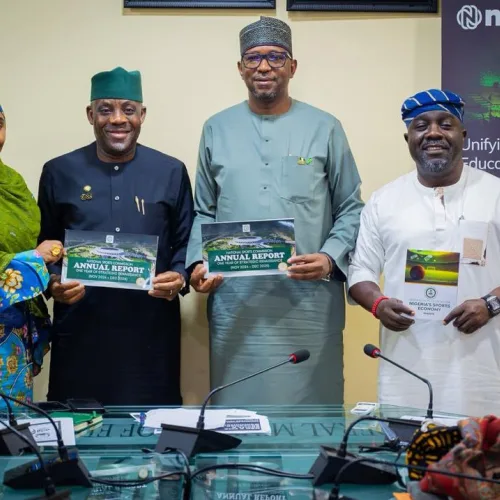
The National Sports Commission (NSC) and the Federal Ministry of Education have unveiled the National Sports and Education Excellence Programme (N-SEEP), a landmark initiative designed to integrate quality education with elite sports development and establish a sustainable pathway for identifying, developing and retaining Nigeria’s sporting talents.

The programme will establish Sports and Education Centres of Excellence across nine tertiary institutions, combining internationally benchmarked academic programmes with high-performance sports training and research.
NSC Chairman Mallam Shehu Dikko said N-SEEP brings together two critical national priorities: education and sports, and addresses the long-standing challenge faced by talented young Nigerians who have often been forced to choose between academic advancement and pursuing elite sporting careers.
“This is about creating a system where our young athletes do not have to sacrifice education to pursue sporting excellence or abandon their sporting potential in order to obtain an education. We are creating an ecosystem where both can thrive together,” Dikko said.
“The performances of our athletes at the recently concluded Glasgow 2026 Commonwealth Games demonstrate the enormous talent available in this country. Our responsibility is to build the structures that continuously identify, develop and support that talent. We want success at major championships to become sustainable rather than occasional.”
He added that engagements are ongoing with international football governing bodies, including FIFA and CAF, towards securing global accreditation and recognition for relevant Nigerian sports education programmes.
Minister of Education Dr. Maruf Tunji Alausa described N-SEEP as one of the transformative reforms being implemented under President Bola Ahmed Tinubu’s Renewed Hope Agenda, saying the programme would enable Nigerian sporting talents to train and develop at home while earning internationally recognised qualifications.
“The future of sports lies not only in winning competitions, but in developing people through quality education. Through this initiative, we are producing athletes who will also become coaches, sports scientists, physiotherapists, administrators, entrepreneurs, researchers and innovators,” Alausa said.
“For too long, talented young Nigerians have been forced to choose between pursuing their education and pursuing their sporting dreams. N-SEEP changes that. We are building world-class institutions where Nigerian talents can learn, train and succeed at home while earning globally recognised qualifications.”
Nine tertiary institutions have been selected to host the National Sports and Education Centres of Excellence: University of Ibadan; Ahmadu Bello University, Zaria; Federal College of Education, Okene; Babcock University; University of Nigeria, Nsukka; University of Benin; University of Jos; Muhammad Buhari University, Maiduguri; and Federal Polytechnic, Offa.
Director-General of the National Sports Commission, Hon. Bukola Olopade, said the programme represents a deliberate move beyond measuring Nigeria’s sporting development solely by medals won at international competitions.
According to Olopade, N-SEEP will help establish a sustainable pipeline of athletes, coaches, sports scientists, educators, administrators and other professionals capable of supporting a modern sports economy.
“This is bigger than medals. We are building the human capital and institutional framework required for sustainable sporting excellence. Our athletes need world-class coaches, scientists, medical professionals, administrators and researchers around them, and N-SEEP gives us an opportunity to develop that entire ecosystem here in Nigeria,” Olopade said.
Phase One will commence during the 2026/2027 academic session at four pioneer institutions: University of Ibadan, Ahmadu Bello University, Federal College of Education, Okene, and Babcock University, before the programme expands to the remaining institutions in subsequent phases.
Under the initiative, participating institutions will develop specialised sports faculties and programmes covering areas including coaching, sports medicine, sports science, sports technology and data analytics, sports business, facility management, event management and sports administration.
Minister of State for Education, Prof. Suwaiba Sa’id Ahmad, also called for greater flexibility within participating institutions to accommodate the unique demands placed on student-athletes, including flexible academic calendars and stronger collaboration among faculties.
The centres will also combine academic instruction with high-performance training facilities and modern research infrastructure, creating an environment capable of producing not only elite athletes but the professionals required to sustain Nigeria’s sports industry.
Beyond elite competition, N-SEEP is expected to expand opportunities for young Nigerians, strengthen the country’s sports workforce, promote discipline and teamwork, support youth development and contribute to the use of sports as an instrument for economic growth and national cohesion.
Dr. Alausa commended Dikko, Olopade, members of the programme’s technical committee and other stakeholders whose collaboration led to the development of the initiative.
Comments
Start the conversation about this story.