





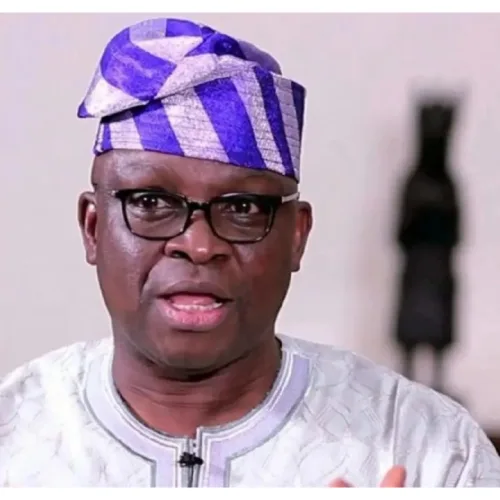
Former Ekiti State Governor, Ayodele Fayose, has argued that persistent electricity shortages in rural communities are having consequences beyond economic hardship, linking the absence of power to early nights, limited social activities and population growth.
Fayose made the remarks in Abuja on Friday shortly after his inauguration as Chairman of the Governing Board of the Rural Electrification Agency, the Federal Government agency charged with expanding electricity access to underserved and unserved communities.
Speaking on the need to tackle Nigeria’s rural electricity deficit, Fayose suggested that the lack of power had significantly altered the social lives of people living in communities without reliable electricity.
According to him, darkness sets in early in many rural areas, leaving residents with few opportunities for recreation or social engagement outside their homes.
He argued that the situation encourages people to retire early and spend more time indoors, with limited alternatives for entertainment after nightfall.
“After 7 o’clock, it gets dark there,” Fayose said, stressing that residents in such communities often have little else to occupy their time.
The former governor went further to draw a link between the lack of evening recreational activities and population growth, arguing that when residents have limited alternatives at night, they are more likely to remain at home with their spouses.
“Everybody is engaging their wives. And the population simply becomes double,” he said.
Fayose maintained that expanding electricity access could transform the social environment in rural communities by extending productive and recreational activities beyond daylight hours.
He said improved electricity supply would make it possible for businesses, entertainment centres and other social activities to operate at night, giving residents alternatives to staying indoors.
“When we address this electricity, there will be nightlife. There will be recreation outside your wife,” he added.
Beyond the unusual social dimension of his argument, Fayose’s comments underscored the broader implications of Nigeria’s rural electrification challenge, particularly for communities where the absence of power affects economic activity, education, security and quality of life.
His remarks came as he assumed leadership of the REA governing board at a time when the Federal Government is pursuing wider electricity access for communities that remain disconnected from the national grid or receive inadequate power supply.
The new board was inaugurated by the Minister of Power, Joseph Tegbe, alongside other newly appointed officials.
Ahmadu Abubakar and Ilyasu Makinta were inaugurated as board members, while three other non-executive directors also joined the governing board.
Abba Aliyu was formally installed as the Managing Director of the Rural Electrification Agency.
With Fayose now at the helm of the REA board, the agency is expected to intensify efforts to expand electricity infrastructure and improve access in rural and underserved communities across the country.
Comments
Start the conversation about this story.