






The Kaiama community in Kwara State has called for sustained government support to rehabilitate and reintegrate victims of the February 3 attack on Woro, following the release of 163 of the victims after about six months in captivity.
A retired permanent secretary in Kwara State and vice president of the Kaiama Development Association, Yakub Jaja, made the call during an interview with PREMIUM TIMES in Ilorin on Saturday.
Mr Jaja thanked President Bola Tinubu, Governor AbdulRahman AbdulRazaq of Kwara, security agencies and local vigilantes for the release of the abductees.
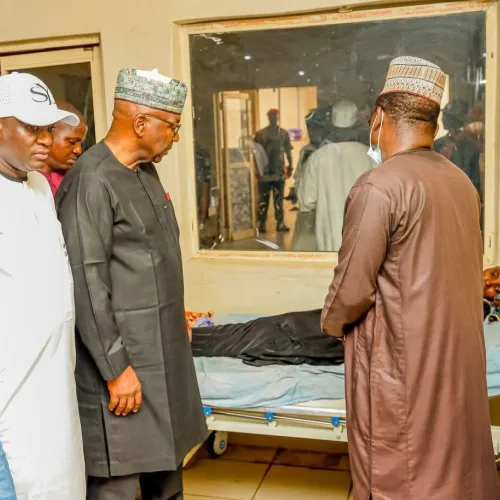
 Governor AbdulRazaq during a visit to some of the rescued victims in a hospital
He said the community was relieved to see the victims return alive after months of uncertainty. Still, he stressed that their release marked the beginning of another phase requiring coordinated government and community intervention.
According to him, 176 persons were initially abducted during the attack, while 163 have so far returned.

He said the 3 February incident left a lasting impact on Woro and neighbouring communities, with homes, shops and places of worship destroyed in the attack.
Mr Jaja said the rescued victims were currently receiving medical treatment at various facilities, including the Kwara State University Teaching Hospital. At the same time, some were being accommodated at the Nigerian Army’s Sobi Barracks.
He explained that the victims were in different conditions, with some physically and mentally stable, while others were in the intensive care unit and hospital wards.
The community leader also recounted some of the experiences shared by the victims, saying some had spent months under difficult conditions while in captivity.

He disclosed that some of the women gave birth during their captivity.
According to him, 11 children were born during the period, including a set of twins, while six of the children died, and five were brought back alive.
Mr Jaja also alleged that some of the abductees were forced into relationships with members of the criminal group. At the same time, some persons aged 15 and above were allegedly incorporated into their activities.
He said he could not confirm whether a ransom was paid to secure the victims’ release.
“I cannot exactly say what transpired in that,” he said when asked about the circumstances surrounding their release.
Mr Jaja recalled that the abductors had initially demanded a ransom of about N2 billion, adding that the community subsequently attempted to mobilise funds for negotiation.
He said the community later intensified advocacy, protests, and engagement with authorities after it became difficult to raise the demanded amount.
The Kaiama leader identified poor road infrastructure as one of the factors complicating security operations in the area.

He said the major routes linking Kaiama with neighbouring communities were in deplorable condition, making it difficult for security personnel to respond promptly to emergencies.
Mr Jaja said Woro is about 40 kilometres from Kaiama town. At the same time, the route linking the community to Nibusa, where army and air force facilities are located, is also difficult to navigate.
He urged the government to improve road infrastructure in the area as part of broader measures to strengthen security and facilitate economic activities.
Mr Jaja welcomed the federal government’s reported approval of the establishment of a military base in Kaiama, describing it as a significant step towards improving security in the area.
He said the presence of a permanent military formation would enhance the response capacity of security agencies and provide greater confidence to residents.
He also commended Governor AbdulRazaq for visiting some of the rescued victims at Sobi Barracks and the hospital.
According to him, the state government has pledged to provide medical care for the victims.
However, he said government intervention should extend beyond immediate medical treatment to include psychological support, accommodation, education and economic assistance.
Mr Jaja said the attack had significantly affected education and economic activities in Woro and the surrounding communities.
He said some parents had moved their children to Kaiama town and the neighbouring communities because of lingering security concerns.
However, he noted that economic activity was gradually returning but had not yet fully recovered, with residents still leaving their communities early due to concerns for their safety.
According to him, the state government had commenced some interventions, including the reconstruction of shops and the provision of water facilities.

He, however, stressed that more needed to be done to restore confidence and enable displaced residents to return permanently.
Mr Jaja appealed to residents to accept the rescued victims without discrimination or stigmatisation.
He said many of the survivors would return to communities where they had lost parents, relatives and property, making reintegration a major challenge.
READ ALSO: 13 unaccounted for after 163 Kwara abductees rescued Community leader
“Some, their father had been killed. Some of their mother had been killed. And they are small children. They would like to see their parents. Unfortunately, they cannot see them,” he said.
He called for a coordinated rehabilitation programme involving the federal government, Kwara State Government, local authorities, traditional institutions and community leaders.
He said the programme should address healthcare, accommodation, education, psychosocial support and livelihood opportunities.
Mr Jaja also urged security agencies to maintain their presence in Woro and other vulnerable communities around Kainji Lake to prevent a recurrence.
He said the rescue of the abductees should be seen not as the end of the crisis but as the beginning of a long-term process of recovery, rehabilitation and restoration of confidence in the affected communities.


Discover more from Premium Times Nigeria
Subscribe to get the latest posts sent to your email.
Comments
Start the conversation about this story.