





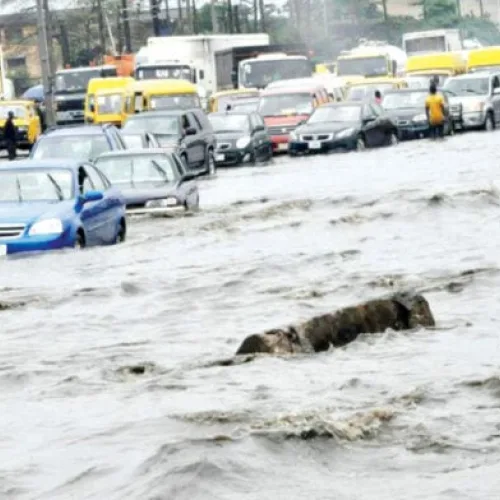
Nigeria’s recurring floods are exerting a heavy economic toll, with losses estimated at between $3.79 billion and $9.12 billion and annual spending on damaged infrastructure reaching roughly N880 billion (about $644 million), according to the latest macroeconomic outlook from Financial Derivatives Company (FDC).
The report attributes most of the damage not to the weather itself but to long-standing structural failures. “Floods are acts of God, but flood losses are mainly acts of man,” FDC notes, quoting floodplain management pioneer Gilbert F. White.
Poor urban planning, inadequate drainage systems, deforestation and environmental degradation have turned higher rainfall into widespread destruction, particularly in southern and southwestern states that lie below sea level.
According to FDC, Nigeria recorded an average rainfall of 68.36 mm in the first half of 2026, a 45.5 per cent rise from 46.99 mm in the corresponding period of the previous year. While climate factors, including El Niño cycles and forecasts from the Nigeria Meteorological Agency, play a role, the firm stresses that preventable weaknesses amplify the impact on agriculture, food supply chains and inflation. The analysis finds a positive correlation of +0.02 between flooding and food inflation.
These disruptions continue to weigh on the broader economy even as other indicators show improvement. FDC expects headline inflation to ease only modestly to 16.08 per cent in July and 15.89 per cent in August. Single-digit inflation is unlikely before the third quarter of 2027.
READ ALSO: Food security: FG, IFDC explore options to reduce price of fertilizer, boost yield
Similarly, the firm noted that the recent cut in ex-depot petrol prices by Dangote Refinery should ease transport costs and household spending, but the pass-through to wider consumer prices is expected to be gradual and will not fully offset food-price pressures driven by weak agricultural productivity and climate shocks.
Despite the headwinds, Nigeria’s capital market continues to stand out. The Nigerian Exchange has maintained its position among the world’s best-performing equity markets in dollar terms in 2026. The anticipated listing of Dangote Refinery, expected to be Africa’s largest initial public offering, could further deepen liquidity and strengthen the country’s investment profile.
FDC characterises the near-term outlook as one of cautious optimism.
Macroeconomic stabilisation is gaining traction, with more predictable exchange-rate conditions and moderating inflation. Yet these gains remain vulnerable to supply-side shocks. Sustained progress, the report concludes, will depend less on monetary policy alone and more on addressing structural constraints infrastructure deficits, climate resilience, agricultural productivity and policy consistency — especially as the 2027 election cycle intensifies political competition and tests reform credibility.
Comments
Start the conversation about this story.