





…insist bill’ll expose Nigerian children to addiction
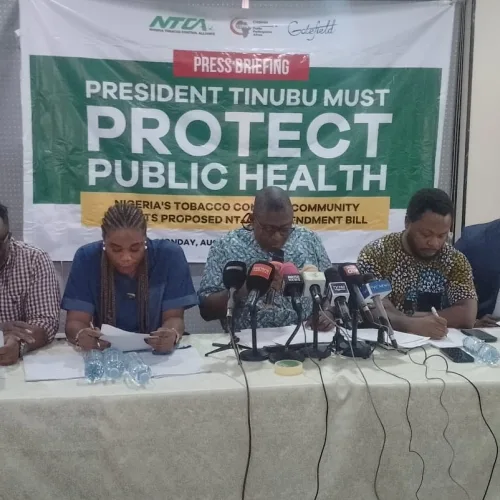
Over 100 civil society organisations (CSOs), health advocates and public-interest groups have urged President Bola Tinubu to reject the proposed amendment to the National Tobacco Control Act, warning that the Bill could reverse more than a decade of tobacco-control gains and expose Nigerian children and young people to nicotine addiction.
The groups, under the Nigeria Tobacco Control Community, also demanded the immediate recall of the National Tobacco Control Act (Amendment) Bill 2025, alleging that the 31-page consolidated draft contains provisions that were not contained in the versions presented to Nigerians during the public hearing in November 2024.
Speaking at a press briefing on Monday in Abuja, Executive Director, Corporate Accountability and Public Participation Africa (CAPPA), Akinbode Oluwafemi, said while the National Tobacco Control Act 2015 and its 2019 Regulations require updating to address emerging tobacco and nicotine products, such reforms must not weaken public-health protections.
The coalition particularly faulted provisions relating to vapes, heated tobacco products and nicotine pouches, arguing that the proposed legislation could create loopholes in advertising, sponsorship, product sampling, retail promotion and online sales.
It also opposed the proposed reclassification of heated tobacco products as non-combustible products, insisting that products containing tobacco should remain subject to tobacco-control regulations.
Oluwafemi said the Bill could weaken health-warning requirements for some novel nicotine products and remove specific penalties for certain violations under the existing law.
He also raised concerns over provisions allowing online sales and remote delivery of non-combustible tobacco products.
The coalition questioned how some of the provisions found their way into the consolidated Bill, noting that the earlier versions, HB 47 and HB 1151, presented at the November 22, 2024 public hearing, did not contain some of the provisions now being challenged.
Also speaking, In-Country Coordinator of the Campaign for Tobacco-Free Kids (CTFK), Michael Olaniyan, said the proposed inclusion of “tobacco harm reduction objectives” in the law was particularly troubling.
Olaniyan argued that harm reduction should not be used to justify weaker regulation of emerging nicotine products, warning that products promoted as alternatives to conventional tobacco could attract people who had never smoked.
He said: “The first issue that we need to address is that harm reduction is not harm elimination.”
Olaniyan warned that the products could become a pathway into nicotine use for non-smokers, particularly young people, as he criticised provisions that could permit advertising of non-combustible products through online platforms, point-of-sale materials and publications classified as being for adults.
He questioned the proposed definition of an “adult publication” as one with at least 50 per cent adult readership, arguing that such a threshold could still expose children to tobacco advertising.
The coalition also opposed provisions allowing tobacco and nicotine companies to sponsor cultural, social and recreational events, warning that promotional content from such events could easily reach children through social media.
Another major concern, Olaniyan said, was the proposed legalisation of online sales of non-combustible tobacco and nicotine products, subject to age verification.
He questioned whether such safeguards could effectively prevent minors from accessing the products.
“If a child wants to buy a tobacco product or a nicotine product, just click, Yes, I am 18 years old,’ and then he has access to it. How does that make any public health sense?” he asked.
He further questioned whether delivery riders would realistically be able to verify the age of every recipient.
The coalition also faulted a provision allowing product sampling in enclosed areas, saying it could create a loophole in the prohibition of indoor use.
Olaniyan said the provision could allow users to repeatedly claim they were merely sampling the products, saying, “So what do you need to do to use the product perpetually? So perpetually sample it.”
He also raised concerns over proposed changes to health warnings on emerging products, saying Nigeria had spent years moving from text-only warnings to graphic health warnings.
According to him, the proposed amendment could introduce weaker requirements for some novel products, particularly by setting a “maximum” rather than a minimum size for certain warnings.
While noting that “The standard good practice is to put it at a minimum benchmark,” Olaniyan further rejected the proposed reclassification of heated tobacco products as non-combustible products, insisting that the presence of tobacco should determine their regulation.
“You cannot on one hand say that heated tobacco products contain tobacco, but at the same time turn around and say, do not apply the rules of tobacco products on heated tobacco products.”
He also criticised a proposed provision granting the Minister of Health broad powers to exempt certain non-combustible products from provisions of the law, warning that such discretion could expose tobacco regulation to lobbying and regulatory capture.
However, the coalition’s strongest governance concern centred on the emergence of the current 31-page draft.
Olaniyan alleged that the two Bills presented at the November 2024 public hearing were only four pages when combined, but that a substantially different 31-page document later emerged.
“We made our recommendations. We took those recommendations into the chambers, discarded all the recommendations that Nigerians made, and then came down to the 31-page new document that has absolutely no bearing on the original two documents that were presented to Nigerians,” he alleged.
He demanded to know who introduced the new provisions and which public-health institutions reviewed them.
Also speaking, Alliance Coordinator, Nigeria Tobacco Control Alliance (NTCA), Olawale Makanjuola, said weakening tobacco controls would impose an additional burden on a health system already struggling with tobacco-related diseases.
He expressed particular concern over the growing visibility of vaping and other nicotine products among young Nigerians, warning that the country could undermine the future of a generation while trying to address other national challenges.
“You need these children, these young people, to come up for you when it’s election year to vote. But yet you are helping or killing them.”
Makanjuola said Nigeria had become a model for tobacco control in Africa, particularly through efforts to restrict tobacco promotion in the entertainment industry, warning that the proposed amendments could undo those gains.
Assistant Executive Director, CAPPA, Zikora Ibeh, said tobacco companies were driven by the need to sustain consumption and profits.
According to her, years of public-health advocacy had helped reduce the visibility and social acceptability of smoking in Nigeria, but warned that emerging nicotine products could provide the industry with new avenues to reach young people.
The coalition called on the National Assembly to recall the Bill and subject it to a transparent, public-health-led review.
It also demanded the publication of committee reports, voting records and stakeholder submissions that informed the current draft.
The groups urged the Federal Ministry of Health and Social Welfare to publicly clarify its position and called on President Tinubu to withhold assent if the Bill reaches his desk in its present form.
They insisted that Nigeria needs a single, strong and product-neutral tobacco-control framework covering cigarettes, heated tobacco products, vapes, nicotine pouches and other emerging nicotine products.
The coalition warned that the decision before the government was ultimately about protecting the next generation from nicotine addiction and preserving the tobacco-control gains Nigeria has built over the past decade.
Please follow and like us:
Comments
Start the conversation about this story.