





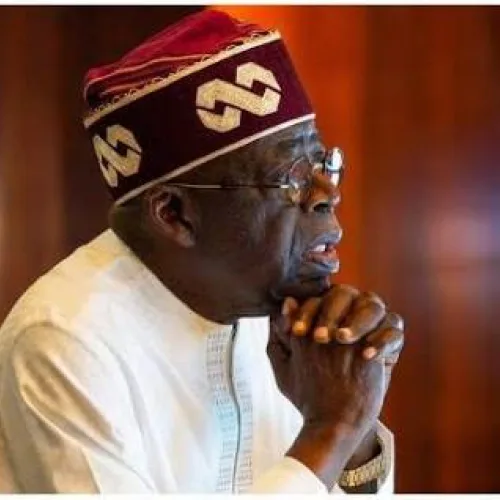
President Bola Ahmed Tinubu recently commended members of his economic team for their foresight, dedication, and diligence. The president received members of his economic team and the management of the Nigerian Exchange Group (NGX) at his office in Aso Rock. The team comprised the Minister of Finance and Coordinating Minister of the Economy, Mr Taiwo Oyedele; the Minister of Budget and National Planning, Alhaji Atiku Bagudu; the Governor of the Central Bank of Nigeria (CBN), Mr Yemi Cardoso; and the Executive Chairman of the Nigeria Revenue Service (NRS), Mr Zacchaeus Adedeji. The NGX team was made up of its Chairman, Alhaji Umaru Kwairanga, and Managing Director, Mr Temi Popoola.
“I can see the excitement in the room. All I can do is celebrate you all today. It is a thing of joy to have this feedback. When we took over, it was very challenging. I had to talk to myself and define my background to accept the assets and liabilities of my predecessor,” Tinubu said. The president further stressed: “I asked for the job, and I have to do it. And my capable partner in one of the thinking and reasoning days was Yemi Cardoso, whom I put in the CBN… Thank you to the chairman of the NRS and all the people in the economic team for what we are doing. My assurance to you is that I won’t stop reading, thinking, and supporting you,”.
The chairman of the NGX briefed the president on how the capitalisation of the Nigerian stock market grew from N30 trillion in 2023 to N160 trillion currently. Oyedele was highly impressed by the growth in NGX capitalisation. “The stock market has experienced significant growth over the past few years… as a result of the reforms in the economy,” Oyedele said. “The capital market in Nigeria is one of the best-performing in the world. The capital market is one of the fastest ways to create wealth for millions of Nigerians,” the minister said in apparent excitement.
The NGX has recorded tremendous growth in recent times. On one frenzied day this year, the market capitalisation of the NGX rose by a record N5 trillion. This year alone, NGX capitalisation has risen by well over N60 trillion.
The increase in NGX capitalisation is a reflection of the outcome of the economic reforms of the Tinubu administration. Foreign portfolio investors were fleeing the NGX in droves when Nigeria’s foreign exchange reserves were trapped at about $33 billion for years. With such low reserves, the CBN could not provide sufficient foreign exchange to enable foreign portfolio investors to repatriate the proceeds of their investments. Consequently, billions of dollars in investment proceeds belonging to foreign portfolio investors were trapped in Nigeria. The situation has been reversed by the reforms embarked upon by the Tinubu administration.
The country’s non-oil export proceeds have risen tremendously in the last one year. The Nigerian Ports Authority (NPA) recently reported a 1,407 per cent increase in non-oil exports. The increase in non-oil exports is so significant that ships bringing imports into Nigeria no longer return empty. They are increasingly loaded with exports for their home countries. In his commendation of the diligence of his economic team, the president stressed the importance of private-sector contributions to economic growth and job creation. He emphasised that the important role of the private sector in economic growth informed his support for Aliko Dangote in his determination to build a private refinery.
The refinery has contributed significantly to the country’s foreign-exchange position, which is one of the factors behind the massive return of foreign portfolio investors to Nigeria. Dangote Refinery contributes to both the demand and supply sides of the foreign-exchange market. The refinery has drastically reduced Nigeria’s annual demand for foreign exchange to finance the importation of refined petroleum products. The emergence of Dangote Refinery has reduced the import bill by more than 70 per cent. On the supply side of the foreign-exchange market, the refinery rakes in billions of dollars from the export of refined petroleum products.
In his commendation of the diligence of the economic team, President Tinubu emphasised that Nigeria’s $1 trillion economy target was achievable. He listed the country’s booming population as one of the factors that could make the target attainable. It is obvious that, with the tremendous growth in the country’s gross domestic product (GDP), Nigeria is poised to meet that daunting target.
However, the population mentioned by the president as a factor in attaining the target must be empowered through massive job creation. A booming population cannot help achieve that target if the unemployment rate remains high.
Blueprint.ng commends the federal government for the gains recorded from its drastic economic reforms. We, however, enjoin the government to tackle unemployment to make it easier to attain the $1 trillion economy target.
Comments
Start the conversation about this story.