





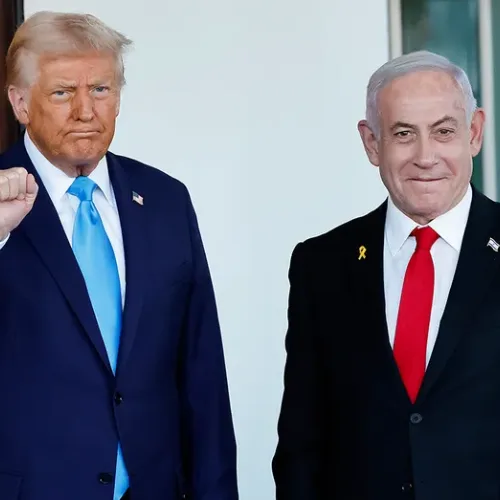
Trump rejects Gaza plan as Netanyahu demands Hamas disarmament first
Benjamin Netanyahu, Israeli Prime Minister has rejected Donald Trump, US President’s 15-point Gaza peace plan, saying Israel will not withdraw its forces from the territory until Hamas is fully and genuinely disarmed.
Netanyahu told his cabinet on Sunday that Israel “rejects the 15-point document” and that the military would continue operating against threats to Israeli troops and civilians. He stressed that any disarmament by Hamas must be real rather than symbolic.
Trump’s plan, announced last September, calls for the disarmament of Hamas and other armed groups, an Israeli military withdrawal, increased humanitarian assistance, the establishment of a civilian administration and the reconstruction of Gaza. A proposed Board of Peace would oversee implementation.
Hamas has said it remains committed to the agreement and is prepared to engage in implementing the plan, but has linked the handover of its heavy weapons to an end to Israeli military action and the withdrawal of Israeli forces.
Netanyahu’s position puts him in a difficult position with Washington, as Trump has made the Gaza initiative a major component of his foreign policy. The Israeli prime minister is also facing pressure from members of his right-wing coalition who oppose concessions to Hamas.
Netanyahu said Israel was discussing the plan with US officials, adding that some of Washington’s proposals were acceptable while others were not. The disagreement could complicate efforts to move from the existing ceasefire arrangements towards a broader political settlement.
Iran says Hormuz deal is close but reopening depends on conditions
Oman says negotiations with Iran over a possible arrangement to restore shipping through the Strait of Hormuz are making progress, but Tehran has warned that any agreement would not automatically reopen the strategically important waterway.
Abbas Araghchi, Iranian Foreign Minister, said the talks were in their final stages, but reopening the strait would remain subject to additional conditions. He did not provide a detailed explanation of the requirements.
The Strait of Hormuz is one of the world’s most important energy routes, carrying roughly a fifth of global oil and natural gas supplies. Its effective closure since US and Israeli attacks on Iran began in February has disrupted shipping and contributed to volatility in global energy markets.
Recent discussions have focused on creating a shipping route through the strait jointly managed by Iran and Oman. The arrangement is intended to provide a framework for commercial vessels to resume passage while addressing Tehran’s security concerns.
Iran has also demanded compensation from the US for what it describes as violations of a June memorandum of understanding intended to end the conflict and advance diplomatic negotiations. That agreement collapsed shortly after it was reached, with military exchanges resuming between the parties.
Mohammad Baqer Zolqadr, Iranian security chief, said the strait would remain closed until Washington changes its behaviour. Among Tehran’s demands are an end to threats against Iran, the removal of a US naval blockade of Iranian ports and the release of frozen Iranian assets.
Oman, which has played a central mediating role, has urged all parties to avoid attacks on commercial shipping that could undermine the negotiations.
Ancient Roman shipwreck packed with amphorae found off Sicily
Italian divers have discovered a more than 2,000-year-old Roman shipwreck off the coast of Sicily, with hundreds of remarkably well-preserved ceramic containers still scattered across the seabed.
The vessel was located about 46 metres below the surface near Mazara del Vallo after fishermen alerted authorities to an unusual object on the seabed. Specialist divers from Italy’s Carabinieri Art Squad were sent to investigate the site.
The wreck is estimated to be about 21 metres long and six metres wide and is believed to date from the first or second century BC. The amphorae found around the vessel were commonly used in antiquity to transport commodities including wine, olive oil and grain.
Alessandro Giuli, Italian Culture Minister, described the discovery as one of the most important recent underwater archaeological finds in the country.
The discovery was made after free-diver Giacomo De Mola detected what appeared to be a large rock on a scanner. On approaching it, he found the remains of the ancient vessel and hundreds of amphorae.
Authorities are now working to secure the site and prevent looting while archaeologists examine the wreck and its cargo. The Mediterranean is known to contain numerous ancient shipwrecks, reflecting the importance of maritime trade during the Roman and pre-Roman periods.
Experts will also study the vessel to establish more about its origin, cargo and the trading routes it may have served.
Russia and Ukraine trade deadly attacks as Odesa port comes under fire
Russia and Ukraine have accused each other of carrying out deadly attacks as both sides continue targeting cities, infrastructure and logistics facilities amid the prolonged war.
In Ukraine, at least three people were killed and 37 injured after a multi-storey residential building was struck in the eastern city of Kharkiv. Ukrainian authorities said Russia also attacked several other regions.
President Volodymyr Zelensky said Russia had damaged the port area of Odesa in a series of drone and missile attacks. The southern city is a critical outlet for Ukraine’s agricultural exports, making its port infrastructure important to global food supplies.
Zelensky accused Moscow of targeting global food security by attacking Odesa. Russia has repeatedly targeted the city and other Black Sea infrastructure as it seeks to restrict Ukraine’s access to maritime trade.
Meanwhile, Russian authorities said five people were killed and 25 injured in a Ukrainian drone attack in the Belgorod region. Ukraine has increasingly targeted Russian energy infrastructure, oil tankers and other facilities linked to Moscow’s war effort.
The latest attacks come as both sides intensify strikes against each other’s logistics networks, including warehouses, energy installations and transport infrastructure. Diplomatic efforts to end the war have so far failed to produce a lasting breakthrough.
Thai school shooting suspect watched violent content online, police say
Police investigating a deadly school shooting in Thailand say the 14-year-old suspect had watched violent material online and had previously shown an interest in firearms.
The teenager allegedly killed his grandparents at their home before shooting six people at his school outside Bangkok on Friday and then taking his own life.
Police said the boy had used social media to learn about firearms and had demonstrated an interest in weapons for between one and two years. A teacher had confiscated a BB gun from him at school last year.
Investigators also found a knife, a firearm, spent ammunition and a computer among the evidence collected from the crime scenes. Police said an examination of the computer showed the teenager had viewed violent content on social media, although investigators have not established that he had practised shooting.
His mother told police she had not noticed any unusual behaviour and described him as bright and cheerful. She also said he had denied being bullied when she asked him about his experiences at school.
Police have interviewed at least 17 witnesses as they investigate the circumstances surrounding the attack.
Thailand’s Education Ministry has announced plans for new school safety measures over the next three months. These include mental health screening, procedures for referring students considered at risk to specialists, emergency response drills and stronger measures to prevent weapons and other dangerous items from being brought into schools.
AFRICA
DR Congo Ebola cases surpass 4,000 as outbreak continues to spread
The Democratic Republic of Congo’s Ebola outbreak has surpassed 4,000 confirmed cases, making it the second-largest Ebola epidemic ever recorded and one of the fastest-spreading outbreaks of the disease.
The country’s public health institute reported 4,053 infections and 1,850 deaths in its latest update. Cases have been recorded in five provinces: Ituri, North Kivu, South Kivu, Haut-Uele and Tshopo.
Health experts believe the virus was circulating for months before the outbreak was officially declared on May 15. A study published in the journal Science suggested transmission may have begun as early as January in Ituri province.
The outbreak involves the Bundibugyo strain of Ebola, a relatively rare form for which there are currently no approved vaccines or specific drug treatments. Researchers are working to accelerate trials of experimental vaccines and treatments.
The rapid growth of the outbreak has been linked to delayed detection, gaps in surveillance and insecurity in eastern Congo, where armed conflict makes it difficult for health teams to reach affected communities.
Authorities are also facing challenges from public mistrust and disruptions to the wider Ebola response, raising concerns that the epidemic could become even more difficult to contain.
Tanzania opens government debt market to all foreign investors
Tanzania has relaxed its foreign exchange rules to allow all foreign investors to purchase government Treasury bills and bonds, in a move aimed at deepening the country’s domestic capital market.
The Bank of Tanzania said the policy change would help broaden participation in the government securities market and strengthen Tanzania’s appeal as an investment destination.
Previously, access was largely limited to investors from the East African Community, the Southern African Development Community and members of the Tanzanian diaspora.
The government is seeking additional sources of financing and revenue as development assistance from international partners comes under pressure. Opening the domestic debt market to a wider pool of international investors could increase demand for government securities and provide authorities with greater access to capital.
The move comes amid broader economic and political scrutiny of President Samia Suluhu Hassan’s administration following last year’s disputed election, which opposition figures said was affected by the exclusion of major challengers.
Ghana appoints new defence minister a year after fatal helicopter crash
John Dramani Mahama, Ghana’s President has appointed Kenneth Gilbert Adjei as the country’s new defence minister, almost a year after the death of his predecessor in a military helicopter crash.
Adjei, who previously served as minister of works, housing and water resources, has also held the position of deputy defence minister between 2012 and 2017.
Finance Minister Cassiel Ato Forson had been acting as defence minister since August 2025, following the crash that killed Defence Minister Edward Omane Boamah, Environment Minister Ibrahim Murtala Muhammed, three other officials and three air force crew members.
Ghana held a memorial service for those killed in the crash on Thursday and unveiled a cenotaph in honour of Boamah.
US tightens Ebola travel screening for travellers from affected countries
The United States has introduced temporary travel measures for people arriving from Uganda, South Sudan and the Democratic Republic of Congo because of concerns over the ongoing Ebola outbreak.
Under the measures, US citizens and nationals who have been in Uganda or South Sudan during the previous 21 days will have their flights routed through designated US airports for enhanced public health screening. The requirement also applies to travellers who only transited through either country.
Travellers who have been in the Democratic Republic of Congo within 21 days of their planned departure for the US will not be permitted to board commercial flights bound for the country until the 21-day period has elapsed.
The measures reflect Ebola’s incubation period and are intended to allow health authorities to identify potential cases before infected travellers enter the wider population.
The CDC said travellers from affected areas may also face additional requirements imposed by local authorities before leaving parts of the DRC. Anyone suspected of having Ebola may be transferred to hospital for medical assessment, isolation and treatment.
The restrictions come as Congo’s outbreak continues to grow, with confirmed cases already exceeding 4,000.
Libya’s Waha Oil resumes pumping after pipeline leak
Libya’s Waha Oil Company has repaired and contained a leak on the Zaqout-Sidra pipeline, allowing pumping operations to resume after the incident was detected during a routine inspection.
The company said the leak was brought under control within 24 hours and pumping resumed at 4:00 a.m. after repairs were completed.
Waha Oil, a subsidiary of Libya’s state-owned National Oil Corporation, typically produces between 340,000 and 400,000 barrels of crude oil per day under normal operating conditions.
The company operates the Waha fields in partnership with international energy companies TotalEnergies and ConocoPhillips.
The rapid repair is significant for Libya’s oil sector, where production and exports remain vulnerable to infrastructure problems, political instability and security disruptions. The Zaqout-Sidra pipeline is part of the infrastructure connecting oil-producing areas to export facilities on Libya’s Mediterranean coast.


Faith Omoboye is a foreign affairs correspondent with background in History and International relations. Her work focuses on African politics, diplomacy, and global governance.
Comments
Start the conversation about this story.