





By Ayorinde Oluokun
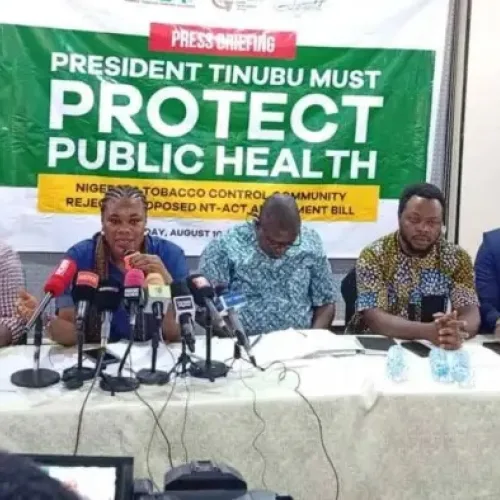
A Coalition of Civil Society Organisations, CSOs on Monday asked President Bola Ahmed Tinubu not to append his signature to the National Tobacco Control Act (Amendment Bill 2025) if the document ever finds its way to his table.
The CSOs made up of over 100 civil society groups, health advocates, and public-interest organisations under the aegis of National Tobacco Control Alliance made the appeal at a press conference addressed by Akinbode Oluwafemi, Executive Director, Corporate Accountability & Public Participation Africa (CAPPA).
In his opening remarks at the press conference, Oluwafemi described the amendments to the National Tobacco Control Act as attempts to roll back what Nigeria has gained over the years in terms of law for regulation of the production, marketing, and distribution of tobacco products.
He also alleged that the amendment bill was a product of “scam” as it was vastly different from the original presented by two members of House of Representatives and discussed at public hearings held by National Assembly by stakeholders.
“We are still dealing with the case of a fake agency. Now, we are beginning to see the case of a fake law that they want to present to our president to sign, and we are saying a resounding ‘no” to that, because it will cause a lot of embarrassment for our country.
In the joint statement of the National Tobacco Alliance, he subsequently read, Oluwafemi said a joint review of the amendments proposed to the National Tobacco Control Act of 2015 by members of the Alliance revealed that they created loopholes for marketing and consumption of vapes, heated tobacco products, and nicotine pouches in the country.
“The Bill amends section 1 of the Principal Act by introducing a new paragraph (n), which inserts “tobacco harm reduction objectives” among the purposes of the Act. At first hearing, this may sound progressive.
“However, the phrase “harm reduction” has become an industry decoy for promoting new products and justifying lighter regulations for them. Marketing vapes and pouches as less harmful than traditional cigarettes does not make them safe.
“Across the world, public health professionals are already recording health complications associated with these products.
“True harm reduction means breaking addiction, not enabling multinational corporations to recruit a new generation of youth.
The Alliance also faulted Clause 16 of the new bill which altered section 45 of the Principal Act by defining heated tobacco products as noncombustible products and subsequently excluded them from the legal definition and regulations for tobacco products. Such reclassification, they argued, not only poses danger to public health, but will set a dangerous precedent across Africa while also undermining Nigeria’s standing in the global public health community
“This is a massive deception. Heated tobacco products contain real tobacco. Heating it instead of burning it does not remove its toxicity or addictiveness. In fact, the World Health Organization is clear that heated tobacco products are tobacco products and must be regulated as such.
They also faulted Clause 7 of the Bill which amended section 12 of the original Act with introduction of subsection (6) that permitted advertising of so-called non-combustible products in “adult publications,” point-of-sale materials and online platforms, as well as sponsorship of cultural, social and recreational events.
The CSOs faulted the definition of “adult publication” in the amendment bill as one whose readership is only 50 per cent or more adults.
“This means that a publication could qualify as adult-oriented even if nearly half—or, at the minimum threshold, exactly half—of its readers are children. Tobacco and nicotine advertisements could therefore be placed in publications with substantial underage audiences while being presented as restricted to adults.
“The provision also raises a serious enforcement question: who will determine the age profile of readers, using what evidence, and how often will that information be verified?
“In Nigeria, where young people form a large share of the population (60 percent) and publications circulate widely through websites and social media, such a weak definition offers little protection. It creates a convenient legal route for tobacco advertising to reach children.
“Furthermore, proposed section 12(6)(i)(b) permits point-of-sale promotional materials. When combined with Clause 6, which allows indoor vaping for product sampling, this provision would effectively turn retail counters into promotional hubs where consumers can see, sample and be encouraged to purchase these products”
“The Bill also permits tobacco and nicotine companies to sponsor cultural, social and recreational events supposedly directed at adults. But in today’s hyper-digital environment, simply describing a concert or festival as “adults only” does not protect young people.
“Images, videos and branded content from such events can be shared by influencers, amplified by algorithms and circulated widely across social-media platforms, where they will inevitably reach children,” the CSOs said.
They also noted that while Section 15(4) of the Principal Act strictly prohibited the sale or distribution of tobacco products through the internet, mail or other online channels,
Clause 9 of the amendment removed the protection for noncombustible products. The Alliance noted that new subsections under the clause authorised online sales, remote orders, mail, shipping and courier delivery with the only safeguard being “age-verification” of the customer. This, the Alliance said, is open to abuse and will create distribution channels that are out of control.
“But we do know from research that such measures can be easily circumvented. Adults can order for minors, identification documents can be borrowed, and someone other than the buyer can receive the delivery. Worse still, Nigeria also lacks the capacity to monitor every website, social-media vendor, courier company and delivery rider. The Bill therefore opens distribution channels that regulators will struggle to control.”
They also noted that Clause 9 of the amendment lowered the cost barrier to experimentation among young people by allowing all -combustible products to be displayed behind retail counters in shops that are not restricted to adults.
“It also amends section 15(5) to permit cigars to be sold in small packs of five rather than intact packages of at least 20, Clause 10 deletes section 16(1) and key penalty clauses in section 16(2)(b), which explicitly enforce punishments for selling to minors, violating packaging rules, and non-compliant distribution. Removing these specific penalties leaves enforcement dependent on vague general provisions, creating legal confusion that directly benefits violators,” the Alliance noted.
The Alliance also noted that while conventional tobacco packaging requires 60 percent graphic health warnings, Clause 12 of the amendment bill reduces warning requirements for novel products: “Vape liquids require text only warnings covering no more than 30 percent of the front, setting a maximum limit rather than a minimum requirement.
Section 20(7)(vi) explicitly exempts e-cigarette and heating devices from carrying any health warning at all. Nicotine pouches are limited to text warnings covering no more than 10 percent of the front packaging.”
Members of the Alliance also faulted that Third Schedule of the amendment bill which mandated manufacturers to be in charge of generating, holding, and internally approving their own safety dossiers under Paragraph 18, while mandating that the Minister of Health to protect their information under Paragraph 18(7).
“Public health cannot rely on self-generated, hidden evidence from tobacco manufacturers. Additionally, Paragraph 21 grants the Minister unchecked power to exempt any noncombustible product from any provision of the Bill under undefined public interest grounds, inviting intense lobbying and regulatory capture” they said while pointing out the dangers of the amendment.
“When HB 47 and HB 1151, now consolidated into a single Bill, were presented at a public hearing on 22 November 2024, they contained none of these worrying concessions. Who introduced these provisions, and which public-health institutions reviewed them? The public has been completely excluded from the process that produced these dangerous alterations,” the National Tobacco Control Alliance said.
The Alliance therefore demanded immediate recall of the consolidated Bill for transparent, public health led review by the National Assembly as well as publication of all committee reports, voting records, and stakeholder submissions, which led to the passage of the bill.
They also called on the Federal Ministry of Health and Social Welfare to clarify its position and demand the recall of the Bill if it was not properly consulted in the process of amendment to the original Act.
More importantly, the Alliance urged President Bola Tinubu not to sign the new bill into law if it was passed to him for assent.
“President Bola Ahmed Tinubu must withhold assent should this compromised draft reach his desk. Nigeria needs one strong and product-neutral framework for every tobacco and nicotine product. Advertising, sponsorship, sampling, retail display and remote sales must remain prohibited.
“We urge all Nigerians, public-health professionals, civil society organisations, young people, parents, the media and other stakeholders to rise and defend public health. We must not remain silent while commercial interests weaken safeguards designed to save lives and shield future generations from addiction and preventable diseases,”
Comments
Start the conversation about this story.