






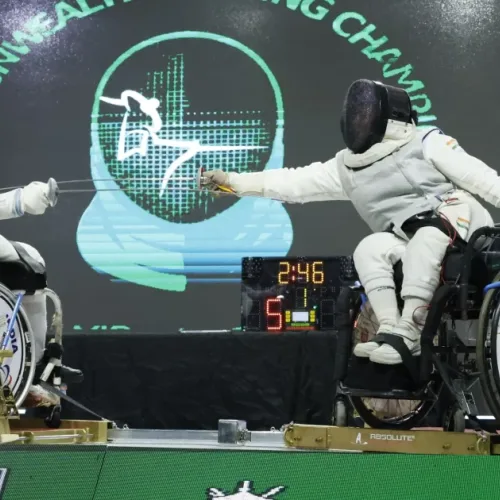
• Nigeria’s para fencer Chidinma Dennis (left)
Nigeria made history on home soil on Tuesday at the 2026 Commonwealth Fencing Championships, hosted at Rugby School Nigeria in Atlantic City, Lagos, clinching nine medals — seven bronze and two silver — and securing Africa’s first-ever international medal in wheelchair fencing.
For the first time, an international wheelchair fencing event was staged in Africa, with Nigeria leading the way.
In the women’s epee category A, Itunu Kumuyi and Joy Iorguma earned bronze medals after battling through to the semifinals before falling to their Indian opponents.
The duo added two more bronze medals in the women’s foil wheelchair event.
In category B, Joyce Otun and Abiola Rahamon also claimed bronze, underscoring Nigeria’s breakthrough in para-fencing. Chidinma Dennis added to the tally with a silver medal after bowing to India’s Sheranthi Thomas in the final.
India, however, continued to assert its dominance in the women’s wheelchair category.
Malti Panaure and Rekha Rekha claimed gold and silver respectively, delivering India its sixth gold medal in the wheelchair events and reinforcing the nation’s commanding presence in the competition.
Programme Director of Wheelchair Fencing in the Nigeria Fencing Federation, Tonye Sawari, hailed the achievement as historic.
“You cannot imagine that we started training just three months ago, yet our athletes quickly became competitive against countries with years of international experience,” Sawari said.
“This is a remarkable beginning, and we hope to build on this success to raise the profile of wheelchair fencing in Nigeria. I am proud of our athletes for making their presence felt in this tournament and commend them for their spirited display.”
Nigeria’s medal haul extended to the men’s senior sabre, where Oluwafolayemi Akinyosoye captured his first international medal.
Ranked as Nigeria’s top competitor, Akinyosoye advanced from pool 2 into the knockout rounds, defeating England’s Charles Gellett 15–6 in the round of 16 and overcoming India’s Bebit Bright 15–12 in the quarter-final.
Despite sustaining an early hand injury, he fought valiantly in the semifinal before bowing 15–10 to Australia’s Yoongi Shim, settling for bronze.
With nine medals secured and a continental milestone achieved, Nigeria’s performance at the championships not only elevated the nation’s standing in fencing but also set a powerful precedent for the growth of both able-bodied and para-fencing across Africa.
Comments
Start the conversation about this story.