





…Sulaiman says 2027 polls demand early legislative capacity building
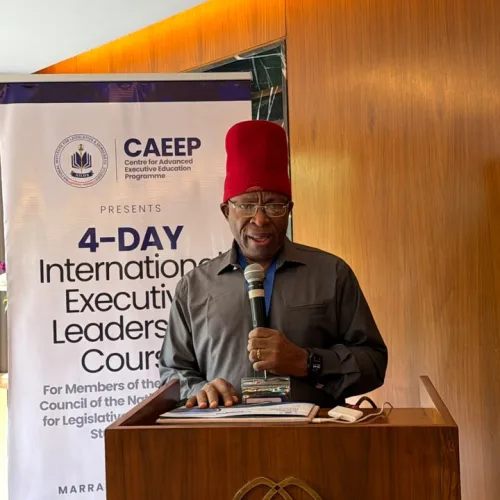
Members of the Governing Council of the National Institute for Legislative and Democratic Studies (NILDS) have converged in Marrakech, Morocco, for a four-day International Executive Leadership Course aimed at strengthening strategic leadership in Nigeria’s legislature ahead of the 2027 general elections.
This is contained in a statement released on Wednesday by the Media Office of NILDS at its national headquarters, Abuja
The programme, themed “Strategic Leadership and Institutional Readiness for Legislative Excellence: Interrogating Topical Issues on Nigeria’s Democratic Development,” is organised by NILDS’ Centre for Advanced Executive Education Programme, CAEEP.
Senator Victor Umeh is representing the President of the Senate and Chairman of the NILDS Governing Council, Senator Godswill Akpabio, at the training, which also has in attendance other National Assembly members and stakeholders.
In his address of welcome, Director-General of NILDS, Prof. Abubakar O. Sulaiman, said the course was more than a retreat, but a platform for participants to “think, reflect, learn, interrogate and prepare” for challenges facing Nigeria’s democratic institutions.
He described the Governing Council as the highest policy organ of NILDS, with responsibility for providing strategic direction beyond routine supervision.
“The quality of decisions taken by the Council has implications not only for NILDS but also for the capacity of the National Assembly to effectively discharge its constitutional responsibilities,” he said.
Prof. Sulaiman stressed that global trends — including technological advancement, artificial intelligence, demands for accountability and complex security challenges — require institutions to move beyond conventional leadership models.
Strategic leadership, he said, must focus on “anticipating change, shaping it and positioning institutions to remain relevant.”
He noted that with the 2027 elections approaching, NILDS must begin early preparations to support the National Assembly through the transition.
This, according to him, includes induction and orientation for new legislators, preservation of institutional knowledge, and training on parliamentary procedures, oversight and constitutional duties.
“Institutional readiness cannot be achieved at the last minute. It requires foresight, planning, coordination and strategic leadership,” he said.
The DG added that while every democracy has unique realities, universal principles such as professionalism, innovation, institutional memory, public engagement and effective use of technology remain critical.
The course features resource persons from Nigeria and abroad, including UN Deputy Secretary-General Amina Mohammed, Nigeria’s Ambassador to Germany, Senator Ita Enang; former INEC Chairman and Presidential Adviser on Livestock Reforms, Prof. Attahiru Jega, and Prof. Zakaria Garno of Euromed University.
Please follow and like us:
Comments
Start the conversation about this story.