






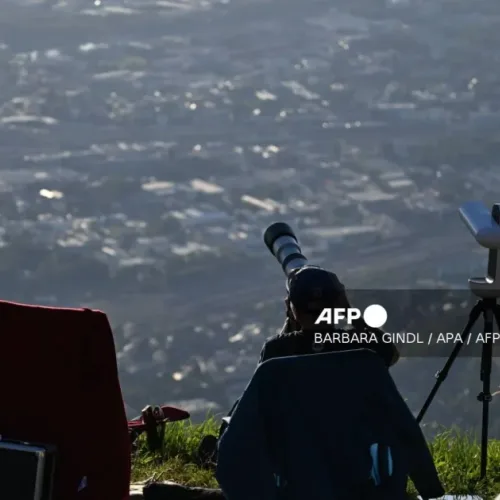
People wait with cameras and other tools on the Gaisberg mountain in front of the sun in Salzburg, Austria on August 12, 2026, ahead of the partial solar eclipse.. CREDIT: AFP
A solar eclipse has begun across the United Kingdom and parts of Europe, with the Moon gradually moving across the face of the Sun.
The eclipse became visible in Edinburgh at about 18:28 BST on Wednesday, with the event expected to peak at around 19:06 in the Scottish capital.
According to BBC, the Moon could be seen in Calton Hill of Edinburgh “starting to take a bite out of the sun,” with sunspots also visible through a telescope.
The platform also reported that the eclipse was already fully underway in parts of Iceland and Greenland, while other European countries were expected to witness a total eclipse.
 Women from Cologne in Germany test their protective glasses at El Arenal beach in Mallorca. CREDIT: BBC
More than 90 per cent of the Sun was expected to be covered by the Moon across most parts of the UK, making it the most significant solar eclipse visible from the country since 1999.
Large crowds gathered at viewing locations across the UK, with special eclipse glasses reportedly selling out in some areas.
Russia and Spain
The Moon first blotted out the Sun at the northernmost tip of mainland Russia at about 1700 GMT, leaving only the shimmering glow of its outer corona, and eerie darkness.
 People wait on the Gaisberg mountain in front of the sun in Salzburg, Austria on August 12, 2026, ahead of the partial solar eclipse.
Millions of people turn their gaze towards the heavens on August 12, 2026 to witness one of nature’s greatest spectacles — a rare total solar eclipse — as it sweeps over mainland Europe to briefly turn day into night. CREDIT: AFP
As it passes down through parts of Greenland and Iceland, excitement built in Spain, where the eclipse’s narrow path cuts diagonally from the northwestern Atlantic coast to the Mediterranean Sea, before being expected to fade at about 1830 GMT.
 A woman holds a pair of eclipse glasses and sun glasses in front of the sun in Salzburg, Austria on August 12, 2026, ahead of the partial solar eclipse.
Millions of people turn their gaze towards the heavens on August 12, 2026 to witness one of nature’s greatest spectacles — a rare total solar eclipse — as it sweeps over mainland Europe to briefly turn day into night.. CREDIT: AFP
Tourists and enthusiasts thronged normally quiet Spanish villages, as mainland Europe has not experienced a total solar eclipse for 20 years while Spain has not witnessed one in more than a century.
What is Solar Eclipse?
A solar eclipse occurs when the Moon passes directly between the Earth and the Sun, casting its shadow onto our planet and temporarily blocking some or all of the Sun’s light from view.
Depending on the precise alignment, observers may see a partial eclipse, in which only part of the solar disc is covered, or a total eclipse, when the Moon completely obscures the Sun for a brief period along a narrow path.
Expert warns
Experts warned viewers not to look directly at the Sun without appropriate eye protection because of the risk of serious eye damage.
The rare celestial event has also attracted scientists, with a group of Irish researchers planning to travel across the Atlantic to study the Sun’s corona during the eclipse.
Comments
Start the conversation about this story.