





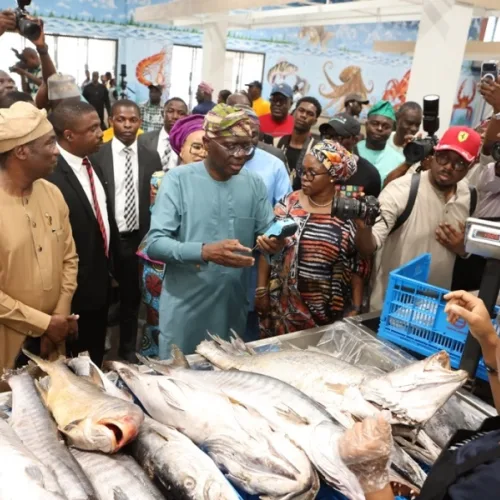
Lagos State Governor Babajide Sanwo-Olu on Wednesday commissioned the Lagos Fresh Food Hub at Pen Cinema, Agege, describing the facility as a key component of the state’s strategy to strengthen food security, improve distribution and make food trading more efficient across the metropolis.
The governor said the project was designed as part of the Lagos State Food Systems Transformation Agenda, which seeks to address challenges across the food chain, from production and aggregation to storage, logistics, processing and retail.
According to Sanwo-Olu, Lagos has a population of more than 25 million people and more than 70 per cent of the food consumed in the state is produced outside its borders.
He said the dependence on food transported over long distances contributes to high logistics costs, post-harvest losses, inadequate storage, supply disruptions and price volatility.
He said the state was therefore developing an interconnected network of food hubs rather than relying on a single central market.
Sanwo-Olu also highlighted other interventions supporting the food system, including the Produce for Lagos Programme and the N500 billion Offtake Guarantee Fund, as well as training programmes that have equipped more than 125,800 farmers and fishermen with modern agricultural skills.
He said more than 4,000 young people had also been trained through the Lagos Agripreneurship Programme, while the Lagos Rice Mill at Imota had produced more than 250,000 50kg bags of Eko Rice in the past year.
The governor said the ultimate objective was to establish structured food hubs across all local government and local council development areas in Lagos.
He urged farmers, traders, aggregators and other operators to maximise the opportunities provided by the Agege facility, saying its success would depend on the effective participation of those who use it.
At the centre of the network is the Lagos Central Food Systems and Logistics Hub at Ketu-Ereyun, Epe, which Sanwo-Olu said was at an advanced stage of construction and would be commissioned before the end of his administration.
The central facility is designed to provide cold and dry storage, processing and repackaging facilities, quality-control laboratories, warehouses, logistics bays and digital trading platforms. It is expected to handle more than 1.5 million metric tonnes of food annually and service more than 1,500 food trucks daily.
The Agege facility forms part of the planned network of mid-level food hubs, alongside facilities in Mushin and Abijo, with additional locations being developed or planned in Opebi, Bombata, Ikorodu, Apapa, Festac and the Lekki axis.
Commissioner for Agriculture and Food Systems, Abisola Olusanya, said the hubs were being developed around a “hub-and-spoke” model, with the central facility serving as the major aggregation and logistics platform while smaller hubs bring food distribution closer to communities.
She said the approach was intended to reduce food losses caused by poor handling and inadequate storage, ease congestion associated with food logistics and provide traders with cleaner, safer and more organised spaces.
The Agege hub occupies about 7,000 square metres, including a 4,000-square-metre trading floor capable of accommodating between 350 and 400 vendors.
It also has about 1,200 square metres of dry storage with capacity for approximately 800 metric tonnes, as well as about 300 metric tonnes of cold storage.
The facility includes a dedicated seafood section, parking for between 80 and 90 vehicles and 10 electric vehicle charging points.
Olusanya said the hub was projected to facilitate more than N5 billion in food transactions annually based on its trading capacity and the volume of produce it is designed to handle.
She disclosed, however, that the hub would commence full operations in six weeks to allow for the completion of operator onboarding and the implementation of its logistics and governance systems.
The facility’s operating model is backed by a 351-page framework covering operator selection, produce receiving and quality control, storage, inventory management, sanitation, waste management and use of trading spaces.
Olusanya said the framework would also improve visibility across the food chain by providing information on the source and volume of produce entering the hub, storage levels and points where losses occur.
She noted that traders would retain control over their commercial relationships, including pricing and payment arrangements, while the government and hub management would provide infrastructure, operating rules and oversight.
The commissioner also disclosed that the Mushin hub had previously served as a platform for the state’s Ounje Eko food subsidy intervention during the 2024 food inflation crisis, which was subsequently expanded to 66 locations across Lagos.
Olusanya said the project was developed in partnership with Origin Tech Group, which worked with the Lagos State Government to translate its food-systems vision into infrastructure supporting aggregation, storage, logistics, wholesale and retail distribution.
She said the state’s ambition was for Agege to demonstrate what a modern food market could offer and eventually serve as a benchmark for food-shopping facilities in Lagos, Nigeria and Africa.
Comments
Start the conversation about this story.