





There is a particular kind of confusion that comes with hearing good economic news and not feeling any of it. Nigerians have been living in that gap for months now. They are told, correctly, that inflation is falling fast, but still paying prices at the market that reflect none of that relief.
The explanation lies in the difference between two things that sound alike but are not: how fast prices are rising, and how high prices already are. Nigeria has made real progress on the first. It has made none on the second, and for the ordinary household doing the weekly shopping, the second is the only number that matters.
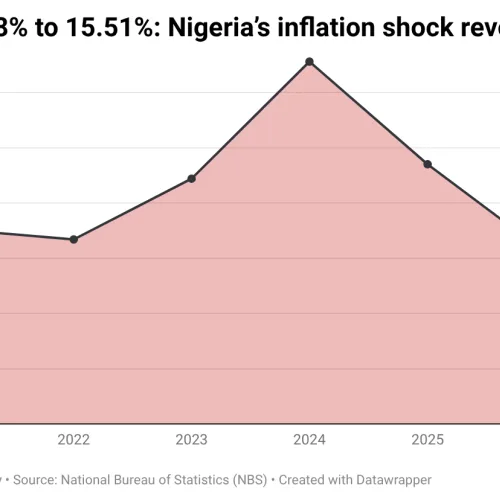
Average inflation rate in Nigeria fell to 15.51 percent in the first half of 2026, down sharply from 23.47 percent a year earlier — a drop of 7.96 percentage points, or roughly a 34 percent reduction in the pace at which consumer prices are increasing. Set against the 32.77 percent average recorded in the first half of 2024, when the shock from the removal of the petrol subsidy and a major currency adjustment was at its worst, the current figure is less than half.
But economists are urging caution about what that improvement actually means. Lower inflation does not mean prices have gone down. It means they are going up more slowly than they were.
“The moderation in inflation is encouraging, but it should not be interpreted as a reduction in the general price level,” said Muda Yusuf, chief executive officer of the Centre for the Promotion of Private Enterprise. “What we are seeing is a slower rate of increase in prices. The purchasing power erosion that occurred during the period of very high inflation has not been reversed. The more important challenge now is to address the structural drivers of inflation, particularly food supply constraints, transportation, energy and other production costs, so that lower inflation can translate into improved living standards.”
Two Years of Disinflation, Laid Out
The scale of the shift is clearer in the broader trend line. Average first-half inflation rose from 16.73 percent in 2022 to 22.20 percent in 2023, then jumped to 32.77 percent in 2024 as the economy absorbed the effects of subsidy removal and exchange-rate reform. It eased to 23.47 percent in the first half of 2025, and has fallen further still, to 15.51 percent in the first half of 2026 — a level now below even the 17.63 percent recorded in the first half of 2021 and the 16.73 percent recorded in 2022, before the crisis began.
Read also: Nigeria’s economic recovery is running ahead of its fundamentals
Month-to-month figures tell a similar story of a economy settling down. In the first half of 2025, inflation swung from 24.48 percent in January to 22.22 percent by June. In the first half of 2026, it held within a narrow band of 15.06 percent to 15.93 percent — a sign, economists say, of an economy that has moved from volatile, accelerating price growth to something slower and more stable.
That is a marked reversal from the first half of 2024, when inflation rose every single month, climbing from 29.90 percent in January to 34.19 percent by June, as higher transport and energy costs, currency pressure and the broader cost of doing business all struck at once.
The Arithmetic Behind the Frustration
To see why falling inflation doesn’t feel like relief, consider a basket of goods priced at N100 before the shock.
A 30 percent inflation rate pushes it to N130. Even after inflation slows to 15 percent, that basket keeps climbing — to N149.50. The rate of increase has been cut in half. The price itself has not fallen; it has simply kept rising, just more gently, from an already elevated base.
Economists say that gap, between the rate of price increases and the actual level of prices, is what households are experiencing, even as headline inflation numbers improve.
“The significant decline in inflation is a positive development, but it is important to distinguish between the rate of price increase and the level of prices,” said Faruq Quadri, an economist at SPEC-Matrix. “Nigerians are still living with the higher price base created during the inflationary shock. For households to genuinely recover purchasing power, income growth has to consistently outpace inflation. Otherwise, even with inflation falling to 15 percent, real household incomes can remain under pressure.”
“The next phase of the adjustment therefore has to be about translating macroeconomic stability into stronger real incomes,” he added. “If wages, employment and productivity do not improve alongside the disinflation, households may continue to feel that the economy is expensive despite the improvement in the headline inflation rate.”
A Higher Cost Base That Isn’t Going Away
For businesses and investors, slower inflation offers something households don’t get as easily: predictability. Idris Oyekan, a credit rating and capital market analyst at Quantum Zenith, said the moderation gives companies and investors “greater visibility over costs, pricing and cash flows,” but cautioned against overstating what that buys.
“Companies and households are still operating from a much higher cost base than they were before the 2024 inflation shock,” he said. “For the credit market, sustained disinflation could gradually improve debt-service planning and investment decisions, particularly if it is accompanied by lower interest rates. But the key question is whether the decline in inflation is durable. If inflation remains structurally high, the cost of capital and the pressure on borrowers’ balance sheets will remain elevated.”
That leaves policymakers with a different, and in some ways harder, task than the one they faced two years ago. Slowing the acceleration of prices, which was the emergency of 2024, is largely behind them. What’s left is quieter but tougher: making sure wages, incomes and productivity eventually rise to meet a cost of living that has permanently reset higher.
At 15.51 percent, inflation in Nigeria remains elevated by almost any standard. But the direction has clearly changed. What hasn’t changed is what that shift feels like at the market stall or the checkout counter: the rate of price increases has fallen. The purchasing power lost along the way has not come back.


Oluwatobi Ojabello, PhD, is a dynamic and multi-dimensional Assistant Editor for Economy and Markets with over two years of professional journalism experience. He delivers authoritative, data-driven coverage of fiscal policy, financial institutions and capital markets, using clear analysis to explain Nigeria’s most complex economic developments. His work focuses on macroeconomic policy, financial stability and corporate performance, turning technical issues into accessible narratives that inform both experts and everyday readers.
Comments
Start the conversation about this story.