





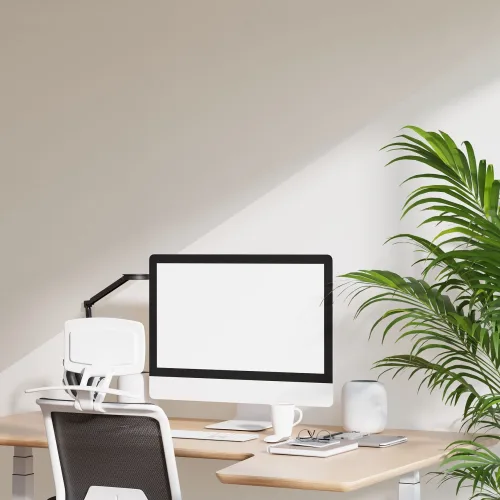
Remote work has redefined the traditional office. For many, the daily commute now ends at a home workspace, whether that is a dedicated room, a dining table, or a quiet corner. However, successful remote work requires more than just a laptop and an internet connection.
- Essential ergonomic workspace checklist
- Start with an adjustable chair
- Optimise monitor height
- ALSO READ: Data analytics: Top 3 free certifications to launch your career
- Maintain sufficient desk depth
- Use natural light to improve the workspace
- Plan for power interruptions
- Keep cables and equipment organised
- Build movement into the working day
- Reduce noise and unnecessary distractions
- Match the setup to the work
- Build for productivity, not appearance
- Frequently Asked Questions (FAQs)
The workspace environment directly impacts comfort, focus, and long-term productivity. An effective home office setup involves more than just aesthetics; it requires careful planning regarding seating, monitor placement, lighting, power, and connectivity.
Studies support the value of structured remote arrangements. A Stanford study showed a 13% increase in employee performance, while research in Nature indicates that hybrid models can boost job satisfaction and reduce turnover without hindering output.
The following guide outlines key factors for building a functional and ergonomic remote workspace.
Essential ergonomic workspace checklist
Start with an adjustable chair
An adjustable chair is essential for maintaining comfort during long working periods. Effective models include adjustable seat height, lumbar support, and a supportive backrest. Adjustable armrests further assist in positioning arms comfortably for computer-based tasks.
OSHA guidelines advocate for a neutral posture where feet remain supported and elbows stay close to the body, ideally between 90 and 120 degrees. However, no single position should be held indefinitely. Guidance from the World Health Organization (WHO) and International Labour Organization (ILO) emphasizes varying working postures and incorporating regular movement to mitigate the risks of static sitting.
For professionals handling coding, writing, or administrative work, adjustability and ergonomic support should take precedence over purely aesthetic considerations.
Optimise monitor height
Correct monitor placement is vital to prevent neck strain. The display should be placed directly ahead, with the top of the screen at or slightly below eye level. A viewing distance of 20 inches generally ensures visual comfort.
Laptop usage often requires a compromise between neck and wrist ergonomics. Elevating the device on a stand improves visibility, though this necessitates the use of an external keyboard and mouse for ergonomic alignment.
In dual-monitor setups, the primary screen should remain centered. If both displays are used equally, placing them in a slight arc side-by-side minimizes excessive neck rotation.
ALSO READ: Data analytics: Top 3 free certifications to launch your career
Maintain sufficient desk depth
Adequate desk depth prevents monitors from being positioned too close to the face. According to standards, sufficient surface area must be provided to maintain a viewing distance of at least 20 inches. A depth of 50 cm serves as a practical minimum.
Greater depth is required if a workflow involves an external keyboard, notebooks, or physical reference materials. Proper desk height allows shoulders to remain relaxed with elbows near the torso. If a desk height is fixed, adjusting the chair or utilizing a footrest can achieve proper alignment.
Frequently used tools and equipment should remain within easy reach to prevent constant stretching or straining.
Use natural light to improve the workspace
Lighting has both practical and visual importance.
Natural light from the front or side of a workstation provides useful illumination for video calls. A window directly behind the worker can leave the face in shadow.
Monitor glare is another concern. Position screens at right angles to windows and use blinds to control brightness.
After sunset, a desk lamp provides balanced illumination. Screens that are significantly brighter than the surrounding room can decrease comfort.
Plan for power interruptions
For remote workers, electricity is part of the working infrastructure.
A power outage can switch off the router during a video conference, interrupt access to cloud applications or disconnect a worker from company systems. A DC mini-UPS can provide short-term backup power for compatible routers and modems.
Compatibility is important. The UPS must provide the correct voltage, while its current capacity must be adequate for the connected equipment. Fibre users should also check whether both the router and the optical network terminal (ONT) require power.
A dual-SIM router does not require a special type of UPS simply because it has two SIM slots. Its electrical specifications determine compatibility. Where both the router and ONT need backup, the chosen power solution must be capable of supporting both devices.
Power redundancy can be complemented by connectivity redundancy. A second mobile network, SIM or internet provider can provide an alternative connection when the primary service fails.
Keep cables and equipment organised
Cable management is a small detail that can make a workspace significantly easier to maintain.
Charging cables, extension cords and power adapters should be arranged so that they do not become tangled around the workstation or create a tripping hazard. A cable tray, clips or simple ties can keep frequently used cables under control.
A dedicated charging area can also reduce clutter. Laptops, phones, headphones and other devices often compete for the same limited desk space, particularly in smaller homes.
The aim is not a perfectly styled desk. It is a workspace in which essential equipment can be located quickly and safely.
Build movement into the working day
Even an excellent chair and well-positioned monitor cannot eliminate the effects of remaining in one position for hours.
Short movement breaks can be incorporated between meetings or tasks. Standing during some phone calls, walking briefly between work sessions and changing sitting positions can break up prolonged periods of inactivity.
WHO and ILO guidance on teleworking highlights prolonged sitting and musculoskeletal risks among issues that can arise when remote work is poorly managed. Appropriate equipment, ergonomic arrangements and regular changes in posture are among the recommended measures.
Movement does not necessarily require a formal exercise session. Regular interruptions to prolonged sitting can be a practical starting point.
Reduce noise and unnecessary distractions
A productive home office also needs to account for the environment surrounding the desk.
Noise from television, traffic, household activity or other occupants can make concentration difficult, particularly during meetings and tasks requiring sustained attention. Noise-cancelling headphones may help where a separate office is not available.
Clear boundaries can also make remote work easier. In shared homes, agreed periods of uninterrupted work can reduce unnecessary interruptions.
At the same time, a home office does not need to look clinical. A plant, simple artwork or another personal item can make the space more pleasant without overwhelming the working area.
Match the setup to the work
There is no universal home-office arrangement. A software developer may require multiple monitors and reliable power. A consultant with frequent video meetings may place greater emphasis on lighting, sound and background appearance.
A writer may value additional desk space, while a customer-service worker may prioritise a dependable headset and internet connection.
The most effective approach is to identify the tasks occupying most of the working day and design the workspace around those demands.
Build for productivity, not appearance
A home office does not need expensive furniture or elaborate décor to function well.
The priorities are straightforward: adequate seating support, appropriate screen positioning, sufficient desk depth, controlled lighting, dependable power and internet, and regular movement.
Improvement can also happen gradually. A laptop stand, external keyboard or inexpensive lighting adjustment may solve a more immediate problem than a complete office renovation.
Ultimately, an effective home office is less about creating an impressive-looking room and more about creating a sustainable place to work. A supportive chair, comfortable screen position, reliable connectivity and a workspace that encourages movement can make the transition to remote work considerably easier.
Frequently Asked Questions (FAQs)
How high should a computer monitor be positioned to prevent neck strain in a home office?
A computer monitor should be positioned so the top edge of the display sits at or slightly below eye level. When looking straight ahead, the eyes should naturally rest on the top third of the screen, allowing a 15-degree downward gaze without tilting the neck forward or backward.
What is the minimum desk depth required for comfortable typing and laptop usage?
The minimum recommended desk depth for a home office setup is 60 cm (24 inches), though 75 cm (30 inches) is ideal. This depth provides enough space for an external monitor at a healthy viewing distance while leaving room for a keyboard and wrist rest.
Can a standard DC mini-UPS effectively power a dual-SIM internet router during a power outage?
Standard DC mini-UPS devices typically provide selector switches for various voltage outputs. A typical mini-UPS can seamlessly power a high-draw fiber gateway router for 4 to 8 hours during a power outage without rebooting the connection.
Comments
Start the conversation about this story.