





The Federal Government has approved tax waivers for almost 4,000 electric vehicles imported into Nigeria in the first half of 2026, as part of a fresh push to accelerate electric mobility despite persistent electricity shortages and inadequate charging infrastructure.
Government data reviewed by Reuters in a report on Wednesday showed that the approvals represented the first batch processed under a new government initiative designed to encourage the adoption of cleaner vehicles through tax incentives and local vehicle assembly programmes.
The move signals an intensification of Nigeria’s efforts to shift part of its transport system away from petrol and diesel vehicles, even though the country’s electricity supply remains far below the level required to support large-scale electric vehicle adoption.
The report read, “The Federal Government has approved tax waivers for nearly 4,000 EVs in the first half of this year, government data showed, as authorities push to accelerate nascent EV adoption despite chronic electricity shortages. The approvals reviewed by Reuters are the first under a new government programme aimed at promoting cleaner transport through tax incentives and local assembly programmes.”
Nigeria’s 2022 Energy Transition Plan targets electric vehicles accounting for 60 per cent of the country’s vehicle fleet by 2050. However, the country is still at the early stages of the transition.
Official data on the current number of electric vehicles on Nigerian roads is unavailable, but dealers cited by Reuters estimated that EVs account for less than one per cent of the country’s vehicle fleet, translating to only tens of thousands of vehicles.
The government has nevertheless introduced a series of fiscal measures to make electric vehicles more competitive. Nigeria exempted electric vehicles from value-added tax in 2024 and reduced import duties on EVs to zero this year from five per cent.
The measures have come against the backdrop of higher petrol prices following the removal of the petrol subsidy in 2023, making fuel-efficient and electric mobility options increasingly attractive to motorists and commercial transport operators.
The biggest challenge facing Nigeria’s electric vehicle ambitions, however, may be the same infrastructure on which the technology depends: electricity.
The national grid supplies around 4,000 megawatts to a population of more than 200 million people, leaving Nigeria with one of the lowest levels of per-capita electricity availability among major economies.
Consequently, millions of households and businesses rely on petrol and diesel generators to supplement unreliable grid supplies. That dependence has now extended into the emerging EV market.
Charging stations, dealerships and battery-swapping operators increasingly use generators to keep their businesses running whenever electricity from the national grid fails.
But industry players argue that waiting for Nigeria’s electricity system to become reliable before expanding electric mobility would leave the country behind other emerging markets.
Commenting, an executive at Saglev, Nigeria’s first electric vehicle manufacturer affiliated with Chinese automaker Dongfeng, Bolanle Boboye, said the country should pursue both energy and transport transitions simultaneously.
“If we wait for electricity to become perfect before adopting EVs, the rest of the world will leave us behind,” Boboye said.
He added that the environmental benefits of electric vehicles could remain significant even where electricity generation was not entirely clean. “Even when EVs are charged using diesel-generated electricity, they can still help reduce overall emissions,” he said.
The argument reflects the broader challenge facing Nigeria’s energy transition: the country is attempting to electrify transportation while its power sector itself remains heavily dependent on fossil fuels and struggles to meet existing demand.
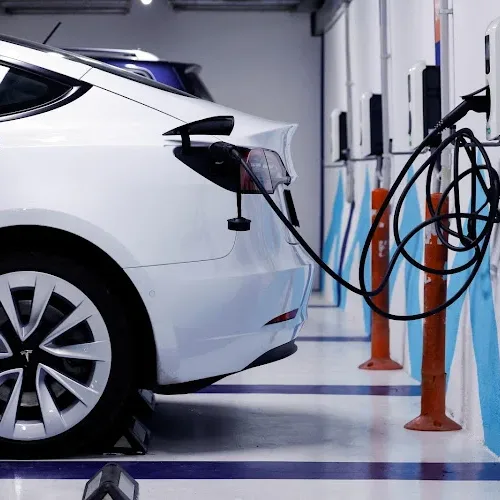
The report also highlighted Nigeria’s unreliable grid, noting a lack of public charging infrastructure needed to support widespread EV ownership. A policy brief reviewed by Reuters estimated that Nigeria had only about 48 public electric vehicle charging stations as of late 2025, with most located in Lagos and Abuja.
That compares with more than 500 public charging stations in South Africa. The disparity highlights the scale of the infrastructure gap Nigeria must bridge if its ambitious 2050 EV target is to become realistic.
The country’s Energy Transition Plan had projected around 60 charging stations by 2030, a figure that underscores how limited the existing public charging network remains.
For many Nigerian EV owners, the practical solution has therefore been to charge vehicles at home. Instead of relying on public charging stations, many owners use portable charging cables connected directly to household electricity outlets.
But even home charging is affected by power outages, forcing vehicle owners and businesses to consider alternative energy sources. The electricity challenge is also beginning to influence the types of electric vehicles gaining traction in Nigeria.
Boboye said extended-range electric vehicles, which combine battery propulsion with a small fuel-powered range extender, had become increasingly popular because they reduce motorists’ dependence on charging infrastructure.
He said sales of the vehicles had doubled this year as Nigerian consumers sought ways to combine the lower running costs of electric propulsion with the security of a fuel-powered backup.
Other manufacturers are adopting similar strategies. Chinese automakers such as BYD and Geely have expanded their presence in Nigeria with electric and hybrid models that industry executives say are more suitable for a market where electricity supply remains unreliable.
Tim Motors, the Nigerian partner of Geely, said new-energy vehicles, including electric and hybrid models, currently account for about two per cent of its vehicle sales in the country.
The company said Nigeria’s large automotive market presented an opportunity to gradually replace the predominantly used-vehicle fleet with newer and cleaner vehicles.
“Nigeria is one of the largest car markets in Africa, but it is dominated by second-hand vehicles. We want to change that,” said Leon Zhan, head of Tim Motors.
The emphasis on newer vehicles is also important because Nigeria has historically relied heavily on imported used cars, many of which are older and less fuel-efficient.
While electric cars are attracting growing attention, analysts believe motorcycles and tricycles could provide the fastest route to mass electrification in Nigeria.
The reason is largely economic. Nigeria has more than 15 million motorcycles, while commercial motorcycle and tricycle operators have been among the groups most affected by the sharp increase in petrol prices since the removal of the subsidy.
For operators who spend a significant portion of their daily income on fuel, the potential savings from electric mobility can be substantial.
Stanley Nwankwo, co-founder of electric mobility start-up Donda X Limited, said electric motorcycles and tricycles could reduce operating costs dramatically. He said the vehicles had cut operating costs by about two-thirds compared with petrol-powered alternatives.
The development is attracting investment from mobility companies seeking to solve another major problem: how to keep electric commercial vehicles running when charging infrastructure is limited.
Mobility companies such as MAX and Spiro are investing in battery-swapping networks, allowing riders to exchange depleted batteries for fully charged ones within minutes.
Unlike conventional charging, which can keep a commercial vehicle idle for hours, battery swapping allows riders to return to the road almost immediately.
The model also offers a way to reduce the impact of unreliable electricity because batteries can be charged centrally when power is available and then distributed through swapping stations.
The Federal Government’s decision to waive taxes on nearly 4,000 EVs in the first six months of the year therefore represents an important policy push, but it also exposes the difficult road ahead.
Tax incentives can reduce the upfront cost of electric vehicles and encourage consumers and businesses to make the switch. However, lower purchase costs alone may not be enough to trigger mass adoption in a country where motorists remain uncertain about where and how they will recharge their vehicles.
Comments
Start the conversation about this story.