





…rises for the first time since 2021, hits 8,100 in 2026
Nigeria added 900 million-dollar millionaires within a period of 12 months, as a stronger naira and new business growth helped reverse some of the wealth losses caused by the currency’s sharp depreciation over the past two years, according to new data from the 2026 Africa Wealth Report.
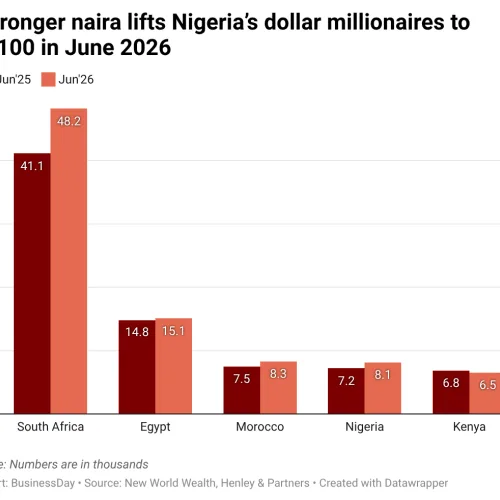
The data sent to BusinessDay from global wealth intelligence firm New World Wealth shows that the number of High-Net-Worth Individuals (HNWIs) in Africa’s most populous nation — people with more than $1 million in liquid wealth — rose by 12.5 percent to 8,100 in June 2026 from 7,200 a year earlier, marking the country’s first annual increase in its millionaire population since 2021.
The increase represents a partial recovery from the wealth losses the West African nation suffered during the naira’s sharp devaluations. The country lost about 1,600 millionaires in 2024 and another 200 in 2023.
“The number of millionaires in the country is up from last year, which is positive. The rise over the past year is mainly due to the strength of the naira against the US dollar and solid new business growth,” Andrew Amoils, head of research at New World Wealth, said, adding that “the currency has still performed very poorly over the full decade.”
Despite the latest rebound, Nigeria’s millionaire population has fallen 46 percent since the Africa Wealth Report was first published in 2013, declining from 15,000 millionaires to 8,100. Over the past decade, the country’s millionaire population has also fallen 33 percent, the steepest decline among the continent’s five largest wealth markets.

Capital-market gains add to wealth creation
The increase in Nigeria’s private wealth also coincides with a strong run in the country’s capital market, which has generated substantial gains for investors since President Bola Tinubu took office in 2023.
Temi Popoola, group managing director and chief executive officer of the Nigerian Exchange Group (NGX), said recently that economic reforms under the Tinubu administration had helped create an estimated 500,000 to 900,000 millionaires through capital-market gains.
Speaking at the State House in Abuja last week, Popoola linked the wealth creation to the strong performance of the Nigerian stock market since 2023.
“Mr President, tied to all these is a lot of wealth that has been created for many people. We don’t have exact figures, but we estimate that about 500,000 to 900,000 millionaires have been created as a result of reforms,” he said.
Popoola’s estimate refers to naira millionaires created through capital-market gains and is therefore different from New World Wealth’s measure of dollar HNWIs with at least $1 million in liquid wealth.
Still, the two figures point to the growing role of asset-price gains and capital-market participation in Nigeria’s wealth creation.

Nigeria remains fourth-largest wealth market
Nigeria ranked fourth among Africa’s five biggest wealth markets in June, behind South Africa, Egypt and Morocco and ahead of Kenya.
South Africa had 48,200 dollar millionaires, followed by Egypt with 15,100, Morocco with 8,300 and Kenya with 6,500.
South Africa’s millionaire population rose by 17.3 percent over the past year, Egypt’s increased by two percent, while Morocco gained 10.7 percent. But Kenya’s number dropped 4.4 percent.
Morocco recorded the strongest decade-long growth among the five major wealth markets, with its millionaire population rising 55 percent.
Amoils attributed Morocco’s growth partly to an influx of wealthy retirees from Europe and the Middle East, a strong currency and strong performance in the country’s prime property market.
“Millionaire growth over the past decade in Mauritius and Rwanda has been slightly higher than in Morocco, although they are much smaller wealth markets,” he said.
Nigeria currently has 22 centi-millionaires — individuals worth more than $100 million — up from 20 a year earlier, while the number of Nigerian billionaires remained unchanged at three.
Africa’s wealth expands
Nigeria’s recovery comes against a broader expansion of private wealth across Africa.
The continent now has just over 127,000 dollar millionaires, including 374 centi-millionaires and 28 billionaires, according to the 2026 Africa Wealth Report.
New World Wealth expects Africa’s wealth creation to accelerate in the coming years, with billionaire numbers projected to rise sharply by 2040.
The firm expects particularly strong growth in so-called “lifestyle destinations”, including Cape Town, Marrakech, the Whale Coast, the Garden Route, Tangier, the Cape Winelands, Nairobi, Windhoek and Swakopmund, as wealthy individuals increasingly seek destinations that combine investment opportunities, safety and quality of life.
Namibia emerges as wealth hub
Namibia is among the markets New World Wealth is particularly bullish on, with its favourable tax regime expected to support its appeal to wealthy individuals and investors.
The southern African country does not tax foreign income and has no capital gains tax or estate duty, according to the report, placing it in an exclusive group of jurisdictions with no capital gains tax that includes the UAE, Cayman Islands, Monaco and Singapore.
Namibia also has a well-developed banking system and comparatively high levels of safety relative to many other African countries.
More than 40 percent of its land is protected through national parks and conservancies, strengthening its appeal as an eco-tourism and lifestyle destination. Luxury developments such as Finkenstein Estate and La Muela are also adding to the country’s high-end property offering.
Naira turnaround
The rebound in Nigeria’s dollar-millionaire population coincides with a significant improvement in the naira’s fortunes.
After two sharp devaluations following major foreign-exchange reforms in June 2023 and January 2024, the currency stabilised in the second half of last year and appreciated against the dollar.
The naira exited Africa’s 10 worst-performing currencies in October, ending almost two years on the list, as improved foreign-exchange liquidity, stronger external reserves and policy reforms supported the currency.
The currency entered this year on a firmer footing and has continued to trade at stronger levels than during much of 2024 and 2025. By August 11, the official exchange rate stood at N1,364.6/$, making the naira the second-best-performing currency in Africa, with a nearly six percent gain against the dollar.
The improvement matters for wealth measured in US dollars because a stronger naira increases the dollar value of naira-denominated assets.
This can push individuals whose wealth is close to the $1 million threshold into the millionaire category without requiring an equivalent increase in the underlying naira value of their assets.
But currency appreciation is not the only factor behind the increase.
New business formation, higher asset values, stronger corporate earnings and rising investment returns can also contribute to the growth of private wealth.
Amoils’ reference to “solid new business growth” is therefore significant, signalling that the increase reflects both a currency effect and genuine wealth creation.
Economic recovery
The naira’s improvement has also coincided with a stronger economic performance.
Nigeria’s real Gross Domestic Growth grew to 3.87 percent in 2025, accelerating from 3.38 percent in 2024, according to the National Bureau of Statistics.
Growth reached 4.07 percent in the fourth quarter of last year, as activity across key sectors strengthened. The momentum continued into 2026. Africa’s third biggest economy grew at its fastest pace in a decade to 3.89 percent in Q1, up from 3.13 percent in the same period of 2025.
The combination of a more stable currency, stronger economic growth, capital-market gains and new business activity provides a more favourable backdrop for private wealth creation than the country experienced during the sharp currency adjustments of 2023 and 2024.
Still, the latest increase in millionaires should be viewed as a recovery rather than a complete reversal of Nigeria’s wealth erosion.
With the country’s dollar-millionaire population still significantly below its 2013 level, Nigeria has substantial ground to recover before returning to its previous position among Africa’s leading wealth markets.
For now, however, the direction has changed: after two years of sharp wealth losses driven partly by currency depreciation, Nigeria is once again adding dollar millionaires.


Bunmi holds a degree in Economics from the University of Lagos and has over eight years of experience in content writing and journalism. Her career spans roles as a financial and business journalist at BusinessDay Media and TechCabal, and as Head of Research at SBM Intelligence, an Africa-focused market intelligence and strategic consulting firm. She also served as Editor at Finance in Africa, a subsidiary of Businessfront and is currently Assistant Editor, Finance (Africa), at BusinessDay.
Comments
Start the conversation about this story.