





…Adeleke, Oyebamiji front-runners in crowded race
Fourteen candidates are vying for a chance to govern Osun State ahead of Saturday’s keenly anticipated gubernatorial elections, a contest which will determine whether the ruling party, which boasts of 31 governors, will consolidate its victory march in the southwest or cede ground to the opposition.
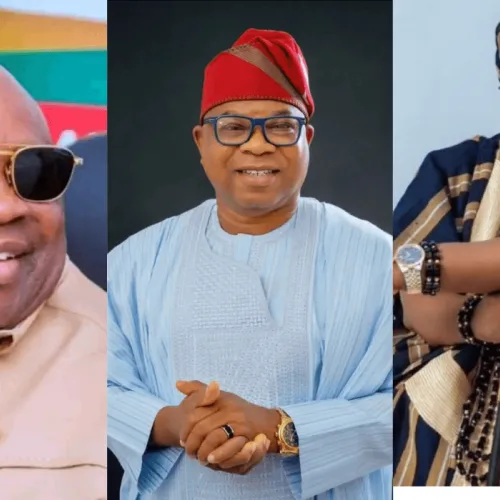
Out of the 14, three are bold contenders for the off-cycle elections, and they include: incumbent governor Ademola Adeleke of the Accord Party, Bola Oyebamiji of the All Progressives Congress (APC) and Najeem Salam of the African Democratic Congress (ADC).
INEC’s final list confirmed the 14 parties fielded, with the Peoples Democratic Party (PDP), the Labour Party (LP) and the Nigeria Democratic Congress (NDC) missing. Here is the full list of the candidates participating in the elections:
Ademola Adeleke — Accord: The incumbent governor is seeking a second term after defeating APC’s Adegboyega Oyetola in the 2022 poll to clinch the governorship seat.
Adeleke’s move from the Peoples Democratic Party (PDP) to the Accord was the product of months of internal wrangling rather than a sudden political decision.
After winning the 2022 election on the PDP platform, Adeleke became increasingly embroiled in the party’s leadership crisis and factional battles. He eventually resigned from the PDP in December 2025, citing the national leadership crisis, before joining Accord and securing its ticket.
The defection was a calculated attempt to secure his re-election without being trapped by PDP’s factional disputes and candidate-selection uncertainties. The move, however, carried a major risk, abandoning an established party structure for a smaller platform.
His gamble was partly softened when PDP leaders in Osun subsequently declared support for his re-election, while several federal lawmakers followed him into Accord.
Adeleke’s campaign is built largely around continuity. He is promising more roads, infrastructure, healthcare, education, economic opportunities and other developmental projects, while pledging to implement Accord’s five-point agenda.
His first term has given him a record to campaign on, including road construction, potable-water projects across the state’s 333 wards, community infrastructure interventions and other public projects. The administration has also sought to present infrastructure renewal and improved public services as evidence of its performance.
Saturday’s contest is therefore a referendum on both Adeleke’s performance and his political gamble. His incumbency, name recognition, PDP support and claims of visible development give him formidable advantages.
But some observers say the Accord platform, challenge from APC’s Bola Oyebamiji and voter concerns over performance and governance make the race far from a walkover.
Jackson Lekan Ojo, political analyst and Osun indigene, told BusinessDay in an interview that Adeleke’s personal popularity has kept the Accord competitive despite its relatively limited party structures in the state.
Ojo, however, contended that Adeleke had weakened his electoral prospects by publicly endorsing President Bola Tinubu for a second term while simultaneously campaigning against the APC in Osun.
“You cannot campaign against a party at the state level and at the same time endorse its national leader. That contradiction has confused many of his supporters and could cost him a significant portion of his political base,” he said.
Some pundits believe that Adeleke remains a strong contender, but his victory will depend on whether his first-term record outweighs the political cost of leaving the PDP.
Bola Oyebamiji — APC: For Bola Oyebamiji, the APC governorship ticket represents a chance to return the party to Government House after its defeat by Adeleke in 2022. A former Osun commissioner for Finance and former managing director of Omoluabi Holdings, Oyebamiji is also banking on his experience in public finance and his recent leadership of the National Inland Waterways Authority to present himself as a technocrat capable of managing the state’s finances.
Observers say what gives him hope is the strength of the APC machinery, the backing of the federal government and the belief within his camp that voters are ready for a change after four years of Adeleke.
Oyebamiji himself has consistently dismissed the governor’s popularity in the course of his campaigns, arguing that Osun voters are more concerned about performance and economic hardship than personality.
His campaign has focused on fiscal discipline, infrastructure renewal, investment, job creation, poverty reduction, healthcare and improved electricity supply. He has also promised to review and pay outstanding workers’ entitlements if elected, positioning his candidacy around economic recovery and better governance.
Oyebamiji is essentially banking on APC’s organisational strength and alleged dissatisfaction with the incumbent’s performance by critics, among others. He is also seeking to consolidate support across the three senatorial districts and turn the election into a referendum on Adeleke’s first-term record.
His chances are therefore significant, but observers say the challenge is formidable. Adeleke remains an incumbent with considerable personal and political support, while the APC must overcome the momentum that carried him to victory in 2022.
Oyebamiji’s path to victory will depend on whether he can convert APC’s structure and anti-incumbency sentiment into votes and persuade undecided voters that his promise of fiscal discipline and economic revival offers a better alternative to Adeleke’s continuity agenda.
Najeem Salam — ADC: His emergence followed the ADC’s decision to make him its consensus candidate, effectively shutting the door on Governor Adeleke, who was at the time searching for an alternative platform after a prolonged crisis in the PDP. Salam subsequently won the ADC primary with 520 of the 528 votes cast.
A two-term former Speaker of the Osun State House of Assembly, Salam brings substantial legislative and grassroots experience. He represented Ejigbo in the Assembly and served as Speaker from 2011 to 2015.
Under his leadership, the House passed 32 bills, adopted 42 resolutions and conducted four public hearings.
His supporters point to this record as evidence of legislative competence, while critics have questioned whether the cordial relationship between the legislature and the executive at the time made the Assembly too accommodating.
Meanwhile, Atiku Abubakar, presidential candidate of the ADC, has expressed optimism that the party would win Saturday’s Osun governorship election, saying the massive turnout at the campaign rally days ago had strengthened his confidence in victory.
“I thank you very much for your turnout, which is quite impressive and that has given us optimism that in the next elections we are going to win; you are going to win,” he said.
The ADC held its grand finale rally ahead of Saturday’s poll, with the party’s national chairman, David Mark, describing the gathering as a celebration of the party’s forthcoming victory. Mark urged voters to turn out en masse, vote for the ADC candidate, Najeem Salam, and protect their votes, warning that anyone who attempts to rig the election would not go unpunished.
Olanrewaju Farinloye — Action Alliance (AA): Farinloye is the AA candidate, seeking to build support beyond the dominant contenders.
Farinloye’s profile highlights his experience in building effective systems across trade, security, identity management and revenue generation. He has pledged to run an administration anchored on technology, entrepreneurship, agriculture, industrialisation and infrastructure, to create sustainable prosperity and expand economic opportunities across the state.
Olajide Esan — African Action Congress (AAC): Esan represents the AAC in the race, offering voters another alternative outside the major political blocs. He holds a degree in Geography and Resource Management from the University of Osun and is the founder and director of Jyde Autos and Logistics. His campaign is built around a promise of renewal, dignity and purposeful leadership, with a focus on providing a fresh direction for the state.
Yemisi Adeagbo Opawoye — African Democratic Party (ADP): This candidate is the only female in the election and one of the oldest contenders in the race. A retired school principal with a Bachelor of Education degree, she is presenting herself as an experienced educator and a motherly figure capable of bringing a different style of leadership to the state.
Her campaign has urged voters to look beyond the established political parties, with Adeagbo pitching a “motherly” administration focused on the welfare of workers and ordinary residents.
Her background in education also gives her campaign a strong emphasis on human development and social welfare, although she lacks the extensive political machinery enjoyed by dominant contenders like Governor Ademola Adeleke of the Accord Party and APC candidate Bola Oyebamiji. Adeagbo’s biggest asset is her distinctiveness.
However, analysts say her chances of winning are slim. The election has effectively narrowed into a contest dominated by Adeleke and Oyebamiji, with ADC’s Najeem Salam also seeking to break into the leading pack.
Adeyemi-Doro Adesina — APGA: The APGA candidate is among the lesser-known contenders seeking to upset the established political order. He is an entrepreneur with a master’s degree in Industrial and Labour Relations from the University of Lagos.
His professional experience spans healthcare management, insurance, business development and human capital administration. He has pledged to transform Osun through quality education, accessible healthcare and a revitalised agricultural sector, with a focus on improving livelihoods and expanding economic opportunities.
Adewale Adebayo — APM: Adebayo is contesting on the Allied Peoples Movement platform, adding another option for voters dissatisfied with the leading parties. Adebayo is a real estate developer and CEO of Tri Edge Real Estate, with an academic background in public administration and economic policy. Contesting on the platform of the Allied Peoples Movement, he has pledged to tackle corruption, create jobs and provide the executive leadership needed to transform Osun State.
Clement Adesuyi — APP: Adesuyi is the Action Peoples Party (APP) candidate, seeking to translate the party’s presence into a governorship breakthrough. He emerged as the party’s governorship candidate in December 2025. He has pledged to transform Osun State through increased investment in youth empowerment, healthcare, education and critical infrastructure, which he identifies as key pillars of his manifesto.
Adeleke Masilo — Boot Party: He is a graduate of the University of Ilorin and previously contested the 2023 senatorial election but was unsuccessful. He is now seeking the Osun governorship, pledging to institutionalise a people-centred administration that prioritises the welfare and wellbeing of citizens.
Taofeek Adeleke — NNPP: The New Nigeria Peoples Party candidate is seeking to expand the party’s footprint in Osun and challenge the dominance of the bigger political machines. He emerged as the governorship candidate of the NNPP in December last year. He vowed to unseat the incumbent governor and place the state on the path of sustainable development.
Saliu Oyelami — PRP: Oyelami is the Peoples Redemption Party (PRP) candidate, representing the party in its bid to attract voters looking for an alternative political platform.
Olalekan Ogunsakin — YPP: Ogunsakin is the Young Progressives Party (YPP) candidate, hoping to appeal particularly to voters seeking a new political direction.
Adefemi Adesuyi — ZLP: Adesuyi is the governorship candidate of the Zenith Labour Party (ZLP). During his campaign, he consistently positioned himself as an alternative to the established political parties, arguing that many Osun voters are tired of the dominance of the major political blocs.
His agenda is centred on giving citizens a more accountable and people-driven government, with emphasis on inclusive governance, improved public services, economic opportunities and greater participation of the electorate in monitoring government performance.
Adeleke, Oyebamiji lead crowded race
However, many observers and political analysts have argued that the election is a straight battle between the Accord and the APC candidates – Ademola Adeleke and Bola Oyebamiji.
With 14 candidates, 30 local government areas and a history of closely fought elections, Osun voters will decide on Saturday whether to retain Adeleke or return power to the APC.
Ojo, a political analyst and Osun indigene, told BusinessDay that Saturday’s governorship election has effectively narrowed to a two-horse race between Adeleke and Oyebamiji.
Ojo said the APC enters the contest with a stronger political structure, backed by governors, serving federal appointees, lawmakers and influential party leaders, as well as the institutional advantage of controlling the federal government.
He, however, said Adeleke’s personal popularity, political network and established family political dynasty have enabled Accord to remain a formidable challenger despite its comparatively weaker party structure across the state.
Ojo also warned that rising political violence, intimidation and attacks on supporters could influence voter turnout and the credibility of the poll, urging security agencies to act decisively to protect voters and candidates.
With the contest increasingly defined by APC’s organisational strength against Adeleke’s personal following and political machinery, Ojo said the election could ultimately be decided by turnout, grassroots mobilisation and the ability of both camps to convert their support into actual votes on election day.


Comments
Start the conversation about this story.