





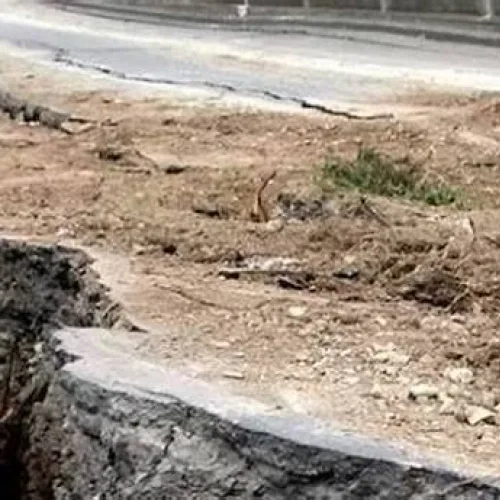
LPenultimate Tuesday, some parts of Abuja experienced earth tremor, prompting the Minister of Solid Minerals Development, Dr. Dele Alake, to direct the Nigerian Geological Survey Agency (NGSA) to furnish him with regular updates on the phenomenon. Residents of the affected locations reported that they experienced mild tremor, raising concern, especially on social media, and calling for official clarification. Dr. Alake urged the residents to remain calm and go about their normal activities, assuring them the tremor posed no serious threat to lives or properties.
The NGSA, through its Seismic Monitoring Station in Utako, had issued an alert that an earth tremor occurred in the early hours of August 4, 2026, that rocked several buildings, originating from a depth of one kilometre and covering four kilometres within five seconds. However, the NGSA assured that the tremor was a “light event of I to II magnitude on the Mercalli scale”.
The latest tremor is not new to the Abuja residents. In 2018 or thereabouts, residents of Mpape, a suburb of the Abuja City Centre, went into a panic mode following the vibration that occurred in their locality. Many inhabitants were frightened away from their homes as the earth murmured under their feet.
There have been reactions from experts in and around the Federal Capital Territory (FCT) over the unusual phenomenon in the nation’s seat of power. The phenomenon is attributed to the escalation of quarry and illegal mining activities in the area in recent times.
Speaking on the latest tremor, a Medical Geologist and Deputy Vice of the Nasarawa State University, Keffi, Prof. Nghargbu K’tso, echoed the concern of seismic experts blaming the phenomenon on increasing and indiscriminate drilling of boreholes in the FCT. He warned residents of Abuja to be wary of the grave implications of every house drilling boreholes because the exercise sent shock waves to earth crust and weakened its belly.
Prof. K’tso also called on the government to act fast to curb the incessant blasting of rocks by quarry operators, road contractors, mining operators, and indiscriminate drilling of boreholes.
There is no gainsaying the fact that owing to the high level of construction in and around the FCT, massive quarry operations have been going on in various parts of Abuja. For instance, in Kubwa, a sprawling town in the Bwari Area Council, hardly any day passes by without powerful explosions from the suburbs rocking buildings. So rampant are the activities of quarry and road construction companies that residents often rush out of their homes in fright.
Nigeria is seen as a disaster-free zone regarding occurrences like devastating natural phenomena such as earthquakes, tornadoes, and cyclones that torment some other parts of the globe. We only read about such tragedies with awe and gratitude that nature has been very kind to us, save the ravaging floods that are witnessed during the rainy season.
In our editorial of March 21, 2016, entitled “Beckoning at earthquake”, Blueprint Newspapers had noted that Nigeria has been fortunate to be spared this natural disaster but warned that human activities could set off the phenomenon. We also echoed the alarm raised by a renowned hydrologist, Mr. Olalekan Omojowa, who cautioned the federal, state, and local governments on the possible occurrences of earthquakes in most parts of the country because of the proliferation of borehole drilling.
The hydrologist had said that “the earth crust is what the people are perforating when they drill boreholes in their various homes”, explaining that when the earth was punctured more than necessary, all that was needed for an earthquake to happen was just a shake from any source.
Mr. Omojowa had further warned: “Earthquake is a man-made disaster waiting to happen in the country. It is not even very far for it to occur because the extent to which we have punctured the earth was alarming.”
He cited a state where the government alone had drilled more than 6,000 holes and when you have a single shake from any source, and fingered politicians, who made borehole drilling as a campaign promise during electioneering, as contributors to recurring incidents. The hydrologist also charged government at all levels to intensify efforts at providing potable water for the people to discourage private drilling of boreholes.
Be that as it may, the phenomenon is a bad augury and a wake-up call to the government and relevant agencies. There is the compelling need to install an early warning mechanism in areas that are prone to the disasters. Since some natural disasters are not preventable, the government owes its citizens a duty to ensure that they are forewarned about such occurrences so that they can quickly evacuate themselves to safety.
The relevant agencies of government should also be alive to their responsibilities in checking illegal and indiscriminate quarry operations as well as unauthorised mining activities in different parts of the country.
As it is said, a stitch in time saves nine.
Comments
Start the conversation about this story.