





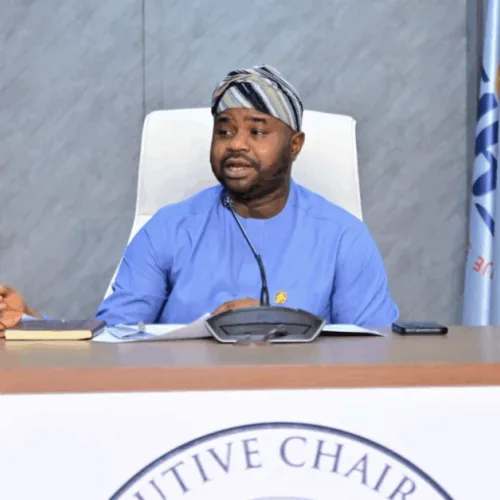
Dr Zacch Adedeji’s appearance on Channels Television’s Politics Today on Sunday night was more than a routine television interview. It was a powerful exposition of the economic thinking behind the Tinubu administration’s reforms and a demonstration of why President Bola Ahmed Tinubu made the right call in entrusting Nigeria’s revenue transformation to him.
For more than an hour, the executive chairman of the Nigeria Revenue Service engaged Seun Okinbaloye on taxation, revenue mobilisation, subsidy removal, inflation, the exchange rate, economic growth and the broader impact of the administration’s reforms. What emerged was a confident, composed and remarkably prepared technocrat who was willing to confront difficult questions with facts, figures and context.
Channels Television itself reported that the conversation focused on the performance and impact of the federal government’s economic policies, the revenue drive and efforts to strengthen Nigeria’s tax and revenue system.
Perhaps the most striking feature of the interview was Adedeji’s ability to place Nigeria’s present economic realities against the baseline inherited in 2023. Rather than offering simplistic political explanations, he used economic indicators and comparative figures to make his case. The Eagle Online described the appearance as an attempt to tell the story of the Tinubu administration “through numbers”, noting that Adedeji came to the studio with charts covering GDP growth, inflation, exchange rates, interest rates, foreign reserves, public debt and oil production. That approach matters. In an environment where economic debates are frequently driven by emotion, Adedeji’s decision to anchor his arguments in data demonstrated the value of evidence-based public communication.
His most compelling message, however, may have been his explanation of the philosophy behind Nigeria’s tax reforms: “Tax prosperity, not poverty.” That is a significant departure from the perception that taxation is primarily about extracting money from citizens and businesses. Adedeji explained that the revenue service’s interest is directly connected to the prosperity of businesses and individuals: when businesses grow, and Nigerians earn more, government revenue naturally increases.
Channels Television reported his argument that the NRS is not there to extract but to create an environment in which businesses and individuals can perform better. That is the kind of explanation Nigerians need as the country builds a modern revenue system.
Adedeji also defended the difficult decision to remove the petrol subsidy, arguing that the reform prevented a potentially unsustainable fiscal burden and helped avert even more severe economic dislocation. Channels Television reported his claim that, without the reform, the subsidy bill could have risen dramatically and the exchange rate could have deteriorated further. Whether one agrees with every policy choice or not, what was evident was a public official prepared to defend the government’s decisions and accept the burden of explaining why difficult choices were made.
The interview has already generated substantial media attention, with publications focusing on different aspects of his arguments, from the economic reforms and subsidy removal to taxation and the cost of governance. The Cable reported his argument that more Nigerians could have fallen into poverty without the reforms. At the same time, The Whistler highlighted his position that the government’s tax policy is intended to support prosperity rather than punish it. The breadth of the coverage demonstrates that Adedeji succeeded in moving the conversation beyond the traditional, narrow discussion of tax collection to the broader question of Nigeria’s economic future.
This is why President Tinubu deserves credit for the appointment. Economic transformation requires more than presidential speeches and policy documents; it requires capable people who can translate policy into institutions, defend difficult decisions and communicate with citizens. Adedeji has increasingly demonstrated those qualities. His performance was neither theatrical nor defensive. He spoke with the confidence of a professional who understands that revenue is ultimately about creating the resources with which the government can finance development and that the prosperity of taxpayers is inseparable from the prosperity of the revenue system.
So, thank you, Mr President, for Zacch Adedeji. You got this one right. Nigeria needs a revenue administration that understands economics, embraces technology, supports enterprise and can mobilise resources without suffocating the productive sector. On that Sunday night, Adedeji gave Nigerians another glimpse of the kind of technocratic leadership required to deliver that transformation. The assignment remains enormous, and the ultimate verdict must be based on results. But if competence, clarity, courage and capacity are the criteria, President Tinubu deserves commendation for putting Zacch Adedeji at the wheel of Nigeria’s revenue revolution.
Arabinrin Aderonke is a 2014 Laureate, Wole Soyinka Investigative Journalism Award; a 2016 finalist for the CNN African Journalist Award; an author; a policy analyst; and a technical advisor on broadcast media to the executive chairman, Nigeria Revenue Service.


Comments
Start the conversation about this story.