





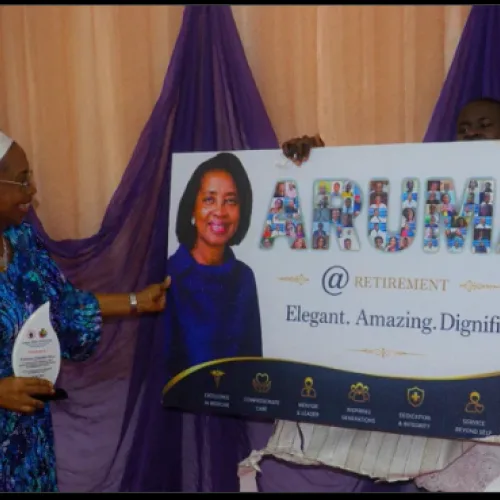
Dr Efunbo Dosekun is before an eager crowd in an auditorium in Ikeja today, Wednesday, 5th August 2026, to deliver a valedictory lecture for her friend, Elizabeth Disu, a professor of paediatrics, who is retiring from academics at the milestone age of 70 years.
The lecturer is inching close to 70 herself and approaching the prospect with some disquiet. There is still much to be done. Outreach Neolife, Kano, her 100-bed specialist children’s hospital designed primarily for salvaging critically ill newborns, full-term or pre-term, and the latest member of her Outreach Hospitals group, which had started in FESTAC and expanded across Lagos, has been literally swamped with work. In the past one month, the survival rate has risen to 95% from an initial 82% in the first three months, and the numbers to more than 1500.
Today is not about her, she knows, but about her friend and colleague. They had been residents together at the Lagos University Teaching Hospital, Idi Araba. She, Efunbo, had spent a year abroad in Newcastle and had returned to be Senior Registrar over a dynamic team that included other friends such as Ngozi Onyia.
The decision to go to Kano under a partnership with the National Health Insurance Agency (NHIA) that guarantees free treatment for critically ill babies seen in her facility has a grim logic to it. 59 out of every 1000 babies born in Kano die in their first month of life, far worse even than the globally infamous Nigerian national average of 41 neonatal deaths out of every 1000 live births. Kano is one of the worst places on earth for any baby to be born. That is not a fact that should be conducive to the peace of mind of anyone. The experience of saving those first 1000 babies in Kano, salutary as it is, has also been a reality check for her on the limitation of high-tech Neonatal Intensive Care Units alone as a panacea for high death and disability in the first month of life in a resource-challenged society like Nigeria.
Getting past the niceties, she begins to talk to the audience about Elizabeth, who is being celebrated by the people she has mentored, and influenced, over the course of decades of clinical work and scholarship at the Lagos State University Teaching Hospital and its sister College of Medicine.
Her presentation slides are not crammed with a Chinese Menu of figures and diagrams. She is talking from the heart about a person she knows, and the care of little Nigerian babies they are both incurably passionate about.
‘Elizabeth has brought in a Public Health dimension to our work’ she says. ‘She taught me her course on ‘Helping Babies to Breathe’. I have myself organised over 50 Training programmes to teach the same skills to other people.’
She describes how Elizabeth had been very enthusiastic about the resuscitation of newborns, after learning from the mutual teacher Professor Nike Grange, and how she designed and started to disseminate ‘Helping Babies To Breathe’ in Lagos. Her trainees included fellow paediatricians, doctors, nurses, and, significantly, staff from General Hospitals and Primary Healthcare centres.
Her innovative work, she says, is like a coin, dropped into water, creating endless ripples. She is an example of a researcher whose work has translated into direct impact on Nigerian society.
‘…Everyone talks about how hard-working Elizabeth is in the Emergency Room and in the clinic. But she has saved thousands of Nigerian babies who she did not even touch with her own hands…’
The Paediatrics Association of Nigeria utilises her training. She is involved with the programmes in the Lagos State Ministry of Health, and with the Federal Ministry of Health. She is principal investigator in a Bill and Melinda Gates funded international study on the simplified administration of a substance to free the airways of distressed newborns.
Babies, avers the lecturer, were designed by God to breathe, and to cry, immediately at birth. Any baby that does not breathe in one minute is in dire trouble. The window is narrow. A baby who has not breathed for three-to-five minutes, but later survives due to even the most expert treatment, may be permanently brain damaged and unable to function optimally in later life.
The drift of her logic is clear. Elizabeth’s drive to diffuse the skills needed to help babies through that critical window to the grassroots is needed to support the achievements of her high-tech hospital in Kano, and others like it. Anybody who has cause to take the delivery of a baby must ultimately have knowledge of how to help the baby to breathe.
She speaks of the celebrant’s NGO – the Abiye Maternal and Child Health International Foundation (AMCH) to which she has been committing huge amounts of time and effort over several years. Through it, she and her supporters have been teaching health workers in less specialised levels of care about minimal cost ways of keeping little babies alive and well and educating mothers and grassroots society on how to prevent or reduce the dangers that kill or damage babies – sepsis, jaundice, perinatal asphyxia, prematurity.
It is a tough labour of love, Efunbo concedes. But there is no retreat. For the celebrant, who is now 70. For her too, soon to be 70. She may be preoccupied currently with driving quality life-saving care in Outreach Neolife in Kano, and her other baby-hospitals. But she has also caught the Public Health bug from her friend and colleague Elizabeth.
There is applause as she concludes her talk.
An endless flow of adulatory tributes follows.
Despite the mirth, there is sombreness in the air, influenced perhaps by the grim pictures painted – of ailing, vulnerable Nigerian babies, in Kano and other places, and all the work that still lies ahead.
Everyone in the auditorium is aware that, for the Professor, retirement may just be the beginning of a reinvention of her mission to save little babies.


Comments
Start the conversation about this story.