





Nigeria’s inflation story has changed dramatically over the past year. The country is no longer battling runaway price growth; it is confronting a more difficult challenge: convincing households that economic stability matters when the cost of living remains painfully high.
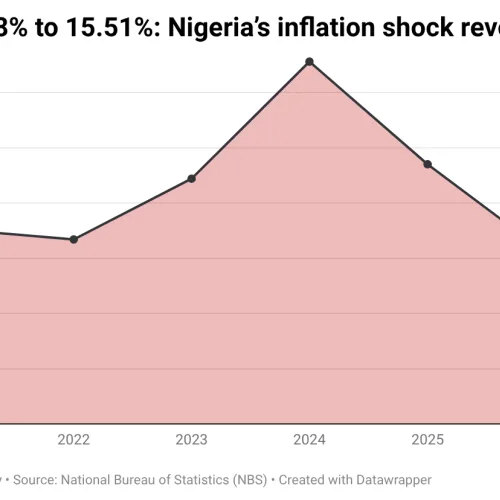
Average inflation fell to 15.51 percent in the first half of 2026, down from 23.47 percent a year earlier and well below the 32.77 percent recorded during the inflation shock of 2024. By any macroeconomic measure, that is substantial progress. For millions of Nigerians buying food, paying rent or commuting to work, the relief remains largely invisible.
The disconnect lies in a distinction that economic headlines rarely explain. Inflation measures how fast prices are rising, not how high prices already are. A lower inflation rate slows the pace of increase; it does not reverse the surge that has already reshaped household budgets.
This is why the optimism surrounding disinflation has collided with widespread public scepticism. Nigerians are not rejecting the data; they are responding to a different reality. The price of rice, transport fares, electricity bills and school fees remains far above pre-2024 levels, even if those prices are no longer rising as rapidly.
The arithmetic is simple. A basket of goods that rises from ₦100 to ₦130 during a period of 30 percent inflation does not return to ₦100 when inflation falls to 15 percent. It rises again to almost ₦150. The inflation rate has been cut in half, but the household is still paying nearly 50 percent more than before the original shock.
That is the gap between macroeconomic improvement and lived experience.
The improvement itself is genuine. After inflation climbed steadily from 16.73 percent in the first half of 2022 to 22.20 percent in 2023, it peaked at 32.77 percent in 2024 as petrol subsidy removal, exchange-rate reforms and higher production costs fed into consumer prices. Since then, inflation has moderated consistently, while monthly figures have become far less volatile than they were during the crisis period.
For policymakers, this marks the end of one phase of economic adjustment. The emergency of 2024 was to prevent prices from accelerating uncontrollably. The challenge now is fundamentally different: translating macroeconomic stability into stronger purchasing power.
That will require tackling the structural costs that continue to shape prices. Food inflation remains vulnerable to insecurity, poor logistics and weak agricultural productivity. Energy costs continue to burden both households and businesses. Expensive transport, unreliable infrastructure and high financing costs raise the price of producing and distributing almost everything Nigerians consume.
Monetary policy alone cannot resolve these pressures. The next phase of reform must therefore shift from stabilising prices to lowering the cost of production. Investments in transport infrastructure, reliable electricity, agricultural productivity and supply-chain efficiency will do more to improve living standards than celebrating another decline in headline inflation.
Income growth is equally important. Even a stable inflation environment offers little comfort if wages and employment fail to keep pace with the higher cost of living. Households recover purchasing power only when earnings consistently grow faster than prices.
This is also where government communication matters. Official statements that celebrate falling inflation without acknowledging the permanence of the higher price base risk widening the credibility gap between economic statistics and public experience. Nigerians are more likely to trust reform when its benefits are explained honestly rather than presented as immediate relief.
Businesses, meanwhile, stand to gain from greater price stability. More predictable costs improve planning, investment decisions and cash-flow management, while sustained disinflation could eventually create room for lower borrowing costs. But companies are still operating from a much higher cost base than before the 2024 shock, limiting how quickly those benefits can reach consumers.
The real measure of recovery must therefore go beyond a falling inflation rate. The priority now should be to strengthen incomes, reduce the cost of production, improve productivity and create an environment in which businesses can invest and expand. If these gains are sustained, lower inflation can gradually translate into stronger purchasing power, more competitive businesses and better living standards for Nigerians.


Comments
Start the conversation about this story.