





The Federal Government has called for deeper collaboration with China in medical equipment, hospital development, diagnostics, digital health, research and local manufacturing as part of efforts to transform Nigeria’s healthcare system.
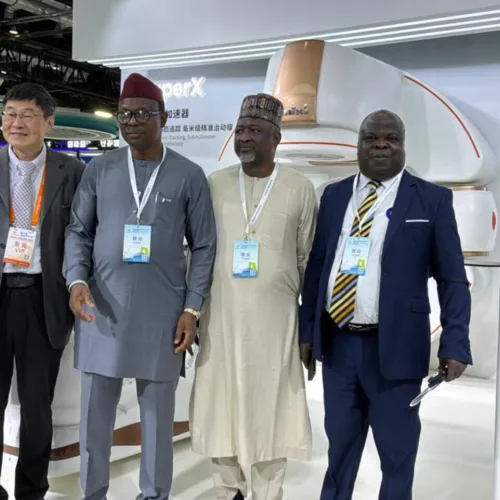
The Minister of State for Health and Social Welfare, Dr Iziaq Salako, made the call at the 32nd China International Medical Equipment Exhibition and Scientific Conference, China-Hospeq 2026, held at the China National Convention Centre, Beijing.
Salako said Nigeria was seeking to expand its partnership with China beyond the trade in raw materials to strategic cooperation capable of delivering sustainable improvements in healthcare.
Represented at the event, the minister said the China-Hospeq platform offered Nigeria an opportunity to identify technologies and innovations that were appropriate, affordable, scalable and responsive to the country’s health system needs.
He said the Federal Government, under President Bola Tinubu’s Renewed Hope Agenda, was implementing reforms aimed at strengthening primary healthcare, improving access to quality and affordable services, accelerating digital health transformation and addressing human resources for health challenges.
According to him, the government is also prioritising the local production of medicines, medical devices, diagnostics and other health commodities.
Salako said achieving these objectives would require more than increased funding, stressing the need for stronger institutions, innovative technologies, sustainable financing, skilled health workers and strategic international partnerships.
He described China-Hospeq as more than an exhibition of medical equipment and technologies, noting that it had evolved into a platform for dialogue, innovation, knowledge exchange and strategic partnerships.
The minister said the focus of the 2026 edition on China-Africa hospital collaboration through artificial intelligence, appropriate technologies, capacity building and laboratory medicine was particularly relevant to Nigeria.
He noted that Nigeria-China cooperation in the health sector had continued to expand, with opportunities in hospital development, medical technology, diagnostics, digital health, research, health workforce development and local manufacturing.
Salako said joint ventures in pharmaceutical manufacturing, medical equipment procurement and maintenance, as well as specialised training in traditional and phytomedicine, were opening new areas of cooperation between both countries.
He also welcomed the growing emphasis on China-Africa health cooperation, particularly through the China-Africa Hospital Collaborative Development initiative and the establishment of the China-Africa Hospitals Alliance.
According to him, such institution-to-institution partnerships could provide practical and sustainable benefits to African health systems.
Salako, however, cautioned that sustainable healthcare transformation could not be achieved through the provision of equipment alone.
He stressed the need to ensure that medical equipment was appropriate to local contexts, while health workers were adequately trained and systems for maintenance, quality assurance and technology integration were established.
The minister listed medical equipment and health technologies, hospital development and clinical engineering, laboratory medicine and diagnostics, digital health and artificial intelligence, research and innovation, health workforce development, technology transfer and knowledge exchange among areas where Nigeria sought deeper cooperation with China.
Others, he said, included local manufacturing and value-chain development, as well as health emergency preparedness and global health security.
Salako said the interconnected nature of global health challenges, including pandemics, antimicrobial resistance, emerging infectious diseases, non-communicable diseases, climate-related health threats and health inequalities, made international cooperation imperative.
He urged participants at China-Hospeq 2026 to move beyond discussions and exhibitions towards practical implementation, sustainable capacity building and measurable health impact.
Comments
Start the conversation about this story.