





•Africa records four percent growth, Western, Central Africa lead with double-digit aviation gains
International tourism showed resilience in the first quarter of 2026, despite mounting geopolitical tensions and rising economic pressures, with approximately 307 million tourists travelling globally, representing a two percent year-on-year increase, UN Tourism has said.
According to the latest UN Tourism data, demand remained strong in January and February.
However, growth slowed towards the end of the quarter following the escalation of conflict in the Middle East, which disrupted air connectivity, pushed up oil prices and increased transport costs.
The development is now projected to reduce global tourism growth by 1–2 percentage points below the initial forecast of three to four percent for 2026.
The report noted that these dynamics are already shifting traveller preferences, with more tourists opting for shorter-haul and regional destinations amid higher costs and uncertainty.
Europe led global arrivals with over 130 million international visitors in Q1 2026, posting a four percent growth. The growth was supported by the redirection of tourism flows toward Southern Mediterranean and Northern European countries, as well as the ongoing recovery in Central and Eastern Europe.
Africa also recorded a four percent increase in arrivals. North Africa recorded particularly strong momentum, including double-digit growth in March, while Sub-Saharan Africa maintained steady gains.
In the Asia and Pacific region, arrivals grew by three percent. However, performance was mixed as strong gains in North-East Asia and Oceania were offset by weaker outcomes in South Asia, partly linked to disruptions affecting regional air hubs. The region as a whole remains below pre-pandemic levels.
READ ALSO: Tourism must go digital, green to remain competitive — Musawa
The Americas recorded modest growth of two percent, driven largely by strong expansion in Central America, while South America saw a slight contraction.
The Middle East, however, experienced a sharp decline of 14 percent, reflecting the direct impact of the conflict, despite having previously exceeded pre-pandemic levels.
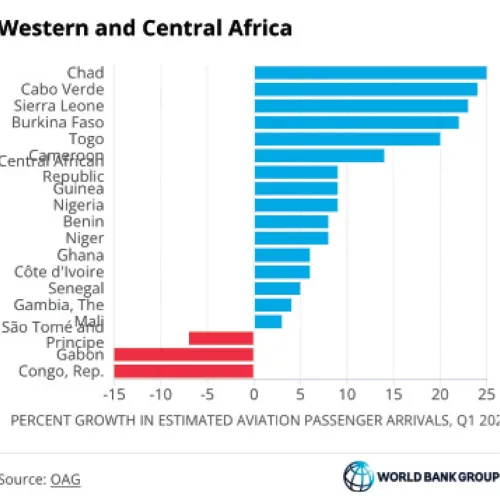
The report highlighted strong aviation performance in parts of Africa. Western and Central Africa stood out with significant growth in passenger arrivals.
Chad, Cabo Verde, and Sierra Leone recorded 25 percent, 24 percent, and 23 percent growth respectively in aviation passenger arrivals in Q1 2026.
On the flip side, three countries in the region recorded declines. São Tomé and Príncipe saw a seven percent decrease, while Gabon and the Republic of Congo both recorded 15 percent year-on-year drops in aviation arrivals.
Tourism stakeholders say the Q1 figures underscore the need for destinations to strengthen regional connectivity and market shorter-haul products to cushion the impact of global disruptions and sustain growth through 2026.
Comments
Start the conversation about this story.