





*Traders speak out amid crackdown
*Say hunger and poverty leave them with no choice
By John Alechenu
ABUJA- It is 1:45pm on Herbert Macaulay Way, one of the busiest roads in the Federal Capital Territory of Nigeria. Top ranging vehicles ply here as a routine because of the presence of the National Oil company on this road. On this particular day a black colour Sports Utility Vehicle idles outside the popular NNPC Towers. Men in suits pace around them, shouting into phones.
Across the road, cars crawl into a Total filling station. Horns blare ceaselessly in a bid to draw attention. But that causes more distraction of its own. However, beside the station, nylon sheets are spread on the ground. Sachet drinks, groundnuts, cucumber, roasted yam, boiled cassava and roasted corn are arranged in rows. Umbrellas and old campaign posters with faded faces provide shade for traders and customers. This is like a full market in session but it is not. It is actually the mini-market that hawkers have unwittingly created to make a living amid the soaring sun.
“This sun can fry an egg,” Paul, a regular at the roadside eatery, says as he fans himself with a file. He shops here as a means of avoiding the high stakes supermarkets that dot the length and breadth of the city.
Less than a metre away, Mama Ada, 52, arranges boiled corn and coconut in a plastic basin. Her customers are bankers, drivers and dispatch riders from offices in the old NITEL building. She is calling out prices when two white Abuja Environmental Protection Board, AEPB, vans screech to a stop nearby.
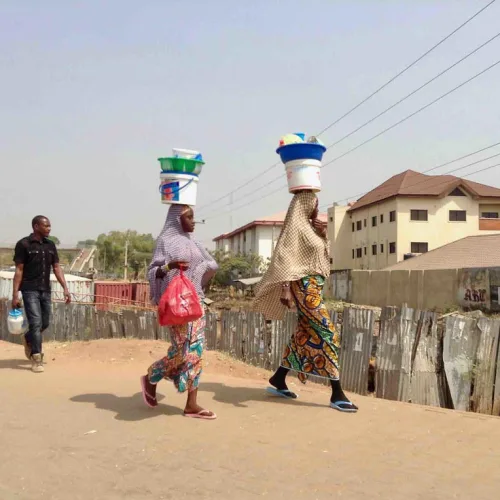
Fifteen-year-old Hauwa is coming from the other direction with a plastic bowl on her head. Inside the container are various goods for her customers – Water, Gala, chewing gum and sweets inside. Men in a black car jump down and Hauwa drops everything and flees with the speed of light to avoid being taken away. She disappears between taxis in seconds, leaving her tray and her goods behind. Sachets of water and other items scatter on the road. A driver menacingly swerves to avoid brushing them.
Other traders who see the task force in time also took off. Mama Ada drags her basin behind an SUV. A young man with phone chargers tucks his wares into a backpack and disappears into the crowd. In less than two minutes, the stretch is almost empty. This has become the daily routine of hawkers, who had since been barred by the FCTA and the Abuja Environmental Protection Board, AEPB. But they have refused to leave the road irrespective of measures churned out by the authorities.
They flog the busy areas such as Wuse, Garki, Area 1, Berger, Area 3, Jabi. Hawkers defy government bans to sell in traffic, at bus stops and around government buildings.
‘How Do We Feed?’
For Hauwa, life as a teenager has been difficult and requires struggling to survive. She shares a single room with her two siblings and three cousins in a slum outside Mpape. The room has no running water. They fetch from a borehole 10 minutes away. At night, they sleep on mats on the floor. Her parents are farmers in Niger State. Two years ago, bandits attacked their village. They took food, money and two goats. Months later, drought destroyed the rest of the harvest. “School finish for JSS2,” Hauwa says quietly. “No money again.”
She followed her aunt to Abuja. The aunt sells vegetables in Garki Market and sleeps in a shop. “People say money dey for Abuja. Nobody go tell you say e hard for poor person to get am,” she says, switching between broken English and Hausa as she sets up another tray 30 minutes after the raid. She borrowed the tray from another hawker.
She admits that on a good day she makes between N3,500 and N6,000. Every Friday she sends N10,000 to N15,000 home through a bus driver to her aged parents.
“My capital na N8,000,” she says, wiping sweat with the back of her hand. If they break my tray today, na two weeks food gone.”
She knows the risks. Last month, a friend was hit by a motorcycle while running from AEPB in Wuse. The girl spent four days in hospital. No one paid the bill. The friend now hawks with a limp.
Yet Hauwa is back on the same spot. “If I no come, how we go chop?” she asks.
Her story is not different from that of Felicia who hails from Nasarawa State. “I am a secondary school student. I am selling this groundnut to help my family.” According to her, she has been “lucky enough” to evade the several raids by AEPB enforcement officers because, “I only sell cooked groundnuts and I don’t go near areas where they patrol.”
‘Task Force Collect My Okada’
At Berger roundabout, Musa, 28, moves between cars selling phone chargers, screen guards, earphones and car perfumes. He is fast. He knows which window will open and which driver will wave him off.
Before the okada ban in 2023, Musa was a commercial motorcyclist in Mabushi. On a good day, he makes about N10,000. Then the FCTA banned commercial motorcycles from the city centre and he quickly moved away into hawking, which appears as a fast-moving business in the FCT.
“Colleagues say Area 1 dey move. I follow them,” he says. Now he averages N3,000 to N4,000 daily. On days when task force raids are serious, he returns home with less than N1,000.
“Now if I see N4,000 I thank God. Government say no okada. Wetin I go do? I get wife and three children for Nyanya,” he says. He finished primary school in Kankiya, Katsina State. He also studied Arabic under his late father, an imam.
“I go school. Now I dey run from task force like thief. But hunger no dey hear grammar,” he says. He considered returning to farming during dry season. But his village is close to a forest where bandits operate. Two of his cousins were kidnapped last year. Ransom was paid before they were reluctantly freed and that memory still haunts him even after relocating from his state to Abuja. He rents a room in Nyanya for N200,000 a year. He wakes at 4:30am to catch the first bus. He returns after 9pm.
“They seized my phone once, and I paid N7,000 to collect it. That week, my children no chop well.” Musa says he has applied to several driving jobs. “They ask for experience, license, and money for ‘processing’. I no get.”
Mama Blessing, 45, is a familiar face at a traffic light in Wuse II. She sells roasted yam, plantain, peppered beef, dried fish and sachet drinks. She has a small charcoal stove and a cooler strapped to a trolley. This year, AEPB has seized her wares severally but she is determined to keep the business running no matter how hard they push her.
“Sometimes they say pay N10,000 before you collect am. If you no get, them go scatter everything. You go lucky if them no carry you go office,” she says.
She lives in Gwagwalada and manages to pay the annual rent of N350,000. She leaves home at 5am and returns after 10pm. Transport alone costs N1,500 daily.
“Na here better market dey,” she says when asked why she travels from the outskirts to come and sell in the city. “For Gwagwalada, people no dey buy like this.”
Her husband died in 2021 after a brief illness. They have three children, who are all in secondary school. The eldest wants to study nursing.
“I dey manage. Sometimes I borrow money to buy yam and plantain. If they seize am, na wahala,” she says.
She tried selling in Gwagwalada market. “Sales no dey. People dey wait till month end. Here, even civil servant go buy N500 yam when traffic hold am.”
On days AEPB task force does not come, she makes N8,000 to N12,000. After food, transport and savings for rent, she has little left.
BUYERS KEEP THEM ALIVE
In Abuja’s daily gridlock, hawkers are part of the system. In 40-minute traffic jams, N50 sachet water, N100 Gala, N200 plantain chips and N500 roasted corn sell fast.“It’s easier,” says Mr. Emmanuel, a civil servant from Lugbe. “And you pity them too. These children suppose dey school. But wetin you go do? If you buy, you help somebody.”
A banker who works on Herbert Macaulay Way says she buys from Mama Ada twice a week. “Corn and coconut is what I buy for my lunch. It’s cheaper than the canteen and it’s fresh.” For many drivers, buying is also about time. “If I enter market, I go waste one hour. Here, they bring it to me,” says Danjuma, a taxi driver.
The trade thrives on convenience and compassion. But it also thrives on desperation.
FCTA: ‘ABUJA IS NOT A MARKET’
Over the years, the Federal Capital Territory Administration has tried to enforce the ban on street hawking. Officials say there is no place for it in a modern capital. They argue that hawking blocks drains, causes traffic, litters the streets and attracts crime. To streamline its work, the Board maintains outposts in key areas across the city centre backed by mobile teams that conduct periodic raids.
A former Director of AEPB, Dr. Baba Lawal, who has since retired was quoted as saying, “Abuja was not designed for this. We have markets in every district. We have skills centres. We are not fighting the poor. But we cannot allow the city to turn to a motor park.”
“Every week we seize goods and we talk to them. We even counsel them. Two hours later they are back. Until people stop buying in traffic, this will continue.”
The AEPB impounds hundreds of trays, coolers and goods monthly. Offenders pay fines ranging from N5,000 to N20,000 before retrieving seized items. Repeat offenders are taken to court. Successive administrations have built markets in Kubwa, Gwagwalada, Kado, Wuse and Garki. The FCTA also runs skills acquisition centres in some parts of the city where physically-challenged persons taken off the streets are given life skills. Many of the hawkers argue that the markets are either “too far or the rent is high.” A lock-up shop in Garki can go for N150,000 to N300,000 annually, plus agreement fees.
THE OTHER SIDE
For all the talk about city planning, the human cost is clear. At an FCT shelter in Bwari, a welfare officer who asked not to be named says most of the children picked up by AEPB are not from Abuja.
“They come because of insecurity, hunger or to meet relatives. Parents think Abuja has money. Abuja is expensive,” she says.
The shelter houses boys and girls between ages 10 and 17 rescued from the streets. Some are reunited with families. Others stay for months.
“It’s not clean,” she says. “Girls get harassed. Boys get into fights. Some get knocked down by vehicles.”
Not too long ago, a thirteen-year-old boy was hit by a car at Area 3 while trying to run away from the task force. He spent two weeks in hospital with a broken leg. A church group paid the bill.
The officer says the cycle continues because there is no alternative. “We counsel them. We tell them to go to school. But when they go home, there is no food for them and they return to the street to struggle for survival,” the official maintains.
‘TELL US WHERE TO GO AND WHAT TO EAT’
Although government officials keep mentioning that there are alternatives areas such as Kubwa, Gwagwalada and Area 10 skills centres, Wuse, Garki and Kado markets with lock-up shops, which street traders can patronize for their business, the traders complain that they have no idea on how to access those places and what it costs to do so.
“Government say make we no hawk. Government never tell us wetin we go chop,” Mama Blessing, a roadside corn seller, says, turning her items of trade on fire as she spoke.
But Musa is tired of the talk and he does not believe the government is serious about addressing their needs. “Give us loan. Give us shop. Then talk. You no fit tell person wey dey hungry to wait,” the hustler says
Many others like Musa have tried to survive the hassles on Abuja roads but for how long can they continue without any serious and practical intervention by the relevant authorities? they ask.
For instance, Hauwa’s aunt registered for an empowerment programme being promoted by a local politician last year. She was told to pay N5,000 for forms but nothing came out of it at the end of the day. She is still lamenting how she lost her money to something she now believes was scam dressed like empowerment.
Similarly, Mama Ada, who applied for a space in Garki Market as far back as 2023, said she was put off when the officials demanded for a compulsory N150,000 payment for the “processing” of her application and she lost out because she could not afford the cash.These antics by those who are supposed to help sort out things, have tended to kill initiatives and dampen the creativity of innocent persons.
The Executive Director of the Civil Society Legislative and Advocacy Centre, CISLAC, says banning hawking without addressing unemployment will not work.
“You cannot criminalise poverty,” he says. “Abuja’s economy is built on government and you must understand that when government jobs are few and the cost of living is high, people will certainly find a way to survive.”
He suggests designated vending zones, micro-credit and linkage to markets, adding, “You don’t chase people away; you organise them.”
Economists note that Abuja’s informal sector employs thousands. A 2024 NBS report puts informal employment in the FCT at over 60%. For many, hawking is the only entry point.
A CITY OF TWO WORLDS
By day, Abuja projects order. New flyovers in Wuye and Jahi. Glass buildings in the Central Business District. Police vans patrol major roads. Diplomats and ministers move in convoys. But, in the evening, another Abuja emerges.
At 7pm, the AEPB vans leave. Traffic eases. Hauwa is back at Area 1 with a borrowed tray. She needs N2,000 before going home. Mama Ada made N3,200 today. She will use N1,000 for transport, N1,000 for food, and save the rest.
Musa counted N3,800. He will send N2,000 home and keep the rest for food and bus fare. Mama Blessing covers her stove as the night business ends but she will undoubtedly return at 6am to continue the daily routine of hustling to survive just like others in her group, who see Abuja as the only place where people buy well on the street.
Irrespective of what the FCT and its numerous agencies do to deter them, the hustlers remain under the sun, in the rain, and under streetlights. But, while they run between cars and trucks to avoid being crushed, they are quick to escape before the task force men can pick them or their wares.
In a city designed to be a model capital, they represent a reality officials detest and try to eradicate but with serious headache.
Street vendors interviewed for this report said they are aware of the law but have no alternative than to use available public space for survival.
“If government give us place where people go pass and rent no too much, we go leave road,” Mama Ada said.
Until the economy changes, until there are jobs and affordable markets, Abuja’s last hawkers will keep running. Because for them, the choice is simple: obey the ban and go hungry, or risk arrest and feed their families.
Comments
Start the conversation about this story.