






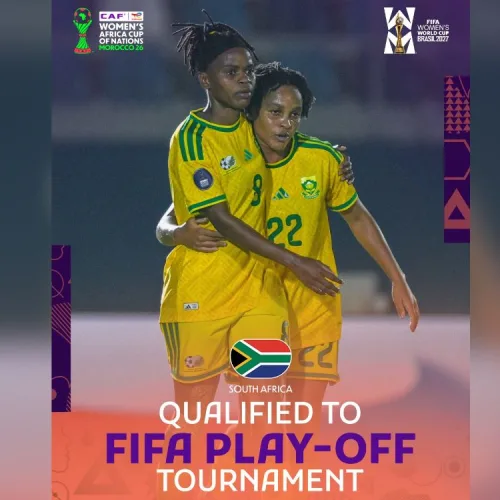
The Super Falcons’ hopes of qualifying for the 2027 FIFA Women’s World Cup have come to a painful end after Nigeria suffered a 2-1 defeat to South Africa in the CAF play-off in Morocco.
The high-stakes encounter brought together the two quarter-final losers at the 2026 Women’s Africa Cup of Nations, with Nigeria having lost 1-0 to Cameroon and South Africa suffering a 2-1 defeat to hosts Morocco.
The winner was guaranteed a place in the intercontinental World Cup play-off route, making the clash a second chance for both nations after disappointing quarter-final exits.
South Africa, however, seized the opportunity, as Thembi Kgatlana broke the deadlock in the 56th minute before captain fantastic, Refiloe Jane doubled Banyana Banyana’s advantage in the 77th minute.
Nigeria responded late when Christy Ucheibe converted from the penalty spot, but the Super Falcons could not find the equaliser as South Africa held on for a historic victory.

PREMIUM TIME looks at the six major takeaways from Nigeria’s defeat.
Super Falcons struggled to create clear-cut chances
Once again, Nigeria struggled to consistently create clear opportunities from open play.
The Super Falcons relied heavily on crosses, corners and set-pieces to trouble South Africa, but found it difficult to break through a disciplined Banyana Banyana defence.
The introduction of Folashade Ijamilusi offered Nigeria greater attacking threat, with the forward delivering dangerous balls into the box and helping win corner kicks.
However, Nigeria lacked the movement and combination play needed to consistently open up South Africa from open play.
Too many attacks ended with crosses rather than clear chances for the forwards.
 After leading Nigeria to a record-extending 10th title last time, Ajibade leads the Falcons to their worst-ever WAFCON campaign (CREDIT: NG Super Falcons X Page)
Nigeria suffered their worst-ever WAFCON campaign
Nigeria’s quarter-final elimination by Cameroon had already ended an extraordinary record.
Before Morocco 2026, the Super Falcons had reached at least the semi-finals in every WAFCON edition they had contested. They had never previously been eliminated in the quarter-finals.
The Falcons also arrived as defending champions and the most successful team in the history of the competition, with 10 African titles to their name.
Their campaign began disastrously with a 3-2 defeat to WAFCON debutants Malawi on July 28.
Temwa Chawinga put Malawi ahead in the 69th minute before Tabitha Chawinga doubled their advantage five minutes later. Rasheedat Ajibade’s stoppage-time penalty briefly revived Nigerian hopes, but Malawi struck again before the final whistle.
Nigeria responded with a 1-0 victory over Zambia and a 6-2 demolition of Egypt, but Cameroon ended their title defence with a 1-0 quarter-final victory.
The defeat to South Africa then made it three losses in five matches; the most Nigeria have suffered at a WAFCON without any of those games going into extra time.
It ultimately made Morocco 2026 the worst WAFCON campaign in the history of the Super Falcons.
 Coach Madugu is heavily criticized for his selection and tactics (CREDIT: WoliG Ólùyà)
Madugu faces serious questions
Coach Justin Madugu will inevitably face scrutiny after another performance in which Nigeria struggled to look like a cohesive unit.
The issue was not simply South Africa’s two goals. Nigeria’s attacking structure frequently lacked direction, while the defence was exposed whenever Banyana Banyana moved the ball quickly.
The concerns are not entirely new; during Nigeria’s preparations, Madugu admitted after the 2-1 friendly victory over Senegal in June that there was still “a lot of work to be done”.
Similar problems were evident during the previous WAFCON campaign, when Nigeria struggled to break down Botswana despite dominating possession and failed to register a shot on target in the first half.
Madugu deserves credit for guiding the Falcons to a remarkable 3-2 comeback against Morocco in last year’s WAFCON final, but the lack of attacking clarity throughout significant portions of this tournament cannot be ignored.
Against South Africa, Nigeria needed quicker combinations, better movement and greater control. Instead, several attacks became isolated individual efforts.
The players must accept responsibility for their execution, but the coach is ultimately responsible for the team’s shape, tactical approach, defensive organisation and response to the opposition.
 NFF President Ibrahim Gusau (CREDIT: Ibrahim Gusau X Page)
NFF’s preparation deserves scrutiny
Nigeria’s preparations for the tournament also deserve serious examination.
The Falcons entered WAFCON after a disrupted build-up that included cancelled fixtures and uncertainty surrounding their warm-up programme.
Nigeria had initially been expected to participate in a four-nation WAFU B tournament in Abidjan in February and March, but the competition was cancelled because of organisational and logistical issues.
The NFF eventually arranged a double-header against Senegal on 5 and 8 June.
Another planned friendly against Ghana on 18 July in Casablanca was later cancelled due to what the federation described as “unforeseen circumstances”.
The squad’s arrival was also far from smooth. By 20 July, only 19 of the 25 invited players had arrived in Morocco, while US-based Deborah Abiodun and Gift Monday did not join the squad until 24 July because of travel problems.
The NFF cannot be blamed for every cancellation or travel disruption, but the federation controls much of the national team’s planning, scheduling and logistics.
A team defending the African title and pursuing World Cup qualification required a more stable preparation programme.
The disjointed performances in Morocco make those shortcomings impossible to overlook.
 The Woman-of-the-Match performance by Goalkeeper Kaylin Swart propelled Bayana Bayana to victory (CREDIT: CAF Women’s Football X Page)
South Africa have beaten Nigeria in a World Cup qualifier or play-off for the first time
The result creates a new chapter in one of African women’s football’s longest rivalries. South Africa had previously faced Nigeria in World Cup qualifying without winning. In March 1995, Nigeria beat Banyana Banyana 4-1 in the first leg in Nigeria before producing an extraordinary 7-1 victory in Johannesburg in the return fixture.
The two countries have also met in Olympic qualifying, with Nigeria holding the advantage. In April 2024, the Falcons won the first leg 1-0 in Abuja before a 0-0 draw in Pretoria secured Nigeria’s Olympic qualification.
South Africa’s previous competitive victories over Nigeria came in other competitions, including the 2018 and 2022 WAFCON group stages. The 2022 victory was particularly painful because Banyana went on to win their first African title that year.
Thursday’s victory is therefore different. It was South Africa’s first win over Nigeria in a World Cup qualifying or play-off match, and it came when a place on the road to Brazil was at stake.
Nigeria’s World Cup qualification streak is over
The most devastating consequence is now official: Nigeria will not feature at the 2027 FIFA Women’s World Cup in Brazil.
The 2026 WAFCON doubled as Africa’s qualifying tournament for the World Cup. The four semi-finalists secured automatic qualification, while the quarter-final losers were given another opportunity through the CAF play-offs, with the winners advancing to the intercontinental qualification tournament.
Nigeria failed to take that second chance, as the defeat ends one of the most remarkable records in women’s international football.
The Super Falcons had qualified for every previous edition of the Women’s World Cup, appearing at all nine tournaments from the inaugural competition in 1991 through the 2023 edition in Australia and New Zealand.
The 2027 tournament will therefore be the first Women’s World Cup without Nigeria
That is a dramatic fall for a team that won the WAFCON title only last year, beating Morocco 3-2 in the final in Rabat after recovering from two goals down.
South Africa’s victory in Casablanca has now closed Nigeria’s historic World Cup qualification streak and left the NFF, Madugu and the players facing difficult questions about how one of Africa’s most dominant women’s football teams reached this point.
Discover more from Premium Times Nigeria
Subscribe to get the latest posts sent to your email.
Comments
Start the conversation about this story.