






There is a particular kind of silence that settles over a rural community when the rains fail, farm produce cannot reach the market, and months of hard work are lost because the roads are impassable. For many farming communities in Kwara State, that was a familiar reality before 2019. The land remained fertile, the farmers resilient, but the infrastructure, investment, and institutional support needed to unlock agriculture’s full potential were largely absent.
When Governor AbdulRahman AbdulRazaq assumed office, his administration recognised that transforming agriculture required far more than distributing inputs or launching seasonal programmes. It demanded a long-term strategy capable of modernising the sector, improving productivity, attracting investment, and creating sustainable livelihoods. That vision gave rise to the Kwara State Agricultural Transformation Plan, a ten-year blueprint developed through consultations with farmers, financial institutions, agribusinesses, and development partners.
Built around six strategic pillars, crop production, agricultural finance, livestock development, market access, value chains, and institutional reform, the plan has provided a clear framework for policy implementation. Rather than existing as another government document, it has shaped practical interventions across the agricultural value chain, ensuring that each initiative contributes to the broader objective of making food available, affordable, and accessible while positioning agriculture as a driver of economic growth.
Perhaps no investment illustrates this philosophy better than the state’s focus on rural infrastructure. Farmers cannot prosper if they remain cut off from markets, regardless of how productive their farms become. Through the Rural Access and Agricultural Marketing Project (RAAMP), supported by the World Bank and Agence Française de Développement, Kwara committed more than ₦4 billion in counterpart funding, earning the World Bank’s Overall Best Counterpart Funding Performance Award.
Today, over 210 kilometres of rural roads are under construction, linking farming communities to aggregation centres, processing facilities, and major markets in locations such as Ajase-Ipo, Alapa, and Kaiama. Beyond improving transportation, these roads are reducing post-harvest losses, lowering logistics costs, and giving farmers quicker access to buyers. They are also opening rural communities to broader economic opportunities that extend well beyond agriculture.
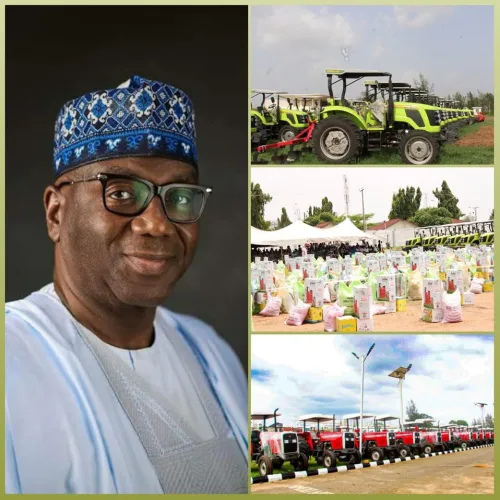
Infrastructure alone, however, cannot transform agriculture without improving productivity. Recognising this, the administration prioritised mechanisation by expanding access to tractors, ploughs, harrows, ridgers, and other modern equipment across all sixteen local government areas. Through subsidised hiring schemes, smallholder farmers who previously depended entirely on manual labour now have greater access to machinery that improves efficiency and expands cultivation.
The mechanisation drive has been complemented by the distribution of improved agricultural inputs, including certified FARO 44 rice seeds, hybrid maize, improved soybean varieties, fertilisers, motorised pumps, knapsack sprayers, and other essential farming materials. Working with organisations such as the Rice Farmers Association of Nigeria, these interventions have reached thousands of farmers across the state. To strengthen extension services, the government also provided more than 190 motorcycles to agricultural officers, enabling them to reach remote communities with modern farming techniques, climate-smart practices, and technical support.
One of the administration’s most significant achievements has been less visible but equally transformative. Kwara has developed a digital database containing over 100,000 farmers, with biometric verification and geo-mapping. This innovation has significantly improved transparency by reducing opportunities for ghost beneficiaries and ensuring that government interventions reach genuine farmers. Building on this progress, the state inaugurated a Multi-Sectoral State Working Committee on Food Security in 2024, bringing together institutions such as the Bank of Agriculture, NIRSAL, traditional rulers, commodity associations, and other stakeholders to coordinate efforts aimed at boosting production, improving market efficiency, and addressing food inflation.
Livestock development, long neglected within Nigeria’s agricultural landscape, has also become a major component of Kwara’s transformation agenda. Through the Special Agro-Industrial Processing Zone programme, Malete is being developed into a major Agro-Industrial Hub, while Agricultural Transformation Centres are planned for Afon, Olodan, Gidan Mogajiya, and Kinnikinni to strengthen processing, storage, and market access.
The state’s six-year Livestock Productivity and Resilience Support Project is laying the foundation for a more organised and commercially viable livestock industry. The revival of the Kaiama Cattle Ranch, statewide vaccination campaigns targeting more than 330,000 cattle, sheep, and goats, and strategic collaboration with FrieslandCampina WAMCO are creating new opportunities within the dairy and livestock value chain while improving the livelihoods of pastoral communities. The broader livestock development programme also provides a framework for expanding pasture resources and strengthening livestock production as implementation progresses.
Climate change continues to pose one of the greatest threats to agricultural productivity, making resilience an essential component of long-term planning. Through the Agro-Climatic Resilience in Semi-Arid Landscapes (ACReSAL) programme and collaboration with the International Institute of Tropical Agriculture (IITA), Kwara is investing in irrigation, land restoration, and sustainable resource management. Under ACReSAL, Community Revolving Funds are also being implemented to provide interest-free financing to organised farmer groups, supporting them to strengthen their livelihoods and invest in productive agricultural activities. The rehabilitation of the Duku-Lade irrigation scheme has further expanded opportunities for year-round farming, enabling farmers to cultivate beyond the limitations imposed by seasonal rainfall.
The administration has equally recognised that agricultural prosperity depends not only on increasing production but also on creating value after harvest. Partnerships with private investors are strengthening rice, cassava, soybean, and shea processing, while the revival of the Thursday Fish Market and expansion of fish hatchery programmes are stimulating aquaculture across the state.
Through the FADAMA NG-CARES programme, thousands of vulnerable households, particularly women and young people, have received productive assets such as irrigation equipment, fish-smoking kilns, grinding machines, sprayers, and processing equipment that support sustainable livelihoods and small-scale enterprise development. At the Kwara State University College of Agriculture in Ilesha Baruba, renewed investment is helping to develop the skilled workforce needed to sustain the state’s agricultural transformation over the long term.
The benefits of these reforms extend beyond the farm. Better infrastructure lowers transportation costs, efficient value chains increase farmers’ incomes, agro-processing creates employment, and higher productivity strengthens food availability. Together, these investments are reinforcing agriculture’s role as a catalyst for inclusive economic growth, poverty reduction, and rural development.
Equally significant is the growing confidence of development partners and investors. Organisations including the World Bank, the African Development Bank, the Islamic Development Bank, the International Institute of Tropical Agriculture, and private-sector investors have continued to deepen their engagement with Kwara because they recognise a government that places a premium on planning, accountability, effective implementation, and measurable outcomes. These partnerships are accelerating the state’s transition towards a more competitive and commercially driven agricultural economy.
Like every meaningful reform programme, the journey is not without challenges. Rising production costs, changing weather patterns, limited access to finance, and the need for greater private-sector participation remain issues that require sustained attention. Agricultural transformation is a continuous process that demands consistency, innovation, and collaboration.
Yet the progress across Kwara’s farming communities is becoming increasingly evident. Rural roads are reconnecting farmers with markets. Mechanisation is reducing the burden of manual labour. Digital technology is improving the targeting of government interventions. Livestock development is opening new streams of income, while expanded irrigation is making year-round farming a practical reality for many communities.
As Chairman of the Nigeria Governors’ Forum, Governor AbdulRahman AbdulRazaq has consistently argued that food security cannot be achieved through short-term interventions alone. It requires deliberate planning, sustained investment, institutional coordination, and strong partnerships involving government, development agencies, the private sector, and farming communities.
Kwara’s experience shows what is possible when agricultural policy is backed by commitment and consistent implementation. The lasting legacy of these reforms will not simply be measured in kilometres of roads, hectares cultivated, or machines deployed. It will be reflected in thriving rural communities, more prosperous farmers, stronger local economies, and a state steadily establishing itself as one of Nigeria’s leading models for agricultural transformation and food security.
Comments
Start the conversation about this story.