





•Suspects who get human parts from exhumed corpses reveal
On August 1, 2026, at about 9:30 a.m., operatives of the Monitoring Unit of the Oyo State Police Command received information from a good Nigerian citizen about people allegedly involved in rituals using human parts. On receiving the credible information, the team of operatives raised for the operation did not waste a moment. They obtained the contact of the first suspect, Ganiyu Nurudeen, an Afaa resident in Iseyin.
In disguise, one of the operatives called Afaa Ganiyu, seeking a solution to a problem, and he demanded N15,000 as a fee for a sacrifice. The amount was negotiated and N10,000 was paid into his account. After receiving the money, Afaa Ganiyu asked his prospective client to call him the following day.
The operative duly called him on August 2, and Ganiyu’s first question was how the caller had obtained his mobile phone number. The caller responded that he got it from his girlfriend. Satisfied with the answer, Ganiyu told his client to come to Iseyin the following day at about 7 a.m.
When the client informed him that he was in Iseyin, Ganiyu asked him to wait at the Central Mosque, Iseyin. He came from his residence to the spot and called to identify his client. There, he was promptly arrested by the operatives who had lain in wait for him.
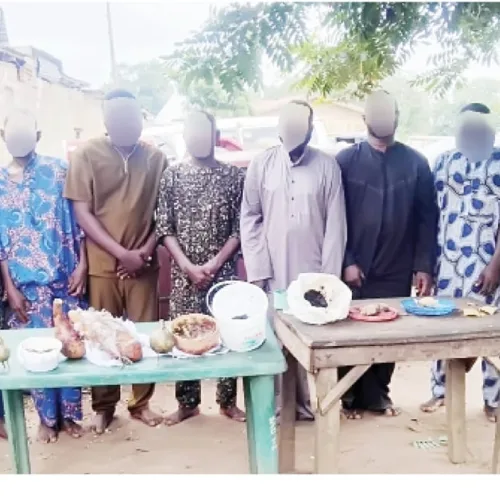
The Police Public Relations Officer, DSP Olayinka Ayanlade, who revealed this in a statement, and that the 10 suspects were apprehended in Iseyin and Saki towns. Their mode of operation, according to the PPRO, was to visit cemeteries in the dead of the night, exhume corpses, and remove needed human parts for sale to ready buyers who are among the arrested suspects. The buyers, after the purchase of the human parts, would allegedly pound them into smooth paste, add other ingredients to make bathing soap and sell it to eager clients as charm for fortune-making.
During interrogation, Ganiyu opened up about his activities. He confessed to collecting a broken human skull from someone, which he used to make a concoction (àsèje). Saturday Tribune learnt that the person is currently on the run.
Ganiyu further confessed that he was not alone in the business. He gave the name of Tijani Wasiu, also an Afaa, aged 54. When arrested, Wasiu disclosed that he was using human flesh and human heart, which he used to get from one Busari Sulaiman, who is based in Saki town.
Saturday Tribune further learnt that the Monitoring Unit team proceeded to Saki the same day, August 2, and apprehended Sulaiman, aged 47. He confessed that he used to collect the human parts from one Afaa Taofeek Raheem, aged 46, also in Saki. The operatives went for Afaa Taofeek, and he also confessed that they were four in number who used to go to a Muslim cemetery along Saki-Ago Are Road to exhume freshly buried corpses, from which they would remove the heart, flesh and hands. They codenamed the heart “tomato”, the flesh “bread” and the hands “hand fans” (abèbè).
Taofeek said he was the one selling the parts to Sulaiman. Sulaiman also mentioned one Afaa Abiola Nurudeen, also in Iseyin, who was arrested on August 3 at about 9:20 a.m. Recovered from him were pieces of human skull, human heart and human flesh, all fresh. His arrest led the Monitoring Unit operatives back to Saki on the same day, to Jimoh Muritala’s house. Jimoh confessed to being one of those who used to go to the cemetery to exhume corpses and remove the needed parts. He also led the operatives to the residence of Adamu Ibrahim, a 42-year-old Togolese from Kande town in Togo. Ibrahim also admitted that he used to go to the cemetery to exhume corpses and cut off needed parts, which would be sold to waiting buyers.
Ibrahim led the operatives to the house of one Nasiru Kabiru, aged 23, of Apinite area in Saki, an Afaa-cum-herbalist, whom he said he sold two hands to. In his confession, Nasiru disclosed that he had used the two hands for a money ritual.
Saturday Tribune interviewed some of the suspects, and their confessions went thus:
Taofeek Raheem
“I’m a farmer. It is true that I used to go to the cemetery to exhume corpses in order to get body parts for buyers who asked for them. I was introduced to it by one man called ‘Doctor’ in Saki. He was known as a medical doctor who had a clinic where he attended to patients, but he was also selling human parts to those who needed them.
“’Doctor’ was the one who invited me to join him. Before I started with ‘Doctor’, he used to ask me to take him to the cemetery on my motorcycle. I would hide somewhere while he exhumed a corpse to remove the body parts he needed. After selling the parts, he used to give me money. I studied him and started doing it on my own.
“Ibrahim and Jimoh joined me and ‘Doctor’ in exhuming corpses and making money from the sale of human parts. ‘Doctor’ was the one who introduced me to buyers.
“However, I stopped exhuming corpses when the dead started coming to me in my dreams, frightening me. They would act as if they wanted to strangle me, baring their fangs. Then, I thought: ‘Ah, this thing is no longer easy.’ So, I quit the act. Before stopping, I had exhumed and cut off body parts from three corpses. I sold hands, flesh and heart to one Nasiru. He was paying me N5,000, N10,000. It was ‘Doctor’ who used to keep the heads, but he died two years ago.
READ ALSO: I convinced my relative to get human parts for fortune-making ritual, suspect admits
“But that didn’t stop me from buying body parts from Jimoh, which I sold to Nasiru whenever he requested human flesh and heart.”
The suspect disclosed that all of them involved in the act used to go to a Muslim cemetery to exhume corpses because of their familiarity with the burial ground as Muslims themselves, and because the graves were not so deep, which made the exhumation easier and faster.
When asked whether his act was in line with Islamic teachings, the suspect replied in the negative, pleading for divine forgiveness. “We were doing this thing despite attending mosques for prayers and engaging in full fasting during Ramadan, but we were wrong because Islam does not teach us such a thing,” he said.
Ibrahim
“I’m a Togolese. I had been shuttling between Nigeria and Togo to work as a labourer before I settled in Saki nine years ago. I’m even married to a Nigerian and we have one child. I started corpse exhumation five years ago and was introduced to it by ‘Doctor’ and Taofeek. After working for them for a while, I told them I was no longer interested. I was paid N20,000 each time I carried out corpse exhumation. I didn’t feel any usefulness of the money given to me, and I started having terrible dreams, with corpses appearing in my dreams. That was why I stopped going two years ago, particularly after the death of ‘Doctor’.”
When asked whether he did such a thing in his country, Ibrahim said: “I didn’t know about exhuming corpses when I was in Togo.”
Jimoh
“I’m 35 years old. I was a bricklayer but had to go into corpse exhumation about two years ago. It was Taofeek who taught me how to dig graves for corpse exhumation and removal of needed human parts. We were going together before he stopped following me.
“I knew Taofeek as a tenant in my family house. I used to remove flesh, heart and hands from the exhumed corpses. I didn’t know how much they were sold for by my boss, Taofeek, but he used to give me N20,000, N30,000 as payment for my job. I did my last job about three weeks ago in a Muslim cemetery. I went alone. I got N20,000 for it.
“It was poverty that pushed me into doing such a despicable thing because, as a bricklayer, I used to sit at home for over a month with no place to work. And I have my wife and children to feed. Farmers already had their labourers, so there was none I could join. I was arrested when Taofeek brought the police to me.”
Nasiru
“I’m an Afaa and herbalist. I’m 45 years old and a Saki native. I knew the late ‘Doctor’ through someone. I used to call ‘Doctor’ whenever I needed human parts for use in herbal preparations. ‘Doctor’ was well known for the supply of human parts. I used to buy flesh and heart to make soap for fortune (àwúre osó) or burn them for fortune-making charms.”
Describing how the charm for fortune was usually prepared, Nasiru said: “It’s either we pound or burn the human parts in a mortar after which we would add other ingredients to them. If it’s just the heart, we would grind it on a grinding stone. Then, we mix the pounded human parts with black soap or Lux soap. We also add Àbámodá, Ēlà, Òdùndùn, ògbò Omo eléwìjí leaves and other ingredients. Then I would make an incantation, saying: ‘enìkan soso ni mo pè, igba eni ni kó wá jé mi t’owó t’owó owó won’ (as I call just one person, 200 people should run to me to serve/favour me with their money in their hands). I would also buy heads of Igún and Àkàlà birds, as well as Kowéè and Olúgeèsà birds, among other things. The mixture would be put in a container, a white calabash or breakable plate, and given to the person requesting the charm to bathe with.
“That was the way it was written in a native doctor’s book used to record how to tackle challenges in traditional ways. I learnt from the one I met in my family and the ones I picked up from various herbalists from whom I sought knowledge.”
When asked whether the charm had been working for his clients, he said they usually stopped visiting him when they experienced a positive change in their finances. On why he didn’t use it for himself in order to break even financially, Nasiru said it was not his destiny (kádàrá) to be rich. He disclosed that his clients used to give him about N100,000 to get all the needed ingredients, including the human parts, leaving him with very little. He also stated that clients using the soap for bathing would not know that its contents included human parts.
On whether he knew that he was acting against the law by dealing in human parts, Nasiru admitted that the law is stronger than any man whose acts are against it, adding: “It is the devil’s work.” He said that he was doing it for survival, but also admitted that the act was unacceptable in Islam, pleading for God’s mercy.
Busari Sulaiman
“I’m an Afaa and I have a school where I teach children about the Quran. My involvement was because I helped a friend, Wasiu, to purchase human flesh from Taofeek for N5,000 when he told me that he needed it. I have bought the human parts twice for the same friend. I didn’t know what he wanted to use them for, but I know that the tenets of Islam don’t support this. I didn’t benefit from the help I rendered. I must have lost my reasoning to have helped the friend with such a thing. I knew Taofeek as a seller of human parts.”
Wasiu
“I’m also an Afaa, and I was the one who sent Sulaiman to purchase human parts for me. He had bought them for me once. I mixed them with the bark of òbò tree and Bintu fragrance. He was about to make another purchase when we were arrested. I just wanted to make a fortune charm for myself, but the first one I did had no positive result. I believe it does not go with my destiny.”
Comments
Start the conversation about this story.