





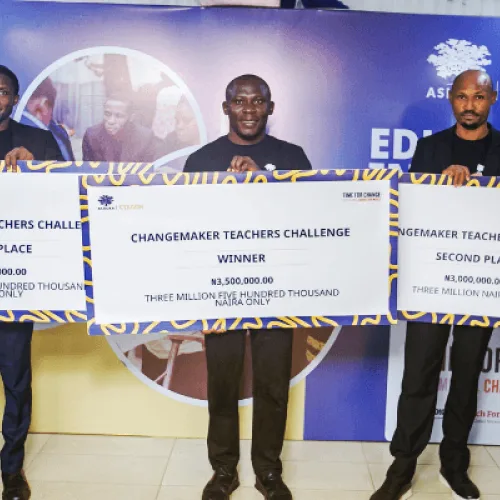
L-R: Abraham Lawal, Lagos Progressive Junior Secondary School, second-place winner; Adeyanju Adeyoola, a teacher from Lagos State Model Junior College, Kankon, Badagry, first-place winner; and Felix Alabi, a teacher from Abule-Eko Community Junior Grammar School, winners of the pilot programme Educator Innovation Showcase in Lagos.
Ashoka Africa has hosted its pilot programme, the Educator Innovation Showcase 2026.
It said it was in its determination to inspire public school teachers in Lagos State to develop scalable ideas that can transform their classrooms and surrounding communities,
According to the organisation, the initiative also aims to shift traditional educational paradigms by funding public school teachers who are actively instilling crucial “changemaking” skills in their students.
The programme culminated in a dynamic pitch event where five finalist teachers presented evidence-backed initiatives to secure substantial implementation grants.
At the end of the pitch, Adeyanju Adeyoola, a teacher from Lagos State Model Junior College, Kankon, Badagry, emerged the first-place winner with the project BKind, an Anti-Bullying Game Initiative for Health, Well-being & Inclusion. He was awarded a cash prize of N3.5 million for the implementation of the project.
Felix Alabi, a teacher from Abule-Eko Community Junior Grammar School, emerged second for his project, the ClassSync Education Innovation (Mathematics Education/Peer Learning. He received a cash prize of N3 million, while Abraham Lawal, Lagos Progressive Junior Secondary School, came 3rd and received a cash prize of N2.5 million to implement his project, Student Leadership for Future of Work Student Agency & Future Skills.
Fourth place: Abiola Alabi, Aguda Junior Grammar School, Surulere, with the project Waste to Worth Environmental Sustainability and fifth-place finalist Aderinoye Temitope, a teacher in Reservation Junior Secondary School, Tolu Schools Complex, Ajegunle, Lagos, with the project Transforming Basic Science into Entrepreneurship: Empowering Students Through Petroleum Jelly and Liquid Soap Production. Student Agency & Future Skills also received
Three outstanding ideas from the broader pool of candidates also received consolation prizes and recognition.
Angelou Ezeilo, co-president of Ashoka Africa and CTEACH director, while speaking to journalists, said that the ultimate goal of the challenge was a fundamental mindset shift for both educators and youth.
Ezeilo noted that Ashoka previously hosted student-focused “pitch-a-thons,” but shifted to empowering teachers after realising educators were bubbling with scalable ideas to change their classrooms and surrounding communities.
Olamide Christianah Adeboye, Project Lead, CTEACH Changemaker Teachers Challenge, while commenting on the multiplier effect of the initiative, said if one teacher is empowered, this can inspire hundreds of students.
Adeboye said that the programme moves beyond traditional academics to teach four core changemaking skills: conscious empathy, shared leadership, changemaking practice, and collaboration.
She noted that rather than applying temporary charitable fixes, Ashoka focuses on addressing root causes. The funded classroom projects reflect this ethos. Standout ideas included “Be Kind,” an engaging anti-bullying game that fosters teamwork, and an innovative basic science curriculum that teaches students how to manufacture Vaseline, effectively bridging the gap between classroom theory and real-world entrepreneurial skills.
To ensure long-term impact, all funded ideas must be highly replicable and scalable. Winners will sign a Memorandum of Understanding (MOU) with Ashoka Africa, requiring them to provide strict accountability reports detailing their budgeting, supply purchases, and classroom impact. Furthermore, successful teachers will be expected to train other educators both within and outside their schools to adopt these methodologies.
Looking ahead, Ashoka Africa plans to leverage the data gathered from this pilot to advocate for widespread policy changes. The organisation is actively engaging with the Ministry of Education and global funders with the ultimate ambition of integrating this changemaker framework directly into the national curriculum.
The challenge was specifically targeted at teachers from the six education districts in Lagos State, with a strategic focus on underserved public schools. Beginning with an initial pool of over one hundred applications, the programme narrowed the field down to 20 semifinalists. These educators were tasked with implementing their innovative ideas in their classrooms over four weeks to gather concrete, evidence-backed data proving their concepts worked before the final five were selected.


Comments
Start the conversation about this story.