






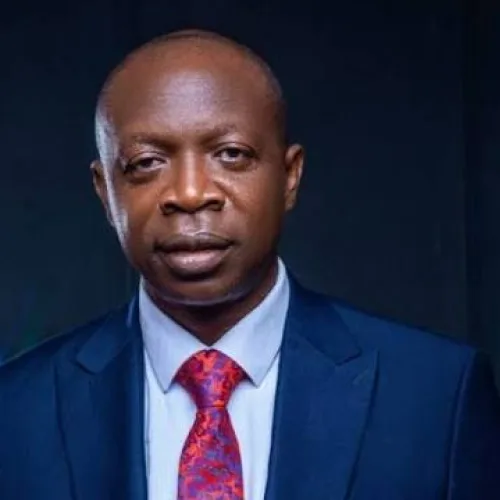
THE National Chairman, Pan Niger Delta Forum (PANDEF), Godknows Igali, has called for restoration of true fiscal federalism, saying Nigeria’s over-centralised system has weakened productivity.
Igali made the call at the Concerned Citizens Assembly organised by Citizens Rebirth and Awareness Initiative (C-RAIN), in Abuja, on Monday
The event had the theme, “A Nation Built on Consent, Strengthened by Strong Regions and United for Peace, Prosperity and Progress”, with participants examining governance, federalism, development and national unity.
He said that the over-centralised structure had also weakened security and accountability, while criticising state governors for failing to translate regional cooperation into concrete economic development.
According to him, restructuring is not about breaking up Nigeria, but strengthening Nigeria.
Igali said PANDEF was gathered not to divide Nigeria, but to save it, adding that the objective was not to weaken the centre, but to strengthen the federation for development.
He said Nigeria’s founding fathers deliberately negotiated a federal system that allowed the regions to develop according to their resources, priorities and peculiar circumstances, without excessive dependence on the centre.
He said that the Western Region developed free primary education and Cocoa House, while the Eastern Region built industries and the Northern Region developed its agricultural base and educational institutions.
“The regions also developed educational institutions and other productive sectors. They achieved significant progress without waiting for monthly allocations from the centre or direct federal intervention.
“That was the dream: a federation of strong, productive units paying dues to a limited but effective centre,” Igali said.
He called for constitutional amendments to devolve powers, strengthen fiscal federalism, restore greater resource control, guarantee local government autonomy and encourage regional cooperation across Nigeria’s federating units for sustainable development.
He, however, said that restructuring should not be equated with disintegration, urging Nigerians to preserve national unity while discussing reforms aimed at improving the federation’s effectiveness, accountability and national development.
“Let us not separate ourselves under ethnicity, let us not separate ourselves under religion, or under those lines. Those lines should be the basis for constructive discussion,” he said.
Convener of the Concerned Citizens Assembly, Deacon Owolabi Oladejo, said that restructuring Nigeria was no longer a political option but a national survival strategy for Nigeria’s future and lasting prosperity.
He said the country’s highly centralised political structure had become increasingly incapable of responding effectively and appropriately to the realities of a complex and diverse federation and its national challenges.
Oladejo said that Nigeria’s crisis could not be resolved merely by changing political leaders, insisting that the fundamental architecture of governance must also be re-examined to achieve stability and progress.
He said that Nigeria needed a new federal compact founded on consent, stronger regions, fiscal responsibility and constitutional reform to address persistent national challenges and strengthen democratic governance nationwide.
“Nigeria needs restructuring, not as a political slogan, but as a national survival strategy.
“There is an urgency of fundamental reforms to Nigeria’s governance structure and national development goals,” he said.
Similarly, General Secretary of the Rebirth Group (TRG) and Citizens for Restructured Nigeria (CRN), Ali Ocheni, said consultations across the six geopolitical zones showed widespread concern over power and centralisation.
Ocheni said ìithat the groups consulted citizens in Ibadan, Kaduna, Enugu, Gombe, Port Harcourt and Jos between May 2024 and March 2026 on Nigeria’s political future, governance reforms and development.
He said the consultations identified over-centralisation and excessive concentration of executive authority at the federal level as major factors behind Nigeria’s fractured unity and poor economic performance across the country.
“Power must be devolved to the sub-regional federating units of government with separate but mutually administered federal and regional constitutions,” Ocheni said.
He said that delegates were favourably disposed to returning to a regional federal structure similar to that established under the 1963 Constitution, which granted regions greater autonomy and developmental responsibility.
He said that autonomous regions would promote productivity through healthy competition and cooperation, while enabling federating units to respond effectively to their distinct developmental priorities and local needs.(NAN)
M.P
Tags: Devolution of Powers Igali PANDEF
Comments
Start the conversation about this story.