





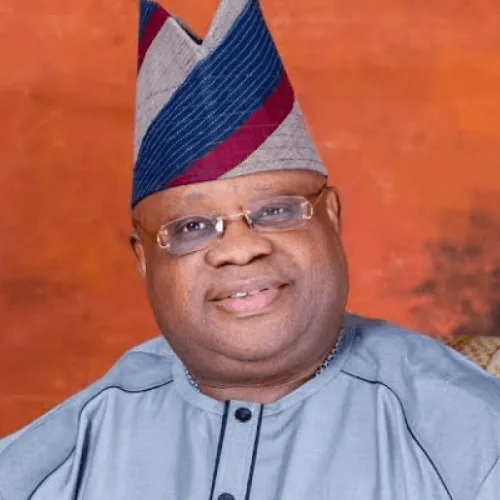
Osun’s gubernatorial election has produced the incumbent governor Ademola Adeleke has the winner but his task doesn’t stop there. His re-election has opened a much more demanding phase for his administration where he will now focus on converting his state from being dependent on federal allocations to an industrial hub capable of generating employment for all residents.
With about 35,000 public workers on payroll and a long-standing reputation as a “civil servants’ state”, analysts say Adeleke’s second term will be judged less by the number of projects commissioned and more by his ability to attract private capital, create jobs and reduce the state’s dependence on federal allocations.
The governor himself recognises the challenge. Speaking on Channels Television on Sunday after securing another four-year mandate, Adeleke said industrialisation would be at the centre of his second-term agenda, with the development of a free trade zone, completion of the state airport and expansion of infrastructure identified as priorities.
“I am tired of hearing Osun State as a civil service state. I want to make sure I move it to an industrial state where investors will come in,” he said.
The ambition comes at a time when the state’s fiscal position has improved considerably, although the structure of its revenue remains heavily dependent on transfers from the Federation Account.
Data analysed by Dataphyte show that Osun’s internally generated revenue (IGR) rose from N22.4 billion in 2021 to N58.8 billion in 2025, representing a 162.1 percent increase.
The growth accelerated after Adeleke assumed office. IGR increased by 62 percent between 2022 and 2023, before rising 2.5 percent in 2024 and 45 percent in 2025.
The analysis attributed part of the increase to the state’s tax harmonisation system and digitisation of revenue collection, which helped reduce leakages and expand the state’s revenue base.
Read also: Osun labour unions hail Adeleke’s re-election, demands more on workers’ welfare
However, despite the improvement, IGR remains below the level needed to make Osun fiscally independent.
Federal allocations remain the largest component of the state’s revenue. Total FAAC receipts rose 77 percent between 2021 and 2025, from N36 billion to N63.7 billion, with the highest annual allocation of N97 billion recorded in 2024, analysis by Dataphyte showed.
The surge in federal transfers, driven by the removal of petrol subsidy, exchange-rate changes and stronger non-oil revenues, became a major issue during the governorship campaign.
Opposition politicians argued that the increase in resources had not translated into sufficient economic transformation.
Munirudeen Oyebamiji, the APC candidate and first runner-up, alleged during a campaign town hall that the state now receives between N17 billion and N20 billion monthly, compared with about N3.5 billion when he served as commissioner for finance, while the wage bill at the time was between N3.7 billion and N3.8 billion.
The argument highlights the central fiscal challenge facing Adeleke in his second term: whether Osun can turn higher government receipts into productive investments capable of generating independent economic activity.
Federal transfers account for the largest share of revenue in many subnational governments. But analysts have warned that excessive reliance on statutory allocations can weaken incentives for states to develop their own productive and revenue-generating capacity.
For Adeleke, therefore, industrialisation cannot simply mean building more public infrastructure. It would require creating an investment ecosystem that can attract manufacturers, agro-processors and other businesses, while ensuring that infrastructure translates into productive economic activity.
Agriculture offers one of the clearest opportunities. Osun has a large agricultural base, while its location and road connections provide access to markets in the South-West. The state’s proposed industrial and free trade zone could potentially provide a platform for processing agricultural products locally rather than exporting raw commodities.
But the success of such a strategy will depend on electricity, transport infrastructure, land administration, taxation, security and ease of doing business.
The governor has already pointed to the airport and infrastructure expansion as part of his second-term priorities. The challenge will be ensuring that such projects generate measurable economic returns rather than becoming additional fiscal burdens.
There are also signs of improvement on the debt side. Osun’s domestic debt fell by 46 percent between 2022 and 2025, from N148.4 billion to N80.3 billion, according to the data. However, external debt rose 7.5 percent during the same period, from $91.8 million to $98.7 million.
This means Adeleke enters his second term with a lower domestic debt burden but still needs to maintain fiscal discipline as he pursues an ambitious industrialisation programme.
President Bola Tinubu, in his congratulatory message to Adeleke, also framed the next phase as one requiring broader political and economic unity.
“Now that he has won, Governor Adeleke must unite the people of Osun State and rally them for growth, stability, and social and economic progress, regardless of the political choices they made at the election,” Tinubu said.
That may ultimately become the defining test of Adeleke’s second term.
His first term established a record around workers’ welfare, infrastructure and revenue reforms. His re-election now gives him four more years to move beyond project delivery and demonstrate whether Osun can build a stronger private sector, create jobs outside government and reduce its dependence on Abuja.


Taofeek Oyedokun is a correspondent at BusinessDay with years of experience reporting on political economy, public policy, migration, environment/climate change, and social justice. A graduate of Political Science from the University of Lagos, he has also earned multiple professional certificates in journalism and media-related training. Known for his clear, data-driven reporting, Oyedokun covers a wide range of national and international socioeconomic issues, bringing depth, balance, and public-interest focus to his work.
Comments
Start the conversation about this story.