





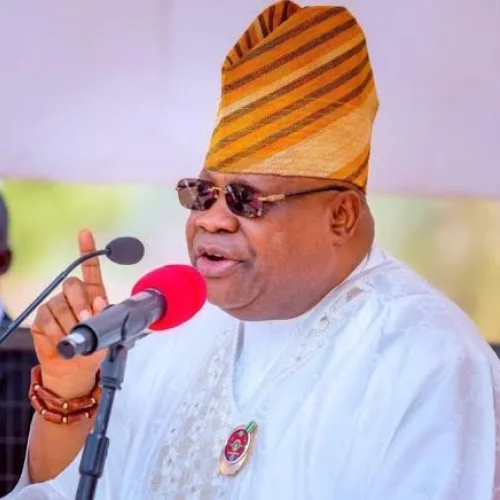
The outcome of the 2026 Osun State governorship election is already attracting attention beyond the state, with political strategists examining what Governor Ademola Adeleke’s victory could mean for Nigeria’s political realignment ahead of the 2027 general elections.
The Independent National Electoral Commission (INEC) declared Adeleke, the Accord Party candidate, winner of the August 15 election after he secured 511,067 votes, defeating the All Progressives Congress (APC) candidate, Bola Oyebamiji, who polled 444,815 votes. Adeleke won by a margin of 66,252 votes.
The result gives Adeleke another four-year term but also provides political parties with an important case study on the power of incumbency, grassroots organisation, political alliances and candidate popularity in Nigerian elections.
One of the major features of the Osun contest was Adeleke’s use of the Accord platform amid the political realignments surrounding the election.
The outcome suggests that established political networks can retain significant electoral strength even when operating under a different party platform, provided the candidate has a strong grassroots structure and can maintain voter loyalty.
For opposition politicians preparing for 2027, the result could strengthen arguments for broader political coalitions and alternative platforms rather than relying exclusively on the country’s traditional major parties.
The Osun experience may therefore encourage politicians to place greater emphasis on candidate appeal and coalition-building, particularly in states where established party structures are divided.
For the ruling APC, Adeleke’s victory represents both a setback in Osun and a warning about the importance of local political organisation.
Oyebamiji’s 444,815 votes nevertheless demonstrate that the APC retains a substantial electoral base in the state. The relatively narrow gap between the two leading candidates means the party remains competitive and could use the result to reassess its strategy ahead of future elections.
The APC will also have to consider the extent to which national economic conditions influenced voter behaviour.
Issues such as the cost of living, household income, food prices and employment can become important factors in state elections, even when the contest is primarily about local governance.
For the ruling party, the challenge going into 2027 will be to translate its national policy agenda into a message that resonates with voters at the state and community levels.
Adeleke’s re-election also highlights the continuing importance of incumbency in Nigerian state politics.
His campaign placed considerable emphasis on issues that directly affect residents, including infrastructure, workers’ welfare and community-level development.
The election suggests that voters may respond strongly to candidates who can point to visible projects and maintain direct connections with local communities.
In state elections, national political narratives can matter, but they do not necessarily override voters’ assessment of a governor’s performance, personality and relationship with constituents.
Adeleke’s ability to secure a second term therefore reinforces the argument that strong grassroots mobilisation and a recognisable local political brand can provide an incumbent with a significant advantage.
The election also underlined the difficulty smaller political parties face when competing against well-funded and deeply established political structures.
With the contest dominated by Adeleke and Oyebamiji, smaller parties struggled to attract a comparable share of the electorate.
The experience could encourage minor-party candidates to pursue strategic alliances earlier in the electoral cycle rather than waiting until the final stages of a campaign.
Political realignment could become an increasingly important feature of Nigerian elections as parties and candidates seek ways to consolidate support and avoid splitting their potential voter base.
Although a state governorship election cannot be treated as a direct prediction of a presidential election, Osun provides political parties with several lessons ahead of 2027.
The first is that grassroots organisation remains crucial. Campaigns need strong structures extending beyond social media and major rallies into wards, polling units and local communities.
The second is that coalition-building can reshape electoral contests. Political alliances can bring together different voter blocs and campaign structures, particularly when parties are divided.
The third is that candidate popularity remains important. Voters can distinguish between national party politics and their assessment of individual candidates.
The fourth is that economic conditions will remain a major electoral issue. As Nigerians continue to deal with the consequences of inflation, fuel prices and changing household incomes, political parties are likely to face increasing pressure to explain how their policies will improve everyday living conditions.
The Osun election also offers an opportunity to assess the performance of electoral technology, including the Bimodal Voter Accreditation System and INEC’s Result Viewing Portal.
During the collation process, thousands of polling-unit results were uploaded to the IReV platform, providing voters and observers with an additional mechanism for monitoring the process.
The performance of these systems, as well as issues surrounding accreditation, result transmission and transparency, will likely remain part of discussions among political parties and electoral stakeholders as Nigeria moves closer to 2027.
Adeleke’s victory does not automatically determine what will happen in the 2027 general elections, but it provides political parties with a clear snapshot of how electoral competition is evolving.
For the Accord camp, the result strengthens its political standing and gives Adeleke another four years in office.
For the APC, the election presents an opportunity to examine its weaknesses and consolidate its substantial support base.
For smaller parties and emerging political coalitions, Osun demonstrates both the challenge of competing independently and the potential value of strategic alliances.
Ultimately, the biggest lesson from Osun 2026 may be that Nigeria’s 2027 elections will not be determined by national political momentum alone.
Candidate credibility, grassroots structures, coalition-building, local governance records and the ability to address voters’ economic concerns could prove just as important when Nigerians return to the polls in 2027.
Comments
Start the conversation about this story.