





…..Inadequate coordination causes menace – Truck driver
By Providence Ayanfeoluwa
Activities along the Mile 2-Kirikiri axis were brought to a standstill yesterday as a heavy traffic gridlock caused by truck movement from the Kirikiri area stretched towards Mile 2, disrupting the movement of motorists, residents and businesses in the area.
This is despite the Nigerian Ports Authority (NPA) introduction of a movement code to guide the movement of empty containers into seaport terminals and reduce traffic congestion caused by container trucks along the Apapa and Tin Can Island port corridors
Vanguard’s visit to the area revealed that traffic was particularly difficult from Kirikiri Junction towards Mile 2, while the road from Kirikiri Junction through Coconut was relatively free-flowing.
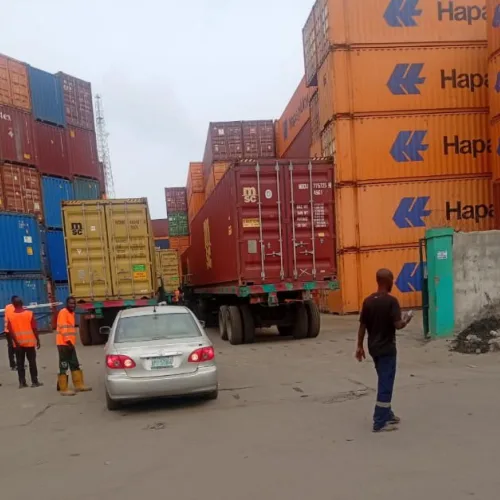
Findings from the visit indicated that the gridlock was largely linked to the movement of container-laden trucks and trucks waiting to access terminals within Kirikiri for the evacuation or return of empty containers.
During visits to different terminals, which included HEZEGOVIN Logistics Limited, AGL Africa Global Logistics, and Bestaf Container Terminal, Vanguard discovered that several trucks were either lined up along access roads or waiting to gain entry into the terminals.
The situation created pressure on the adjoining roads, with trucks occupying significant portions of the available carriageway and slowing down traffic towards Mile 2.
A task force official monitoring the situation told Vanguard that the congestion was being exacerbated by activities around some of the terminals. He alleged that the gate of AGL Africa Global Logistics was locked at the time, leaving several container trucks lined up while waiting to be admitted. However, security personnel at the terminal dismissed the allegation, insisting that the facility’s gates were open for both entry and exit.
At HEZEGOVIN Logistics Limited, trucks were also seen lined up near the entrance, waiting to be called into the terminal. The management, however, maintained that operations within its facility were running smoothly and that it was not responsible for the traffic build-up outside its premises. The terminal’s position further fuelled the blame game over who was responsible for the worsening congestion along the axis.
The situation was noticeably different at Bestaf Container Terminal, where traffic flow around the facility was relatively smooth. Trucks were being admitted according to their unit numbers, a system that appeared to help regulate vehicle movement into the terminal. The trucks accessed the facility through Shokunbi Street, inward Otun Waterside, while they exited through Ikudehindu Street, formerly G.Cappa.
Residents and traders along Otun Street, however, said they had been bearing the brunt of the recurring traffic situation. A trader who spoke with Vanguard said, “We are driven to different locations at regular intervals. Sometimes the gridlock affects our businesses. When trucks take over the roads, customers find it difficult to come here, and we lose business.”
A truck driver, Ifeanyin Akachukwu, who was among those waiting in the queue, also expressed frustration over the situation, blaming the police, traffic management personnel and some terminal operators for failing to adequately coordinate truck movements.
“The terminals and the authorities need to work together. When trucks are allowed to queue indiscriminately or are not attended to on time, the whole road becomes blocked. The traffic does not only affect us; it affects everybody,” he said.
He pointed out that the development has renewed concerns over the coordination of truck traffic and terminal operations in the Kirikiri axis, with stakeholders trading blame over the source of the congestion.
“While some operators insist that activities within their terminals remain smooth, motorists and residents are left to contend with the consequences as truck queues spill onto public roads. Until there is better coordination among terminal operators, truck drivers, security agencies and traffic management authorities, the recurring gridlock could continue to disrupt economic activities around Mile 2 and Kirikiri,”’, he said.
Comments
Start the conversation about this story.