






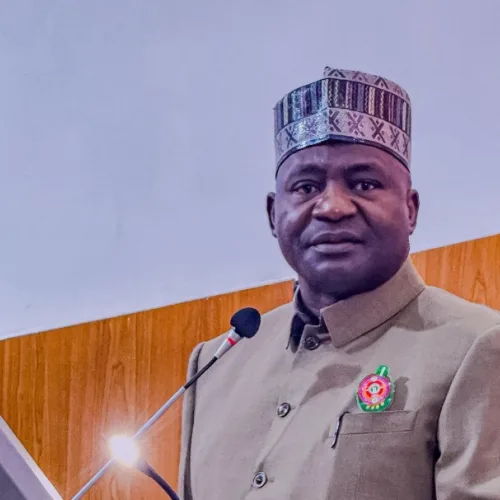
The minister of defence, General Christopher Gwabin Musa (retd.), has said cyber attacks are the greatest threats to election security, adding that the nature of security threats has evolved over time physical to cyberspace.
“The greatest threat to an election today may not necessarily be the individual carrying a weapon near a polling unit.
“It may well be the anonymous actor operating behind a computer screen, deliberately manipulating information, exploiting social divisions and attempting to weaken confidence in democratic institutions.
“This is why election security must now extend beyond physical protection to include cyber resilience, strategic communication and the defence of truth itself,” he said.
According to him, election security can no longer be viewed simply as the protection of polling stations, but fundamentally, the protection of democratic legitimacy.
The minister stated this Tuesday while delivering the keynote adress at the 8th edition of Blueprint Newspapers public lecture/ Impact and Awards, Theme: ” Security Challenges and Integrity of Nigeria’s 2027 Elections.”
Represented by Major General Olufemi Akinjobi, (Retd.), his Special Adviser on policy and research, Musa noted that digital revolution has transformed the information environment, adding that artificial intelligence has introduced extraordinary opportunities for development, innovation and governance, but it has also created new vulnerabilities.
“Today, sophisticated technologies can generate convincing but entirely fabricated videos, cloned voices and manipulated images capable of misleading millions of people within minutes.
“Across different parts of the world, we have already witnessed elections influenced by coordinated misinformation campaigns, cyber interference and malicious digital content designed to erode public confidence. Africa is not immune. Neither is Nigeria. ”
The minister however, lauded Nigeria’s resilience in protecting democratic institutions since the return of democracy in 1999, adding that remarkable progress has made in defending Nigeria’s democracy.
He said, “Confronting that evolving threat picture is not something we are starting from scratch. Nigeria’s democratic journey has been one of resilience, learning and continuous institutional improvement.
“Since the return to democratic rule in 1999, each electoral cycle has presented new challenges while also strengthening our collective capacity to respond to them.
“The 2023 General Elections demonstrated both the progress we have made and the areas where further improvement remains necessary.
“Security agencies undertook one of the largest coordinated election security operations in our democratic history, working alongside the Independent National Electoral Commission and other stakeholders to provide security across thousands of polling locations nationwide.”
While acknowledging that there were were isolated incidents in some areas in the 2023 elections, he said “millions of Nigerians exercised their democratic rights peacefully, reflecting both the resilience of our citizens and the dedication of those charged with protecting the process.”
Musa said election security is not achieved through last-minute deployments but achieved through months of planning, intelligence-led operations, inter-agency coordination, effective communication and continuous assessment of emerging threats.
“Security should never be viewed as an event. It is a process that begins long before campaigns commence and continues long after the final vote has been counted,” he said.
According to the minister, if the threats confronting elections have evolved, then our response must evolve with them.
He said preparing for the 2027 General Elections should not simply be viewed as an operational exercise for election day.
” It must become a national project aimed at strengthening democratic resilience the capacity of institutions to withstand pressure without compromising their constitutional responsibilities, the ability of citizens to reject misinformation without abandoning trust, and the confidence that, regardless of political affiliation, every Nigerian can participate in the democratic process safely and freely.
Comments
Start the conversation about this story.