





By Emmanuel Oloniruha
The Independent National Electoral Commission (INEC) has projected that Nigeria’s registered voting population will surpass 100 million when the just concluded nationwide Continuous Voter Registration (CVR) is finalised ahead of the 2027 general elections.
Mallam Mohammed Haruna, INEC’s National Commissioner, disclosed this on Tuesday in Abuja.
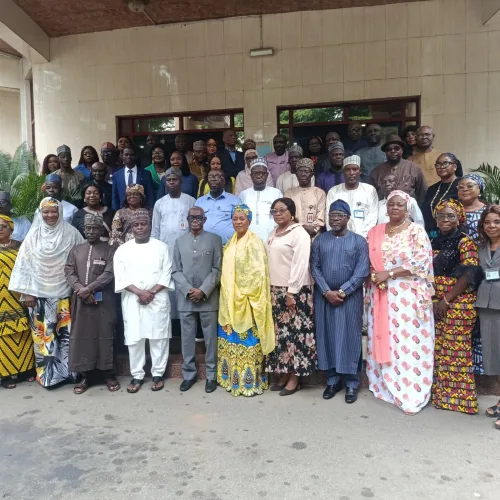
Haruna, also the Chairman, Information and Voter Education Committee (IVEC), spoke at INEC’s “Joint Implementation Meeting of the Departments of Voter Education and Publicity (VEP) and Gender and Inclusivity (G&I) for the 2027 General Elections”.
The meeting was to draft the communication and inclusivity roadmap for the 2027 General Election, to ensure the elections were free, fair, credible, peaceful, and inclusive.
He said that with the previous voter register standing at over 93 million, it was expected to cross 100 million when the nationwide Continuous Voter Registration (CVR) is finalised.
According to him, this will place Nigeria as the largest electoral democracy in Africa.
Haruna said that with 151 days to the first phase of the general elections, INEC information officers should deliver effective publicity to mobilise all eligible citizens.
“Our job is to give the widest and most effective publicity to all five sets of elections to mobilise all Nigerians of voting age to choose their leaders.
“This job is at once simple and complex,” he said.
Haruna said that managing communication for over 100 million voters required high professional standards, urging information officers to equip themselves with relevant skills and basic legal frameworks.
“First, we must have a grasp of the language we wish to communicate in and do so with the simplest words and in the most civil manner.
“Second, we must be knowledgeable about our country’s Constitution, the Electoral Law, and the Commission’s Guidelines.
“We must also be well-informed on other relevant legislation like the Freedom of Information and Data Protection Acts,” he said.
Haruna added that building on the success of recent off-cycle elections including Osun, demanded harder work to deliver the freest and most credible general elections in the country’s history.
In his remarks, Mr Adedayo Oketola, the Chief Press Secretary to INEC Chairman, reiterated the commission’s commitment under Prof. Joash Amupitan to credible and inclusive elections, as well as implementation of the outcome of the meeting.
Oketola described the joint meeting as timely and vital for drafting an actionable communication and inclusivity roadmap.
He said that while technological infrastructure and operational logistics form the backbone of electoral administration, the two departments constituted the human face and voice of INEC.
“You build public trust, simplify complex procedures, and ensure that no eligible citizen is left behind,” Oketola said.
He, however, warned that the communication landscape leading into 2027 presented threats such as misinformation and disinformation aimed to undermine voter confidence and fuel apathy.
“The antidote to disinformation is proactive, factual, and continuous public engagement.
“Our messaging must move beyond traditional announcement-style publicity into aggressive, daily civic education that demystifies our technology, such as the Bimodal Voter Accreditation System (BVAS) and INEC Results Viewing (IReV) and reinforces the integrity of the open secret ballot system,” Oketola said.
On gender and inclusivity, he reiterated that electoral access for Persons with Disabilities (PWDs), women, youths, and elderly voters remained a constitutional right.
“From the deployment of Braille ballot guides and magnifying glasses to prioritising vulnerable queues and expanding youth participation through CVR, 2027 must set a new benchmark for electoral access in Nigeria,” Oketola said.
The Director of VEP, Victoria Eta-Messi, said that INEC’s grassroots reach with regard to voter sensitisation and enlightenment depended largely on the capacity and efficiency of the heads of departments.
Eta-Messi also said that it depended on VEP who were expected to be drivers of the programmes in their respective states.
She said that the implementation meeting provided clarity and direction for uniformity in task execution.
“The off-cycle governorship elections are out of the way, and what lies ahead is the 2027 general election, and going by the line of activities of both departments, this meeting takes precedence and sets the tone for what lies ahead.
“This meeting will, therefore, provide a platform for both departments to walk participants through the commission’s approved activities, highlight the strategies for implementation, and ensure that the timelines and expectations are clearly understood.
Present at the meeting were heads of departments of VEP and G&I across the 36 states and the FCT. (NAN)
Comments
Start the conversation about this story.