





..Ghana now ranks second globally, while Nigeria slips to third as South Korean equities rebound sharply
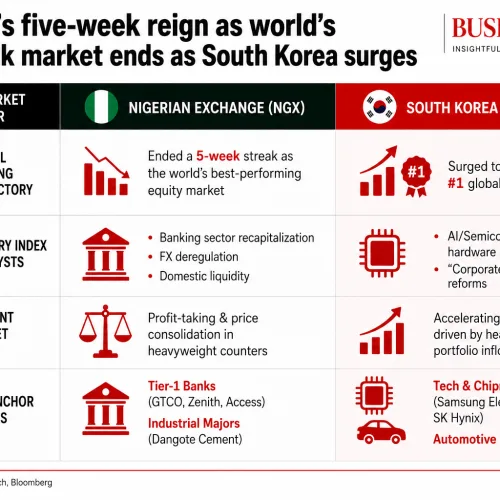
Nigeria has lost its position as the world’s best-performing stock market, five weeks after taking the global crown from South Korea, as a sharp rebound in Korean equities pushed the Kospi back to the top of the Bloomberg ranking.
Data covering 92 global stock exchanges tracked by Bloomberg showed that, as of August 14, South Korea’s Kospi had gained 68.52 percent year to date in dollar terms, ahead of Ghana’s Composite Index at 66.68 percent and the Nigerian Exchange All-Share Index at 65.23 percent.
Africa’s most populous nation took the top spot on July 10, when its dollar-denominated returns briefly overtook South Korea’s, extending a rally that has made the market one of the world’s strongest performers this year.
The reversal highlights how quickly global market leadership can change, particularly as South Korean equities rebound from a sharp July selloff.
Read also: Here are 10 oldest listed Nigerian companies on NGX
South Korea’s sharp rebound
South Korea’s stock market is back in a technical bull market, just two weeks after a brutal downturn.
On Thursday, the East Asian country’s benchmark Kospi closed four percent higher, leaving it about 23 percent above its July 30 low and meeting the widely used definition of a technical bull market, according to Yahoo Finance.
The turnaround has been swift. The Kospi plunged about 40 percent from its June 22 peak to its July 30 trough, as losses in index heavyweights Samsung Electronics and SK Hynix amplified the selloff.
That same Thursday, Samsung Electronics and SK Hynix closed more than five percent and seven percent higher respectively, as renewed optimism over Artificial-Intelligence-driven demand for memory chips lifted semiconductor stocks.
The rebound has been driven by a recovery in global AI-related trading, although investors remain conscious of the sharp gains accumulated by South Korean chipmakers and questions over whether the semiconductor sector has reached a peak.
Fundstrat Global Advisors said in an article last week that the recovery in Samsung Electronics and SK Hynix could give the broader South Korean market further momentum.
Mark Newton, head of technical strategy at Fundstrat, noted that the iShares MSCI South Korea ETF had broken through key technical levels as share prices of the country’s memory-chip giants recovered, improving the near-term outlook for South Korean equities.
Analysts at Macquarie Capital, meanwhile, said the steep July losses appeared to have been driven more by investor positioning and fund flows than by a deterioration in market fundamentals.
Foreign and institutional selling has stabilised since late July, while margin financing remains at reasonable levels, according to the bank’s analysts.
“The volatility is over,” Macquarie’s analysts wrote in a recent note.
Being in a technical bull market, however, does not guarantee that the Kospi’s rally will continue.
Macquarie expects the two chipmakers to lead the near-term rebound, supported by strong AI-driven demand for memory chips.
“We are facing the worst memory crunch in history and see no signs of supply constraints easing within the next three years,” the firm said.
It added that AI inference-driven demand is “off the charts,” requiring large amounts of memory even as supply remains constrained and slow to respond.
Nigeria’s rally has a different foundation
Nigeria’s rise to the top of the global ranking has had a very different foundation from South Korea’s technology-led rally.
The NGX market’s performance has been supported by a combination of foreign-exchange reforms, relative naira stability, stronger corporate earnings, banking recapitalisation, higher dividends and strong domestic investor participation.
The naira’s relative stability has also helped Nigerian equities perform strongly in dollar terms. For international investors, this matters because gains in local share prices can be eroded by currency depreciation.
The latest currency performance marks a broader turnaround for the naira, following two years of sharp depreciation after major foreign-exchange reforms in 2023 and 2024.
Read also: 25 Nigerian companies join NGX trillionaire club
The currency stabilised in the second half of 2025 and appreciated against the dollar, eventually exiting Africa’s 10 worst-performing currencies in October.
The improvement reflected stronger foreign-exchange liquidity, higher external reserves and policy measures aimed at improving the functioning of the FX market.
The naira entered this year on a firmer footing and has continued to trade at stronger levels than during much of the previous two years.
As of August 14, the average official exchange rate stood at N1,357.7/$, its strongest level in two months.
Data from African Markets, a real-time market-tracking platform shows that, the naira was the second-best-performing currency among 17 African currencies against the dollar year to date as of August 16, with a gain of nearly six percent.
The relative strength of the currency has provided some relief to importers and borrowers with dollar exposure while also reducing the naira value of foreign-currency liabilities.
For equity investors, however, the bigger significance is that a more stable currency reduces the risk that gains in Nigerian stocks will be wiped out when translated back into dollars.
That has helped make the country’s equity rally more compelling to global investors, even as foreign participation remains relatively limited.
Nigeria’s market comes under pressure
Despite its strong year-to-date performance, Nigeria’s market has recently pulled back.
From August 10 to August 14, the NGX All-Share Index dropped by 2.78 percent to 242,619.2 points, while market capitalisation fell to N156.6 trillion from N160.4 trillion.
In a report on Monday, analysts at CSL Research noted that the market advanced in only one of the five trading sessions, resulting in a moderation of the year-to- date return to 55.9 percent in local , from 57.8 percent in the preceding week.
The decline, however, remains modest compared with the market’s gains over the past several years.
According to the Exchange, market capitalisation climbed to a record N158.1 trillion as of August 5, 2026, representing growth of about 450 percent from the first half of 2023.
The NGX All-Share Index also rose from 52,974 points in the first half of 2023 to a record 244,912.24 points, an increase of 339 percent.
The figures underline the scale of the country’s market re-rating, even after the recent pullback.
Looking ahead, CSL expects a maintain a cautiously positive outlook on the domestic bourse as the recent pullback appears to reflect profit-taking following the strong rally in preceding weeks rather than a broad-based deterioration in market fundamentals.
“We expect investor sentiment this week to remain supported by the ongoing release of corporate earnings and continued corporate actions, although elevated valuations and recent profit-taking, alongside the recent availability of OMO bill securities to retail investors, could sustain near-term volatility as investors are likely to rotate capital into OMO securities,” they added.
Reforms and earnings underpin the rally
Temi Popoola, group managing director and CEO of Nigerian Exchange Group, recently ranked Nigeria’s stock market as the second-best performer among selected global markets in the first half of 2026, with a return of 57 percent.
South Korea’s Kospi led with 101 percent, while Japan’s Nikkei 225 returned 39 percent.
Kenya’s NSE, the MSCI Emerging Markets Index and the FTSE 100 recorded returns of 27 percent, 24 percent and six percent respectively.
Read also: FTSE Russell stops Nigeria’s Frontier Market upgrade on T+1 shift
Popoola attributed Nigeria’s rally to the Investments and Securities Act 2025, foreign-exchange reforms, banking recapitalisation, stronger corporate earnings and higher dividends.
He said the performance represented more than rising share prices, describing it as a broad “re-rating of Nigeria” driven by returning investor confidence, deeper capital formation and improved corporate fundamentals.
Popoola cited substantial increases in the profits of major listed companies, including MTN Nigeria, Dangote Cement, Aradel Holdings, Seplat Energy and BUA Cement.
According to him, the combined profit before tax of the selected companies rose by about 6.2 times from their 2023 levels.
That earnings growth is important because it gives the rally a fundamental underpinning beyond market sentiment.
Domestic investors are driving the gains
One of the more striking features of Nigeria’s performance is the source of the buying.
Ray Ndlovu, Bloomberg’s emerging markets reporter, said on the Next Africa podcast last month that domestic investors accounted for about 89 percent of participation and transactions on the Nigerian market during the first half of the year, compared with 11 percent for foreign investors.
“It’s in fact local investors that are driving the gains that are being translated on the exchange there,” Ndlovu said.
That distinction matters.
Nigeria’s rise to the top of the global performance rankings has not been accompanied by a wholesale return of international portfolio capital.
Foreign investors remain interested, but many are waiting to see whether the country’s reforms are durable before deploying more capital.
Read also: FTSE upgrade sparks N1.36trn stock investors windfall in 72 hours
“That’s not to say that there are no foreign participation,” Ndlovu said. “Some are in quite a waiting position and looking to see if the reforms or the story of reforms in those markets are lasting.”
Domestic investors may be driving today’s gains, but foreign investors could determine whether the rally becomes a sustained repricing of Nigerian assets.
The foreign-exchange test
For Ndlovu, one of the key improvements supporting Nigeria’s market is greater stability in the currency.
“The reform story then comes or kicks in to play because there’s been relative stability in terms of the currency front,” he said.
The naira’s stronger performance against the dollar has helped reduce one of the biggest risks historically associated with Nigerian assets: the possibility that currency losses would erase equity gains for foreign investors.
Ndlovu added that the naira was up almost five percent against the dollar during the period under discussion, while higher commodity prices had helped boost Nigeria’s foreign-exchange reserves.
That provides an additional buffer for investors concerned about their ability to repatriate capital.
The broader reform story is therefore becoming central to the Nigerian market’s investment case.
Ndlovu noted that investors increasingly believe that some of the changes, particularly the liberalisation of the foreign-exchange market, have taken root.
“There’s no way that Nigeria would want to go back to having multiple exchange rates because they know the pain of being in that sort of space,” he said.
Africa’s broader market rally
Nigeria’s loss of the global crown should not obscure the broader strength of African equities.
Ghana now ranks second globally behind South Korea, according to the Bloomberg ranking, while Nigeria sits third.
Other African markets, including Kenya, Tunisia and Tanzania, have also recorded strong gains this year.
The continent’s performance is becoming increasingly difficult for international investors to ignore.
Last year, African markets were already breaking into the global performance rankings. Bloomberg reported in October that Ghana was the world’s best-performing market in dollar terms, with Zambia second, Nigeria 14th, Kenya 15th and South Africa 21st.
The current performance signals the African equity story may be broader than a one-off rally.
But whether it becomes a sustained investment cycle will depend on what happens next.
Analysts say Nigeria would need to maintain currency stability, continue economic and market reforms, deliver earnings growth and deepen liquidity.
Read also: Nigeria’s Securities Dealers knock FTSE halt of frontier market upgrade on T+1 shift
Foreign investors, meanwhile, will be watching to see whether the improvements are durable enough to justify committing more capital.
South Korea faces a different test. Its comeback is closely tied to the semiconductor and AI cycle, leaving the Kospi exposed to shifts in technology valuations, chip demand and global investor positioning.
The two markets have therefore reached the top of the global rankings through very different routes.
Nigeria’s rally is being driven by reform, domestic liquidity, currency stability and improving corporate fundamentals.
South Korea’s rebound is being powered by renewed enthusiasm for AI and memory chips.
For Nigeria, losing the global crown after five weeks is therefore not necessarily a reversal of the investment story.
It may instead be a reminder that the real test is no longer whether Nigerian equities can deliver spectacular returns.
It is whether the reforms, currency stability, domestic liquidity and corporate earnings supporting those returns can turn a market rally into a durable re-rating of Nigerian and, more broadly, African assets.


Bunmi holds a degree in Economics from the University of Lagos and has over eight years of experience in content writing and journalism. Her career spans roles as a financial and business journalist at BusinessDay Media and TechCabal, and as Head of Research at SBM Intelligence, an Africa-focused market intelligence and strategic consulting firm. She also served as Editor at Finance in Africa, a subsidiary of Businessfront and is currently Assistant Editor, Finance (Africa), at BusinessDay.
Comments
Start the conversation about this story.