





High taxes, airport levies, and regulatory fees are driving intra-African airfares above long-haul rates to Europe, choking regional tourism and trade despite easing visa barriers.
Findings by BusinessDay show that short-haul flights between African hubs frequently cost more than long-haul journeys to major European cities. Tightened visa conditions from the US and European nations have forced many Nigerian travelers to pivot toward regional destinations like Kenya, Rwanda, Egypt, Morocco, Mauritius, and Seychelles. However, exorbitant ticket prices threaten to derail this shift.
Taxes, levies, and charges make up between 35 and over 70 percent of an airline ticket cost in Nigeria and most African countries, depending on the route and how comprehensive the calculation of operational fees is. Industry reports point to over 54 distinct taxes and charges, with individual tickets carrying up to 18 separate line-item or embedded regulatory levies.
Roughly one-third (33 percent) of an African plane ticket goes strictly to government taxes, levies, and airport charges instead of the airline. African international and regional departures average about $68 in direct taxes per passenger, roughly double the global average.
Nations like Nigeria, Gabon, and Sierra Leone feature much higher averages, with passengers paying between $180 and $297 just in taxes and regulatory fees per ticket.
Common taxes and charges in Nigeria include Value Added Tax (VAT) at 7.5 percent on applicable airfares; NCAA Ticket Sales Charge is a mandatory five percent deduction of the ticket value, Passenger Service Charge (PSC) is collected by airport authorities per passenger. Security and other levies include specific security charges and regional fees like APIS
In addition to offering seamless entry protocols, many of these destinations allow payment processing mechanisms that reduce reliance on scarce foreign exchange currencies for Nigerian tourists.
However, summer travellers lament that exorbitant ticket pricing has created a financial bottleneck, effectively replacing diplomatic visa barriers with high fares.
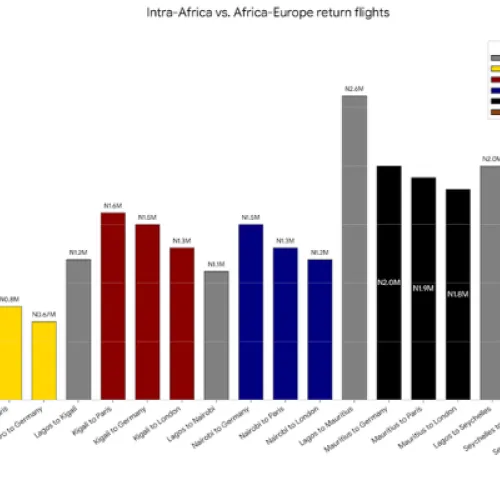
Data gathered on key summer routes highlights a pricing difference when comparing short African routes to long-haul intercontinental journeys.
The fare discrepancy is most pronounced along North African routes. A return flight from Lagos to Cairo costs an average of N1.7 million for a 5-hour, 15-minute journey. Meanwhile, flying from Cairo to major European hubs for almost the identical flight duration costs a fraction of that price: Cairo to Germany averages N670,000 (5 hours), Cairo to Paris averages N800,000 (5 hours), and Cairo to London sits at N1.1 million (5 hours, 35 minutes).
A return ticket from Lagos to Kigali costs an average of N1.2million for a direct 5-hour, 20-minute flight. Conversely, traveling from Kigali to European capitals offers significantly more flight hours per naira spent. A Kigali-to-London ticket averages N1.3 million (9 to 15 hours depending on layovers), Kigali-to-Germany costs N1.5 million (11 to 15 hours), and Kigali-to-Paris averages N1.6 million (9 hours, 20 minutes).
Read also: Ibom Air’s third Airbus A220-300 aircraft inspected in Canada
A return flight from Lagos to Nairobi costs N1.1 million for a 5-hour, 20-minute flight. By comparison, flying from Nairobi to London costs just a little higher with the rate of N1.2 million for a 9-hour, 30-minute trip. Flights from Nairobi to Paris average N1.3 million, while routes to Germany cost around N1.5 million.
Flying from Lagos to Mauritius averages N2.6 million, involving up to 13 travel hours due to layovers. In contrast, long-haul flights connecting Mauritius to Europe command lower rates despite comparable durations: Mauritius to London averages N1.8 million (12 hours, 30 minutes), Mauritius to Paris averages N1.9 million (12 hours), and Mauritius to Germany sits at N2 million (12 hours).
A return flight from Lagos to Seychelles averages N2 million with a travel time of approximately 11 hours, 10 minutes. Traveling from Seychelles to Europe is cheaper across the board: N1.5 million to Paris (10 hours, 30 minutes), N1.7 million to Germany (10 hours, 25 minutes), and N1.7 million to London (13 hours, 30 minutes).
Industry analysts attribute these structural disparities to limited fifth-freedom flight rights, high regional aviation taxes and airport charges, fragmented air traffic agreements, and insufficient competition among carriers operating intra-African routes. Until regional aviation policies address these cost drivers, the promise of a seamless, visa-free Africa will remain constrained by high airfares.
Olumide Ohunayo, industry analyst and director of research at Zenith Travels told BusinessDay that obnoxious taxes and charges on the African airspace is legendary and the International Air Transport Association (IATA) has continued to speak on the need for African countries to look at airports, airspace and the aviation industry charges; which is discouraging travel and increasing fares.
“The Economic Community of West African States (ECOWAS) gave a January 2026 deadline for members to bring down 25 percent of the charges and fares, which our own country has also not implemented. Only one of the member states has implemented but our own country is yet to implement. If we are able to work on the charges and lift the barriers, it would help boost travel,” Ohunayo said.
According to Ohunayo, what brings down travel cost is not the number of airlines but the ease and facilitation to travel, access to different countries and reduced taxes and charges.
Samuel Caulcrick, former Rector of the Nigerian College of Aviation Technology (NCAT), explained that domestic fiscal policy, government taxation, and foreign exchange friction account for the structural disparity.
“Fuel is not the problem. Distance is not the problem. The naira environment and the tax regime are the problem,” Caulcrick stated.
A comparative breakdown of the Lagos–Nairobi route ($680 for 3,680 km) versus the Nairobi–London route ($750 for 6,845 km) demonstrates how structural cost loads distort ticket pricing.
According to Caulcrick, passengers departing Nigeria face government taxes, security surcharges, and passenger service charges totaling roughly $180 per ticket—more than triple Kenya’s departure tax of $55. The moment a traveller steps out of a Nigerian airport, they absorb a tax load nearly $125 higher than their East African counterparts on a five-hour flight.
With airlines operating in Nigeria sourcing foreign exchange at volatile rates, ticket pricing reflects an embedded risk premium.
Caulcrick estimates that every international ticket out of Nigeria carries a currency hedge of approximately $100 to protect foreign carriers against exchange rate swings and delayed repatriation of funds.
Jomo Kenyatta International Airport (NBO) in Nairobi operates as a major regional hub hosting over 60 international carriers competing aggressively on price. Conversely, the Lagos–Nairobi corridor is serviced by only two to three main carriers, allowing airlines to extract higher yields from a captive market of business elites and travellers.
When calculated on a per-kilometer basis, a Nigerian traveller pays $0.18 per km to fly to Nairobi, compared to a Kenyan traveller paying $0.11 per km to fly to London. In effect, Nigerians pay 60 percent more per kilometer to travel within their own continent than travellers flying from East Africa to Europe.
Seyi Adewale, the chief executive officer of Mainstream Cargo Limited said airport taxes, passenger fees, levies, and other aviation or navigation charges in total are very high and IATA has already confirmed and established this fact.
Adewale stated that similarly, IATA also confirmed the fact that Africa as a continent has one the highest airport, navigation, and aviation charges in the world.
He also said insurance cover associated with the aircraft leases are far more higher than that of European airliners and often not dry leases but wet leases.
“Fair pricing and regulatory oversight, actual demands on both sides, and opportunities for other commercial revenue generating activities such as cargo, size of cargo bellies, aircraft type, adverts etc,” he added.


Ifeoma Okeke-Korieocha is the Aviation Correspondent at BusinessDay Media Limited, publishers of BusinessDay Newspapers. She is also the Deputy Editor, BusinessDay Weekender Magazine, the Saturday Weekend edition of BusinessDay. She holds a BSC in Mass Communication from the prestigious University of Nigeria, Nsukka and a Masters degree in Marketing at the University of Lagos. As the lead writer on the aviation desk, Ifeoma is responsible and in charge of the three weekly aviation and travel pages in BusinessDay and BDSunday. She also overseas and edits all pages of BusinessDay Saturday Weekender. She has written various investigative, features and news stories in aviation and business related issues and has been severally nominated for award in the category of Aviation Writer of the Year by the Nigeria Media Nite-Out awards; one of the Nigeria’s most prestigious media awards ceremonies. Ifeoma is a one-time winner of the prestigious Nigeria Media Merit Award under the 'Aviation Writer of the Year' Category. She is the 2025 Eloy Award winner under the Print Media Journalist category. She has undergone several journalism trainings by various prestigious organisations. Ifeoma is also a fellow of the Female Reporters Leadership Fellowship of the Wole Soyinka Centre for Investigative Journalism.
Comments
Start the conversation about this story.