





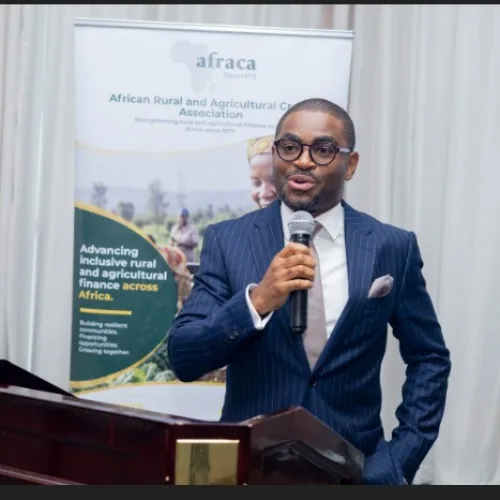
The African Rural and Agricultural Credit Association (AFRACA), in collaboration with NIRSAL Plc and other partners, has convened finance-sector professionals from across Africa in Lagos for the AFRACA Masterclass on Inclusive Finance for Climate Resilience and Artificial Intelligence (AI) for Financial Services and Agricultural Finance.
The week-long programme brings together participants from Uganda, Ghana, Tanzania, the Democratic Republic of Congo, Kenya, Nigeria and other African countries, with four Central Banks represented.
Nigerian participants include commercial banks, insurance companies, development finance institutions, microfinance banks, and the Central Bank of Nigeria.
Opening the programme, Secretary-General,
Ngo Bakang Anny Caroll, expressed delight at the return of AFRACA’s capacity-development programme to Nigeria for the first time since 2017.
Against the backdrop of climate change and stressed food systems, she drew attention to the responsibility of Africa’s financial institutions as custodians and allocators of capital, emphasising the role they must play in strengthening the continent’s capacity to sustainably feed itself and improve its global competitiveness.
NIRSAL Plc was represented by a delegation led by its Executive Director, Operations, Ewaen Imohe, who delivered a welcome address on behalf of the Managing Director/CEO, Sa’ad Hamidu.
Hamidu situated the programme within a broader challenge confronting agricultural finance in Africa: the relationship between knowledge, risk, and financial institutions’ disposition towards the sector.
According to him, increasing finance to African agriculture requires continually improving the knowledge, systems, and capabilities that determine how finance is sourced, structured, deployed and managed.
“At NIRSAL, we have always maintained that agriculture, especially in sub-Saharan Africa, is not underfinanced because opportunities do not exist, but because the risks have not been sufficiently understood, measured, appropriately priced, and managed,” Hamidu said.
He explained that NIRSAL’s response has been to co-develop systems and financing frameworks that bring greater structure to agricultural value chains, better define and mitigate their risks, and improve financiers’ understanding of the sector and confidence to lend.
The results, he said, are evident in the growing participation of financial institutions in agricultural lending. In 2025, NIRSAL approved Credit Risk Guarantees for loans in excess of N100 billion and has already surpassed that figure in 2026 year-to-date, representing commercial capital flowing to farmers, processors, aggregators, exporters and other businesses across multiple agricultural value chains.
Of particular interest is the growing participation of non-interest financial institutions, which accounted for well over 50 percent of the loans guaranteed by NIRSAL in the first half of 2026.
Hamidu said the trend demonstrates what becomes possible when appropriate risk-sharing frameworks create sufficient confidence for different forms of capital to participate in agriculture.
The NIRSAL Managing Director described the Masterclass as particularly timely, noting that climate change is no longer an abstract global concern but a practical reality confronting farmers, agribusinesses and their financiers every production season across Africa.
The programme’s first major theme, Inclusive Finance for Climate Resilience, exposed participants to the concepts, tools, and approaches required to understand climate risk and develop financeable adaptation and mitigation projects.
Discussions highlighted the need to deepen practical climate-finance expertise within the financial sector, particularly in climate-risk assessment, adaptation and mitigation, climate-rationale development, green-project structuring, and access to specialised climate-finance mechanisms.
Chris Myungu from the Alliance of Bioversity International & CIAT (CGIAR), partners on the programme, introduced participants to the Africa Adaptation Atlas and CGIAR climate-rationale outputs, demonstrating how climate data, research and evidence can support the identification and design of climate-resilient agricultural investments.
Overall, the sessions seek to translate climate finance from a broad development concept into practical knowledge that financial institutions can apply in identifying viable projects and mobilising capital towards them.
For the second major theme of the Masterclass, Artificial Intelligence for Financial Services and Agricultural Finance, Hamidu expressed the expectation that participants would move beyond the excitement surrounding AI to examine how it can improve risk understanding, transaction assessment, and financial decision-making in agriculture.
He also pointed to opportunities for technology to complement climate finance, blended finance, grants, and other innovative mechanisms capable of expanding the financial and technical resources available to African agriculture.
On Deepening AFRACA-NIRSAL Collaboration
Mr. Hamidu described the Masterclass as another demonstration of the value of NIRSAL’s membership of and partnership with AFRACA.
“AFRACA, for us, is a platform for knowledge, continental exchange, and global insight. On our part, we remain a results-driven source of practical experience for AFRACA member countries.”
The relationship combines AFRACA’s continental network and knowledge-exchange platform with NIRSAL’s practical experience in designing and implementing agricultural risk-sharing, value-chain development, and finance-facilitation interventions.
The Masterclass continues in Lagos with further technical sessions before moving into practical engagements on Artificial Intelligence for Financial Services and Agricultural Finance.


Iheanyi Nwachukwu, is a creative content writer with almost two decades journalism experience writing on banking, finance, capital markets, and tax. The multiple awards winning journalist is Assistant Editor, BusinessDay. Iheanyi holds BSc Degree in Economics from Imo State University; Master of Science (MSc) Degree in Management from University of Lagos. Iheanyi has attended several work-related trainings including (i) Advanced Writing and Reporting Skills (Pan African University, Lagos); (ii) News Agency Journalism (Indian Institute of Mass Communication {IIMC}, New Delhi, India); and (iii) Capital Markets Development and Regulations (International Law Institute {ILI} of Georgetown University, Washington DC, USA). Other trainings Iheanyi attended include: Economic/Political Risk Analysis (By Thomson Reuters Foundation); International Financial Journalism (IFJ) (By PMA Media Training, UK); Effective Business Writing Skills (By Phillips Consulting); Reporting on Corporate Governance (By International Finance Corporation (IFC) & Thomson Reuters Foundation UK); etc. In addition, he has participated in high-level economy & markets events in Dubai, South Africa, Morocco, and other African countries like Zambia, Ghana and Gambia.
Comments
Start the conversation about this story.