





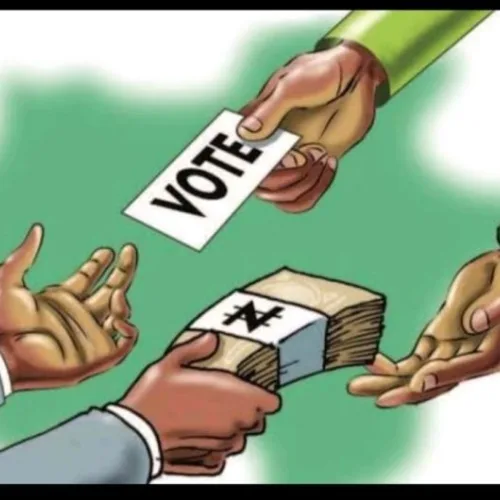
Nigeria’s 2026 off-cycle elections have revealed a troubling trend: vote-buying is not only persisting but becoming more expensive. As inflation bites and household incomes stagnate, the cost of political inducement is rising, reshaping the economics of electoral competition.
The Centre for Journalism Innovation and Development (CJID) warned during the Osun governorship election that “the frequency and geographic spread of these reports make possible voter inducement a significant concern in assessing the integrity of the voting process.”
The Inflation of the Political Marketplace
The Osun governorship election illustrates how quickly the numbers can grow. Reports alleged inducements ranging from N10,000 to N20,000 per voter, with some claims reaching N50,000. In Iwo, an APC chieftain reportedly said N700,000 had been allocated to each of 170 polling units for distribution at N15,000 per voter, amounting to N119 million in one local government area if fully spent.
While parties often describe such payments as transportation or feeding support, the consistency of reports across locations and the sums involved point to a deeper problem. Nigeria has no official price index for votes, but there appears to be a shift from smaller sums in earlier elections towards five-figure inducements in recent contests.
This creates an uncomfortable economic feedback loop: as food, transport, rent and school fees become more expensive, the value of cash offered by political actors also changes. Politicians may therefore have to spend more to generate the same political effect.
Entrenched practice in electoral system
Reports from Osun also suggested inducements ranging from N10,000 to N20,000 per voter, alongside food items such as rice and salt. Allegations included payments of N20,000 per voter in Ilesa and N15,000 in Osogbo, with one APC chieftain reportedly claiming N700,000 had been allocated to each of 170 polling units, amounting to N119 million in a single local government area if fully disbursed.
Public affairs analyst Ismail Abiola said such practices have become entrenched. “Vote-buying is here to stay in Nigeria’s electoral system unless something fundamental changes,” he noted. Politicians, he argued, now deploy gifts, emergency empowerment programmes and direct cash payments to sway voters. Poverty and economic hardship, he added, make citizens more vulnerable: “When people are struggling to meet basic needs, a cash payment on election day can become more attractive than the long-term value of their vote.”
Abiola urged civil society organisations to intensify voter education, warning that the sums offered are insignificant compared with the cost of four years of poor governance.
Enforcement gap
A political scientist, speaking anonymously, attributed the persistence of vote-buying to weak enforcement of electoral laws. “Vote-buying will continue to thrive for as long as politicians do not see serious consequences for engaging in it. It is illegal, but how many politicians have actually been prosecuted and jailed for buying votes?” he asked.
He argued that politicians increasingly view money spent on inducement as an investment rather than an offence. “When a politician spends millions or even billions of naira to secure votes and win an election, he sees the money as an investment that can be recovered once he gets into office. That mindset makes vote-buying attractive.”
Nigeria’s vote-buying trend has evolved dramatically over the past decade and a half, reflecting both economic realities and political adaptation. Based on past media reports, in 2011, inducements were modest, typically between N500 and N1,000 per voter, often disguised as gifts or food items. By 2015, the practice had become more structured, with payments rising to N1,000–N5,000 as competition intensified. 
The 2019 general election marked a turning point: cash inducements of N5,000–N10,000 became widespread, signalling that vote-buying had become a mainstream electoral strategy. In 2023, amid rising inflation and economic hardship, payments reached N5,000–N20,000 per voter, with politicians viewing such spending as a campaign investment rather than an offence.
The 2026 Osun election pushed the boundaries further, with reports of N10,000–N50,000 per voter, underscoring how inflation and poverty have inflated the “price” of political influence. This escalation highlights a dangerous feedback loop, economic distress fuels inducement, while weak enforcement sustains it, suggesting that Nigeria’s 2027 elections could be the most capital-intensive yet unless campaign finance transparency and electoral accountability improve.
Inflation of the political marketplace
Nigeria has no official price index for votes, but the sums reported in Osun suggest a shift from smaller inducements in earlier elections towards five-figure payments. Rising living costs have created an uncomfortable feedback loop: as food, transport and rent become more expensive, politicians must spend more to achieve the same electoral effect.
This dynamic risks creating an electoral arms race. If one candidate offers N10,000 and another N15,000, the second gains a tactical advantage. If the first responds with N20,000, the market moves again. Replicated across wards and polling units, the sums can quickly escalate into hundreds of millions.
Following the money
Civil society groups, SERAP and HURIWA have urged Nigeria’s institutions to move beyond condemning vote-buying and begin tracing the financial networks behind it. They argue that enforcement must focus on campaign financing, unusual cash withdrawals around elections, and transparent party accounts.
Without such investigations, the incentive remains intact. Political actors can calculate that the potential electoral benefit of spending millions outweighs the probability of arrest, prosecution and conviction.
The real cost
The secrecy of the ballot means vote-buying is an imperfect investment—some voters accept money from multiple parties and still vote according to preference. But the practice is far from harmless. Each election in which politicians distribute money without consequence reinforces the idea that political participation should yield immediate financial reward.
It also raises the cost of entering politics. Candidates with strong policy platforms but limited financial resources may struggle against wealthier opponents capable of financing large grassroots cash operations. That deepens the influence of money over political recruitment and risks turning democracy into a contest of financial capacity rather than ideas.
Early warning for 2027
Osun should be treated as an early warning rather than an isolated event. If the trend continues, Nigeria’s 2027 presidential and National Assembly elections could create an enormous financial marketplace.
The challenge is bigger than voter education. As Abiola and CJID emphasise, civil society must continue to warn voters of the dangers of inducement. But the state must also attack the supply side of the market through stronger campaign-finance monitoring and rapid investigation of credible allegations.
The anonymous political scientist put it bluntly: “Vote-buying will continue to thrive for as long as politicians do not see serious consequences.”


Obidike Okafor & Taofeek Oyedokun
Obidike Okafor is an award winning, seasoned journalist and content consultant. Obidike has left his mark on the global stage, writing for prestigious publications in Nigeria, the UK, South Africa, Kenya, Germany, and Senegal. He also has experience as an editor, research analyst and podcaster.
Comments
Start the conversation about this story.