





Amnesty International Nigeria has called on governors in the South-East, the Federal Ministry of Justice and security agencies to urgently investigate reported human rights violations and unlawful killings across the region.
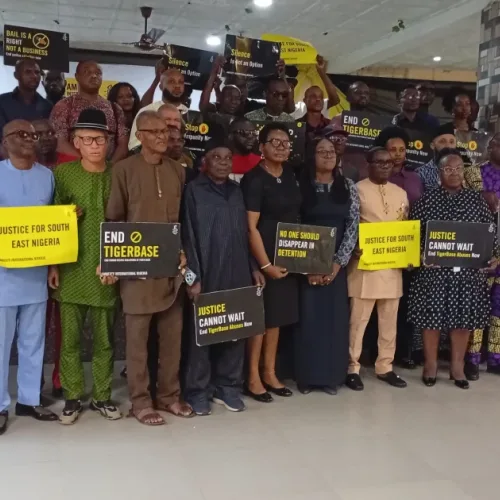
The organisation made the call on Thursday in Umuahia, Abia State, during a town hall on human rights violations and accountability in the South-East, where it presented two reports, including “A Decade of Impunity: Attacks and Unlawful Killings in South-East Nigeria” and “Tiger Base of Atrocities: Human Rights Violations by Nigeria Police Anti-Kidnapping Unit in Owerri.”
Speaking at the event, Benedicta Ofili of Amnesty International Nigeria said the organisation had gathered stakeholders to confront what she described as “a bitter reality” marked by loss of lives, systemic silence and a prolonged struggle for justice in the region.
“We gather here in Abia State to confront a bitter reality. Following previous launches in Lagos and Enugu, we bring this vital conversation directly to Abia,” she said.
According to Ofili, the first report documented at least 1,844 deaths between 2021 and mid-2023 across Abia, Anambra, Ebonyi, Enugu and Imo states.
She said the deaths occurred amid what Amnesty described as “a brutal crossfire involving non-state armed groups, state-backed outfits, and heavy-handed security operations.”
The organisation also documented alleged indiscriminate raids, enforced disappearances and unlawful killings, saying many of the incidents had not been followed by independent investigations or prosecutions.
“The cycle of impunity continues without thorough, independent investigations or prosecutions,” Ofili said.
She added that the insecurity had also caused displacement of farming communities, disrupted education and created what the organisation described as “ungoverned spaces,” with enforced sit-at-home orders further affecting residents.
Presenting the second report, Amnesty researcher Maurice Chukwu detailed alleged abuses at the Imo State Police Command’s Anti-Kidnapping Unit, popularly known as Tiger Base.
Chukwu alleged that the unit was linked to prolonged arbitrary detention, extortion, physical torture, deaths in custody and enforced disappearances, including cases where children were allegedly separated from detained mothers without official records.
“These actions directly violate the Nigerian Constitution, the Anti-Torture Act of 2017, and international human rights frameworks,” he said.
Chukwu called for investigations into all documented allegations, prosecution of suspects through fair trials and reparations for survivors and families of victims.
“This re-launch in Abia State is not merely a presentation of statistics; it is a call for accountability,” he said.
Meanwhile, the Abia State Attorney General and Commissioner for Justice, Ikechukwu Uwanna, said the state government had zero tolerance for human rights violations.
Uwanna, who was represented by the Director of the Citizens’ Rights Department, Chinonyere Patience Onyemenaonu, said although the Ministry of Justice could not direct the police on their operations, the government had mechanisms for addressing complaints of rights violations.
He said the Citizens’ Rights Department received complaints, interviewed victims and made recommendations to the Attorney General for appropriate action.
“When matters get to us, whether on human rights violations, what do we do? We engage the aggrieved victims. We call on them, we interview them, we hear them out, and then we make our recommendations to the Attorney General for appropriate action,” he said.
During the event, relatives of persons they alleged had been arrested or abducted by security operatives also narrated their experiences.
Miriam Onyema said her husband, Kingsley Chinedu, was arrested on April 25, 2021, at Hospital Junction, Imo State, and had not been released despite repeated efforts to locate him.
Esther Chinedu said her husband, Pastor Godspower Chinedu, was arrested in 2022 and that the family had not seen him since, despite visiting several police detention facilities.
Caroline Chukwuma also alleged that her husband, Chukwuma Nwokike, was abducted in 2021 at St. Paul Junction, Aba, and later transferred to Abuja after she and her lawyers were denied access to him.
Similarly, Chinwendu Chidiebere said her husband, Chidiebere Ekwe, was arrested at his workshop in Aba on June 22, 2021, and taken to CPS Aba, where the family was allegedly denied access to him.
An elderly man, Nicolas Ejekwu, tearfully recounted the alleged arrest of his two sons, Obinna and Onyebuchi, by soldiers at his home. He claimed he was later informed that they had been tortured and killed, with their bodies taken to the Federal Medical Centre, Umuahia.
Cecilia Nmaoche also said her son, Christian Ifeanyi, was abducted by security operatives in 2022 and had not been seen or heard from since.
The relatives appealed to Amnesty International and government authorities to help locate their loved ones and ensure that anyone accused of a crime was either released or brought before a competent court.
Amnesty urged lawyers, activists, community leaders, security officials and other stakeholders to support its campaign against unlawful killings and impunity in the South-East.
Comments
Start the conversation about this story.