





…Says it is archaic, will lead to job losses, archaic, cut down income of states
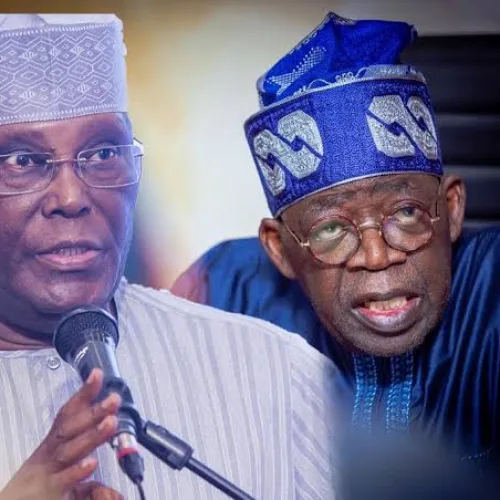
The Presidency on Thursday, described former Vice President Atiku Abubakar’s economic blue print, ahead of the 2027 general election as ” archaic”, adding that any plan to reintroduce fuel subsidy will lead to job losses and cripple the economy
Bayo Onanuga, Special Adviser to the President on Information and Strategy, in his response to the former Vice President’s economic plan, stated that such plan “would require a clear legal, fiscal and administrative framework, including identifying the source of the funds and determining how such a policy would be implemented under the present petroleum-market structure.
The presidency noted that Nigeria’s petroleum landscape has changed significantly since May 2023, adding ” for many years, the country relied heavily on imported petrol, with the government bearing the consequences of the gap between the regulated pump price and the cost of supplying the product”
Former Vice President of Nigeria and Presidential Candidate of the African Democratic Congress (ADC), Atiku Abubakar, had on Thursday, unveiled details of his proposed petroleum subsidy reform, declaring that “his administration would replace Nigeria’s old import-subsidy architecture with a targeted, capped, transparently budgeted and independently audited production subsidy designed to lower energy costs while accelerating domestic refining.
Atiku, in a statement issued by Phrank Shaibu, Senior Special Assistant on Public Communication, the Atiku Economic Recovery Plan (AERP) 2027, said it ” recognises that the choice before Nigeria is not simply between subsidy and no subsidy, but between an opaque intervention that breeds waste and a disciplined economic instrument that delivers measurable benefits to citizens.
“My proposal is not to resurrect the old subsidy regime. We will move subsidy from importation to production, from middlemen to Nigerian refineries, and from unverifiable claims to verifiable barrels.
“The principle is simple: the subsidy will follow the barrel.”
Atiku, in his plan, noted that “Under the AERP, qualifying public and private Nigerian refineries would receive domestic crude at a preferential price, subject to strict production, efficiency, transparency and domestic-supply conditions.
He acknowledged that supplying crude below its market-equivalent value represents a real opportunity cost to the Federation and said his plan would account for that cost openly rather than pretend it does not exist.
“The cost will be known. The ceiling will be known. The beneficiaries will be known. And, most importantly, the benefit delivered to Nigerians will be measurable.
“We will determine what Nigeria can afford before we subsidise. We will not subsidise first and discover the bill afterwards.”
Under the Nigeria subsidy regime, over N20 trillion was lost between 2006 and 2022, due to under recovery
Onanuga, while reacting to the former Vice President, said ” Against expectations that he would announce a more creative and ingenious alternative to the programme being executed by the Tinubu administration, Atiku Abubakar behaved like a man from an archaic past who least comprehends the present economic dynamics and suggested that he would restore the much-abused, wasteful, pillaged, corruption-ridden fuel subsidy regime, which the Petroleum Industry Act made illegal from the end of June, 2023″
He note the plans possess such questions including “much will the programme cost annually? What revenue source will finance it? Whether the government will borrow to fund it?
“Will the National Assembly be asked to amend existing PIA legislation and petroleum-sector rules? How will subsidy payments be verified and protected from abuse, as witnessed some years ago?”
Presidency described Abubakar as a man who is “desperate for power”, and “who needed to make a promise that he knew, if he were candid with our people, does not make fiscal sense, is retrogressive, and is against the genuine interest of the people.”
“However, Nigerians also deserve to understand what the proposed restoration of subsidy would actually mean, how it would be funded, and whether it is compatible with the legal and structural changes that have taken place in the petroleum sector.
“First, we must clear some ambiguities about the so-called subsidy. It is not some money sitting in the treasury to be disbursed to offer cheap fuel to Nigerians. It is the massive discount the NNPC offered the Nigerian government: selling fuel it bought at N100 at N50 at the pump, leading to under-recovery of costs and massive losses.
“Somewhere in the NNPC books are still trillions of Naira in subsidy costs that the Nigerian government has not paid. Contrary to Atiku’s claim in his interview, no N30 trillion subsidy windfall or savings exists anywhere except in his imagination.
“The petrol subsidy regime that Nigerians knew before May 2023 was dismantled as part of the country’s petroleum-sector reforms”
The Presidency explained that the Petroleum Industry Act has ” established a new framework for the downstream petroleum market. It removed the subsidy, as was previously done for diesel, kerosene and aviation fuel, ending a system that had placed a substantial and often unpredictable burden on public finances.
“The PIA scheduled the subsidy removal by the end of June 2023. President Tinubu only accelerated it by weeks to stop further bleeding before the due date.
“Restoring the old arrangement therefore cannot simply be presented as a matter of announcing that government will once again pay part of the cost of petrol” .
Presidency also explained that the emergence of substantial domestic refining capacity has fundamentally altered that equation, adding that” the Dangote Refinery has become a major source of locally refined petrol. Indeed, the Dangote Refinery would not have kickstarted production for local consumption were the subsidy regime operative. This is an important point that Atiku deceptively ignored.
” Atiku’s proposal portends a reversal of current local production, and it will spell bankruptcy for smaller local refineries like Aradel’s, causing attendant job losses and a loss of foreign exchange”
Explaining that the sector is now market-driven, Presidency noted that Nigeria now exports refined products to Europe, Asia, and the United States, restoring national pride. This development is a sharp contrast to when Obasanjo and Atiku were in power: Nigeria’s largest import, costing about $10 billion, was refined products!. President Tinubu has flipped that to Nigeria’s advantage.
“The N15 trillion that would have been borrowed and spent on selling discounted petrol has now significantly gone into the coffers of the three tiers of government. Now all states are fiscally stable and can pay salaries regularly and embark on infrastructure projects. In July, the three tiers shared about N3 trillion, a record, from the federation account. That is a major achievement, since the abolition of petrol price discount and distortions in the foreign exchange regime.
“Nigeria is increasingly moving from a model in which scarce foreign exchange is used to import refined petrol to one in which crude oil, largely sold in Naira, can be processed domestically and supplied to the Nigerian market. That transition creates opportunities for greater energy security, foreign-exchange conservation, industrial development and ultimately a boost to employment generation.
“The subsidy debate must therefore be grounded in the realities of today’s market rather than treated as though Nigeria’s petroleum sector has remained unchanged.
The former petrol price discount arrangement involved the public sector absorbing the difference between regulated prices and the actual cost of supplying petrol, with substantial fiscal consequences.
At various points, the government had financed or accommodated the burden through borrowing and other public-sector financing arrangements. Millions of barrels of crude oil had previously been pledged against loans used to finance the subsidy regime. At a stage, the NNPC in 2024 was at a breaking point, owing suppliers billions of dollars.
“In practical terms, therefore, Nigerians should ask a straightforward question: If the subsidy is restored, who pays for it? What will the new pump price be? N200 or N500? If petrol is sold below its economic cost, which is about N1,200 to N1,300, someone must absorb the difference.
“Ultimately, that cost falls on the public finances—through reduced funds for infrastructure and social services, reduced allocation to states and 774 local councils, increased borrowing, higher public debt, or some combination of these.
Presidency noted further that the cost of petrol places enormous pressure on Nigerian households and businesses, adding that “hardship created by higher energy and transportation costs is real, and government will continue to pursue policies that reduce the burden on citizens.
“The Tinubu administration, for instance, has been encouraging the use of Compressed Natural Gas, 70 per cent cheaper than petrol, to power taxis, cars and distribution trucks. Even Dangote and BUA have CNG trucks in their fleet. What remains is for commercial trucks, buses, and taxis to pass on the benefits of reduced energy costs to our people.
“We believe sustainable relief is different from recreating a fiscal arrangement that will again cripple our country.
“The better question is how Nigeria can use its emerging domestic refining capacity, improved petroleum-sector regulation, and increased competition to achieve more stable and affordable energy prices without returning to an opaque and fiscally burdensome subsidy regime.
“Political promises must be backed by fiscal arithmetic. Alhaji Atiku Abubakar is entitled to propose a different economic direction. Specific answers should accompany any promise to restore fuel subsidy.
Presidency advised that ” now that Nigeria has substantially increased domestic petrol production, what precisely would the proposed subsidy be subsidising—the cost of local production, transportation and distribution, or some other component of the petroleum value chain?
“Nigeria cannot afford to return to policies whose costs are hidden from citizens until they appear later as debt, reduced government spending on social services, and further pressure on the national currency.
“The country should welcome robust debate about the cost of living and the direction of economic policy. But that debate must be anchored in Nigeria’s reality today, not yesterday’s petroleum economy.
It therefore , urged all political actors, including “Alhaji Atiku Abubakar, to present Nigerians with the full fiscal and legal implications of any proposal to restore fuel subsidy.”


Comments
Start the conversation about this story.