





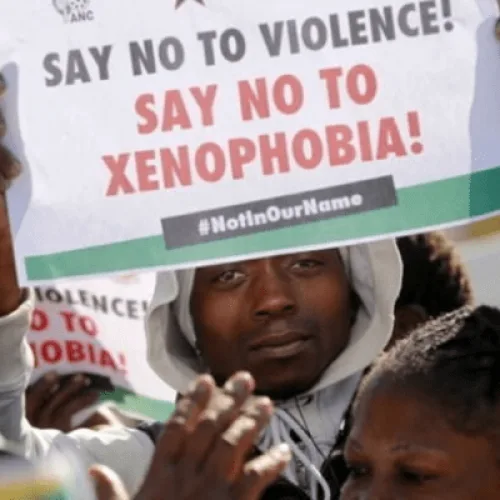
South Africa has rejected the description of the country as xenophobic, as Nigeria raised concerns over inflammatory rhetoric and recurring violence against African migrants, warning that the tensions could undermine relations between the two countries and the wider Pan-African project.
Read also: I was born here;, Beauty queen Chidinma Adetshina decries xenophobia in South Africa deportation row
The issue was discussed at a Nigerian Institute of International Affairs (NIIA) roundtable in Lagos on Tuesday titled “South Africa’s ‘Xenophobia’ in Comparative Perspective”, which brought together officials and scholars to examine the causes of anti-migrant violence in South Africa.
Olusola Enikanolaiye, Minister of State for Foreign Affairs, said Nigeria recognised South Africa’s right to manage migration but rejected attempts to blame migrants for the country’s economic and institutional problems.
“Nigerians did not create unemployment. Migrants did not design dysfunctional municipal systems. Migrants did not create corruption or institutional weaknesses,” Enikanolaiye said.
He cited South Africa’s 2022 Income and Expenditure Survey, which estimated the foreign-born population at about 3.1 million, or 5.1 percent of the population, arguing that public discourse sometimes creates the impression that the country is being overwhelmed by foreigners.
The minister also criticised statements by some South African leaders portraying migrants as “drug lords, criminals, parasites” and threats to national survival, saying such rhetoric could create an environment for violence and undermine Nelson Mandela’s legacy.
Read also: FG evacuates 83 more Nigerians from South Africa amid renewed anti-immigrant tensions
He called for faster processing of legal migration routes, stronger state control over law enforcement, responsible political language, evidence-based public information, and stronger early warning mechanisms.
Enikanolaiye also urged Nigeria and South Africa to activate their Binational Commission and deepen people-to-people diplomacy to address recurring tensions.
Bobby Moroe, South Africa’s Consul General in Lagos, rejected the xenophobic label, arguing that the country’s constitutional framework and large migrant population did not support such a characterisation.
“Let me state our position very clearly: South Africans are not xenophobic,” Moroe said.
Read also: South Africa’s M&A market stalls as Iran war fuels corporate caution
He said South Africa hosts about 3.9 million migrants, representing about 6.3 percent of its estimated 65 million population, including about 2.4 million documented migrants. The country also hosts about 187,000 refugees and asylum seekers, while the Nigerian community is estimated at about 800,000.
Moroe acknowledged violence against African migrants but said isolated acts of criminality should not be used to define an entire country or its people. He said more than 80 people had been arrested in connection with anti migrant protests in the past month.
Eghosa Osaghae, Director General of the NIIA, warned that the tensions threatened the Pan-African project, saying Nigeria and South Africa were central to Africa’s future.
“The fate of Africa rests on how Nigeria and South Africa work together,” Osaghae said.
Read also:
Adele Jinadu questioned whether South African authorities were doing enough to prevent attacks, arrest perpetrators and prosecute those involved. He also warned that political actors could exploit hostility towards foreigners for electoral gains.
The speakers agreed that addressing anti migrant violence would require stronger institutions, better migration management and responsible political communication, while preventing tensions over migration from weakening Africa’s broader integration agenda.


Faith Omoboye is a foreign affairs correspondent with background in History and International relations. Her work focuses on African politics, diplomacy, and global governance.
Comments
Start the conversation about this story.