





For residents of Abesan Estate in Ipaja, Saturday, July 11, began like any other weekend. After the mental and emotional toll of the working week in Lagos, residents had looked forward to a restful and peaceful Saturday.
But that particular morning turned out differently. Rather than provide the much-needed opportunity to unwind, it brought pain, anguish and uncertainty to occupants and property owners of Block 341.
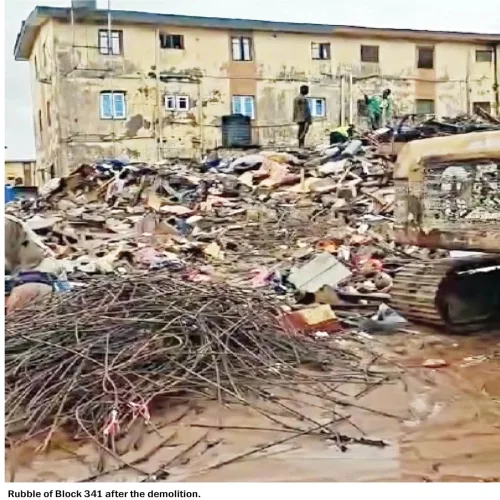
It was a day that altered the fortunes of the owners of apartments in the building, who suddenly watched one of their most valuable possessions reduced to rubble in an estate built for low-income earners by the administration of the late Alhaji Lateef Jakande, then governor of Lagos State.
Very early that morning, some residents noticed a crack in the building and immediately drew the attention of other residents, including property owners and tenants.
Before they could decide what to do, the Lagos State Building Control Agency (LASBCA) had been alerted.
“We wouldn’t know who called them because it was not long after we discovered the crack that officials of the agency came,” a resident who narrated the incident to Saturday Tribune said.
The officials were said to have ordered the occupants out of the building, sealed off the premises and barred the tenants, comprising about six families, from returning to retrieve their belongings.
One of the property owners, a retired civil servant said to be living in Ogun State, reportedly rushed back to Lagos after being informed of the development. By the time he arrived, however, what he regarded as one of his most prized assets had been reduced to rubble.
While residents did not consider LASBCA’s prompt response unusual, what they found disturbing was the alleged refusal to allow occupants to retrieve their belongings.
Saturday Tribune learnt that even the plea of one tenant who wanted to retrieve his international passport and other vital documents was allegedly turned down. The situation was said to have almost degenerated into a confrontation before officials sealed off the building and punched holes in parts of the structure to make it uninhabitable.
“The place was immediately sealed that Saturday morning, and they punched some holes in the building to make it uninhabitable. They came back the following day, which was Sunday, to carry out the demolition, though not without some resistance from occupants who protested that they had not been allowed to move their belongings out,” the resident said.
Suspicion over demolition
But what went wrong with Block 341?
Saturday Tribune’s investigation revealed that there had lately been apprehension among some residents of the estate amid claims that certain government officials and politically connected individuals were becoming increasingly interested in acquiring properties within the estate.
Some residents who spoke with Saturday Tribune said the speed of the government’s intervention and the alleged refusal to give the affected owners more time fuelled such suspicions. They expressed fears that even if the demolished block was eventually rebuilt, its original owners might not have the opportunity to reclaim their apartments.
“It was like playing into their hands,” one resident said.
An eyewitness acknowledged that there was a noticeable crack in the building but argued that the owners should have been given an opportunity to take remedial action if this could safely be done.
READ ALSO: Amosun’s demolition, Abiodun’s compensation
“For instance, while the building was sealed off on Saturday, it was not demolished until Sunday morning. The people who witnessed the demolition can attest to the fact that it took some effort before the building came down.
“It didn’t yield to the bulldozer the way you would expect an utterly distressed building to, thus supporting the insinuations in some quarters that there was more to the demolition than met the ordinary eye,” he said.
The demolition of the residential block has, however, brought to the fore long-standing but often overlooked challenges confronting many of Lagos State’s public housing estates — ageing infrastructure, poor maintenance culture and inadequate structural supervision.
The exercise, which displaced six families, was seen by many residents as more than the demolition of a single building. To them, it was a sobering reminder that many structures in the over four-decade-old estate are approaching critical stages in their lifespan and require urgent professional attention.
Who should maintain the estate?
But who should bear responsibility for the poor maintenance of the buildings?
While accusing fingers are often pointed at residents, some experts believe the government should shoulder a significant part of the responsibility.
A civil engineer and estate management expert, Mr Taiwo Akinsefunmi, argued that the government should be at the forefront of maintenance activities in the estate.
“It is the duty of the government to ensure that the buildings are maintained from time to time. The fact that maintenance fees are being charged lends credence to this.
“Even if government is not carrying out the repairs, it should have ensured that property owners do so under its close supervision. If that had been done, this type of incident could have been prevented,” he argued.
Speaking with Saturday Tribune, the President of the Abesan Housing Estate Residents’ Association, Mr Shina Dare, confirmed that the building had not shown visible signs of distress until cracks suddenly appeared that Saturday morning.
“There were no signs of distress on the building. It all happened suddenly. A crack appeared and that prompted concerned residents to draw public attention to the development through social media. This attracted LASBCA officials, who carried out structural integrity tests and concluded that the building posed an imminent danger to lives and property,” Dare explained.
Rather than treat the incident as an isolated occurrence, he said residents had responded by initiating estate-wide preventive measures.
According to him, an emergency meeting was held, leading to the establishment of a Building Compliance and Enforcement Committee comprising quantity surveyors, engineers and town planners. The committee is expected to inspect more than 1,000 buildings across the estate.
It has also directed property owners to undertake necessary structural repairs before October 2026, while encouraging the external rehabilitation and repainting of buildings to improve safety and aesthetics.
The initiative represents a shift from reactive to preventive management — an approach housing experts believe should become standard practice across Lagos’ ageing public housing estates.
Beyond the immediate structural concerns, residents said the incident had also exposed a deeper institutional challenge.
Dare urged the Lagos State Government to strengthen routine supervision of public housing estates, stressing that regular inspections could identify structural defects before they develop into emergencies.
He also appealed for temporary accommodation and compensation for families displaced by the demolition while they seek alternative housing.
“I appeal to the Lagos State Government and the Lagos Building Investment Company (LBIC) to see the need to compensate the victims of the demolition and find temporary accommodation for the affected families,” he said.
Dangers of alterations
The Chairman of the estate’s Building Compliance and Enforcement Committee, Mr Tunji Showole, traced some of the current challenges to the original design of the estate.
Built during the administration of the late Governor Lateef Jakande, Abesan was conceived as an affordable housing scheme aimed at expanding home ownership for low- and middle-income residents. To achieve affordability, the buildings employed construction methods requiring careful maintenance throughout their lifespan.
According to Showole, the structures rely heavily on load-bearing walls, making indiscriminate alterations particularly dangerous. Removing or weakening a structural wall, he explained, could compromise the stability of an entire building.
He observed that while every building naturally deteriorates with age, poor maintenance could accelerate structural defects.
The immediate trigger for the intervention at Block 341, he explained, was the discovery that residents could no longer open some apartment doors because of severe structural movement. Subsequent investigations revealed extensive cracking, prompting LASBCA’s intervention before the building could collapse.
Another concern identified by the committee is the location and construction of sewage chambers. Residents believe chambers located too close to building foundations could allow wastewater to seep into the soil whenever drainage channels become blocked, gradually weakening foundations.
Consequently, the committee has recommended relocating such chambers farther away from residential blocks as part of broader efforts to safeguard the structural integrity of the estate.
For the immediate past President of the Residents’ Association, Pa Aderemi Kehinde, the demolition reflects broader pressures facing Lagos’ housing sector.
He argued that the severe housing shortage had increased pressure on existing public estates, with a growing population placing additional demands on ageing infrastructure.
Kehinde also questioned what he described as the absence of continuous government supervision despite residents paying supervision fees when the estate was developed.
According to him, effective monitoring could have detected deteriorating underground infrastructure, including leaking sewage systems, before they threatened building foundations.
“The housing challenge in Lagos is very acute and that is partly responsible for the challenges we are having in our estate. You’ll see people moving about during the day and hanging around at night.
“When we were coming into the estate some years back, we were asked to pay a supervision fee, but that aspect of supervision is lacking. We want the government to implement this and ensure thorough supervision of estates across the state.
“If there had been adequate supervision, they would have known that the building was distressed and taken steps to prevent the occurrence. The cost of preventive maintenance may be significant, but it is far less than the human and economic consequences of another avoidable building collapse,” he said.
LASBCA defends action
An official of LASBCA, who spoke with Saturday Tribune on condition of anonymity, however, explained that the agency’s prompt response to the distress call was in the best interest of the community.
“We don’t have to wait till disaster happens before taking action. If we had waited a little bit longer and the building collapsed on its own, it is these same people who would blame us for not being proactive. So, our action was meant to save lives and not to inflict pain on residents,” he said.
The official also dismissed insinuations that powerful interests were behind the demolition.
According to him, it would be almost impossible to dislodge lawful occupants or take over any of the buildings from their original owners if the rules governing ownership and continued occupation of properties in the estate were strictly adhered to.
The Abesan experience presents important lessons for both government and homeowners. Building safety does not end with obtaining construction approval. It requires continuous maintenance, periodic structural assessment, responsible occupancy and strict enforcement of building regulations.
While LASBCA’s swift intervention may have prevented a possible loss of lives, residents insist that long-term safety must go beyond emergency responses.
Many have therefore welcomed the steps taken by the Residents’ Association, particularly the establishment of the Building Compliance and Enforcement Committee and the October deadline for property owners to carry out necessary repairs.
But the general view is that such measures should not be ad hoc. Residents want standing rules governing the ownership, alteration and maintenance of properties in the estate, with clearly defined responsibilities for homeowners, the residents’ association and relevant government agencies.
For property owners now embarking on repairs and structural assessments, the rubble of Block 341 has become a warning lying in plain sight: what happened to one block could happen elsewhere unless ageing buildings are inspected, maintained and repaired before cracks become emergencies.
Comments
Start the conversation about this story.