





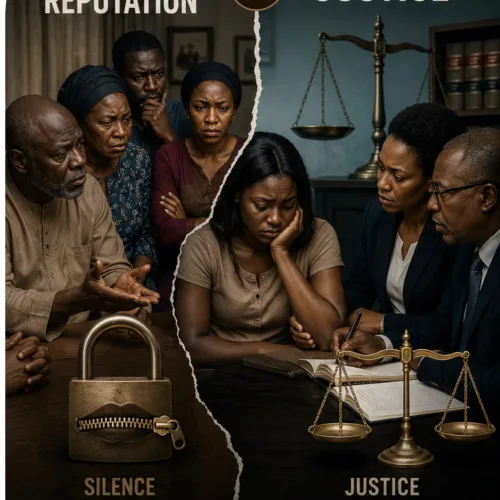
There is a question we should be brave enough to ask ourselves: When does protecting a person become protecting a crime?
It is easy to point at the man who beats his wife, the adult who abuses a child, the person accused of rape or the parent who protects an abusive son and say, “That person is the problem.”But what about the people who knew what was happening and told the victim to remain silent? What about the pastor who advised her to keep praying and endure? The relative who begged her not to “destroy the family”? The neighbour who knew a child was being abused but decided it was “a family matter”? The influential person who persuaded a victim to withdraw a complaint?
At some point, we have to confront an uncomfortable truth: a crime does not happen only because of the person who commits it. It can continue because of the people who enable, conceal, excuse or normalise it.
Nigeria has a serious problem with the culture of silence surrounding violence, particularly violence against women and children.
UNICEF reports that six in 10 children in Nigeria experience some form of violence before they reach adulthood, while many never receive support. It also notes that perpetrators are often people the child knows and that violence frequently occurs in places where children should be safest—homes, schools and communities.
These numbers should frighten us.
But statistics alone cannot capture what happens behind closed doors.
There is the young woman whose husband repeatedly beats her, but whenever she seeks help, someone tells her, “Men are naturally polygamous.”
There is the child who tries to tell an adult that someone is touching them inappropriately, only to be told, “Don’t say that about Uncle. He is a good man.
There is the wife who discovers repeated infidelity and is labelled disrespectful when she asks questions, while the husband is excused because “men are men.”
There is the girl who reports sexual abuse and is asked what she was wearing, where she was, why she went there or why she did not fight harder.
There is the family that knows a relative has sexually abused children but chooses silence because exposing him might bring embarrassment to the family.
And there is the survivor who is eventually persuaded to withdraw a complaint because “nothing good will come from destroying his life.”
But what about the life that was already destroyed?
When tradition becomes an excuse
Nigeria has many beautiful traditions built around family, community, reconciliation and respect for elders. But traditions become dangerous when they are used to protect wrongdoing.
We have to stop confusing forgiveness with the absence of accountability.
Forgiveness may be a personal decision. Reconciliation may be possible in some circumstances. Therapy can be important. Religious faith can provide enormous emotional strength.
But none of these should be used as substitutes for protecting victims or dealing appropriately with serious allegations and crimes.
A woman being beaten by her husband does not need someone to tell her simply to pray harder.
She may need safety.
She may need medical attention.
She may need counselling.
She may need legal advice.
And if a crime has occurred, she may need access to the justice system.
Prayer and professional intervention do not have to compete with each other.
The dangerous double standard
We also need to examine the double standards that exist around relationships.
When a married man is unfaithful, people sometimes dismiss it with the familiar expression that “men are polygamous.” Yet when a woman cheats, the insults can become vicious and degrading.
Infidelity is wrong regardless of gender. A marriage should not operate under two different moral rulebooks.
But the bigger issue is what happens when these attitudes are extended to violence.
A man who beats his wife should not be defended because he is the husband.
A woman who abuses her husband should not be excused because she is a woman.
A parent should not protect an abusive child because of blood relationship.
And an adult who sexually abuses a child should never be shielded because the family fears embarrassment.
The protection of a family name should never become more important than the protection of a child.
Who protects the child when adults choose silence?
One of the most heartbreaking aspects of child abuse is that children often depend entirely on adults to protect them.
They cannot always leave.
They may not understand what is happening.
They may be afraid of being blamed.
They may depend financially on the person abusing them.
And sometimes, tragically, the adults they trust are the very people who silence them.
UNICEF’s account of a 14-year-old Nigerian girl, identified under the pseudonym Alice, illustrates how difficult this silence can be. She experienced three years of sexual abuse before finally disclosing it after hearing information about how to report violence safely. Her case was subsequently referred to the Nigeria Police Force’s Gender Desk for investigation.
Her story carries an important lesson: sometimes the difference between continued abuse and a path to justice is simply whether a child finds one adult who believes them and knows what to do next.
That adult could be a parent.
A teacher.
A doctor.
A police officer.
A religious leader.
A neighbour.
Or a relative.
Pastors, parents and elders must understand the weight of their advice
This is not an attack on religion. Far from it.
Faith communities have an important role to play in supporting families, protecting vulnerable people and helping survivors rebuild their lives.
But religious leaders must recognise the limits of pastoral advice.
If someone reports serious abuse, the first response should not be to pressure the victim into silence for the sake of preserving a marriage, reputation or congregation.
The same applies to parents and elders.
When someone comes to you with an allegation of abuse, you are not being asked to become judge and jury. You are being asked to respond responsibly.
Listen.
Protect the vulnerable person.
Seek appropriate professional assistance.
Report where required.
And allow qualified professionals and lawful processes to establish what happened.
The same principle applies to lawyers, counsellors, medical professionals, teachers and law-enforcement officers. Every profession that comes into contact with vulnerable people carries an enormous responsibility.
Nigeria’s Violence Against Persons (Prohibition) Act was designed to prohibit violence against persons, provide protection and remedies for victims, and punish offenders. NAPTIP is mandated to administer the Act and provides mechanisms for reporting sexual offences and accessing service providers.
There are systems.
The challenge is making sure people use them effectively.
Covering for an offender does not make the problem disappear
Imagine a mother discovers that her teenage son has sexually abused another child.
She has two choices.
She can confront the reality, seek professional help, protect potential victims and allow the appropriate authorities to deal with the matter.
Or she can hide it because “he is my son.”
The second choice may feel like protection.
It is not.
If the behaviour continues and another child is harmed, the consequences become even more devastating.
Parents have a responsibility to raise children with boundaries, accountability, respect for consent and respect for other people’s bodies.
Love does not mean defending everything your child does.
Sometimes loving your child means confronting behaviour that could destroy both their life and someone else’s.
The victim should not become the person on trial
One of the most damaging things we do is turn survivors into suspects.
Why did you stay?
Why did you go there?
Why didn’t you scream?
Why didn’t you leave earlier?
Why are you reporting him now?
What will people say?
These questions can deepen trauma.
Of course, investigations must establish facts. Allegations should be handled fairly, and everyone accused of a crime is entitled to due process.
But due process does not mean humiliating survivors.
Justice requires both fairness to the accused and protection for victims.
We should be capable of holding those two principles at the same time.
Nigeria must move from private settlement to responsible intervention
There are circumstances where families can resolve disagreements privately. Not every marital disagreement is a criminal matter, and not every family conflict requires police intervention.
But serious violence, sexual abuse and crimes against children should never be casually dismissed as *“family matters.”*
When a person is in immediate danger, safety must come first.
When a child is being abused, protecting the child must come first.
When a serious crime is alleged, qualified authorities should be allowed to investigate.
When survivors need psychological support, they should be connected to competent professionals.
This is not about destroying families.
It is about preventing destroyed lives.
NAPTIP’s national sexual-offender and service-provider database demonstrates that Nigeria has established mechanisms for reporting sexual offences and connecting survivors with support. Its database currently records thousands of sexual-offence records across different stages of the justice process, including convictions, investigations and cases before the courts.
The existence of such systems matters—but systems only work when people use them.
We must stop rewarding silence
Perhaps the hardest change Nigeria needs is cultural.
We need to stop asking, “What will people say?” and start asking, “Is this person safe?”
We need to stop asking, “How will this affect the family’s reputation?” and start asking, “How many more people could be harmed if we remain silent?”
We need to stop protecting adults at the expense of children.
We need to stop telling women to endure violence simply because they are married.
We need to stop telling men that violence is an acceptable expression of masculinity.
We need to stop treating sexual abuse as something that should disappear because the offender is a relative, church member, respected professional or wealthy individual.
And we need to stop confusing silence with peace.
Silence is not peace when someone is being abused.
Silence is not forgiveness when someone is being threatened.
Silence is not family loyalty when a child remains at risk.
Sometimes silence is simply permission for the abuse to continue.
The question is no longer whether we know
Nigeria cannot say it does not know.
We know that children are being abused.
We know women experience violence.
We know victims are sometimes pressured into silence.
We know stigma discourages reporting.
We know some families protect offenders because they fear shame.
And we know that professional, survivor-centred responses can make a difference.
The real question is what we will do with that knowledge.
If a victim comes to you, do not become another wall standing between them and justice.
If you are a parent, teach your children boundaries, respect, empathy and accountability.
If you are a religious leader, provide spiritual support without substituting it for professional intervention.
If you are a police officer, treat complaints seriously and professionally.
If you are a counsellor, understand that your advice can determine whether someone seeks safety or returns to danger.
If you are an elder, remember that age should bring wisdom, not merely authority.
And if you know that a child is being abused, do not look away.
Because there is a profound difference between protecting a person from injustice and protecting a person from the consequences of their own wrongdoing.
We must learn that difference.
A society is judged not only by how it treats its most powerful citizens, but by how fiercely it protects those who are most vulnerable.
The next time someone asks us to “let it go,” perhaps we should ask one more question:
Let what go—and who will pay the price?
Too many lives have already paid it.
Nigeria can do better.
And sometimes, doing better begins with refusing to keep a secret that is hurting someone.
Author Bio
Tomilayo Imade is a Nigerian writer and project management professional based in England. Passionate about social justice and human-interest stories, she writes thought-provoking articles on culture, mental health, gender, and public affairs. Through her writing, she seeks to challenge harmful social norms, amplify everyday experiences, and inspire meaningful conversations that drive positive change.


Comments
Start the conversation about this story.