





As the Olu of Warri, Ogiame Atuwatse III, marks his fifth year on the throne, activities are being held across the kingdom to celebrate the anniversary and promote the culture, identity and development of the Itsekiri people.
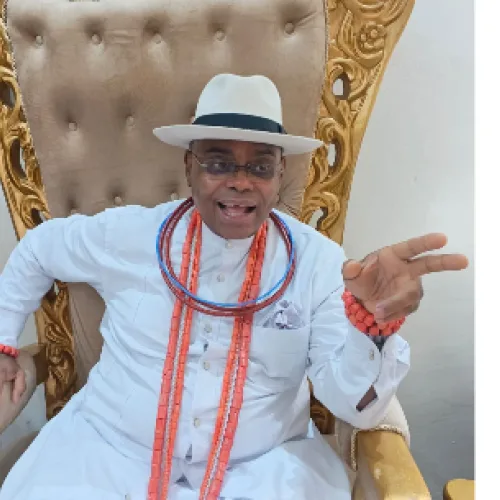
In this interview, the Agura Tete of Warri Kingdom, Chief Lawrence Wilbert, speaks on the significance of the anniversary, the Olu’s vision for Warri Kingdom, the preservation of Itsekiri language and culture, inter-ethnic relations in the Niger Delta, and the potential of Warri as a hub for blue economy.
By Charles Kumolu, Deputy Editor
The Olu of Warri, Ogiame Atuwatse lll, is celebrating his fifth year on the throne…
The formal programme started on August 17, with activities highlighting what Ogiame has been able to achieve this year with the Global Homecoming of Itsekiri people.
That was preceded by an Itsekiri language competition involving children, which is part of the efforts to promote the language among the younger generation.
There were also a series of activities taking place across the kingdom before the formal programme. One of these is the Benin River Life series of events, which takes place on August 15. There are also activities involving gospel artistes and other programmes.
There was also a novelty football match on August 20.
What does the fifth coronation anniversary mean to the Itsekiri people?
The king lives forever. Five years is a landmark, and His Majesty, Ogiame Atuwatse III, is someone who makes sure that his family, his children and his subjects are involved in everything that will bring life and progress to them.
For the fifth coronation anniversary, he considered it an opportunity for Itsekiri people all over the world to return home. It is not limited to Itsekiri alone. It includes friends of Itsekiri and everyone who has blood ties to Itsekiri.
His Majesty is looking forward to personally welcoming them and participating in events with them. It has so far been a grand occasion.
The anniversary provides an opportunity to say that, after five years of building, this is the time to come together once again and celebrate as a people.
We have a history and a traditional institution that goes back more than 500 years. That heritage cannot simply be written away. There was a period when people lost confidence in who they were, but today, the Itsekiri are becoming increasingly confident in their identity, particularly with a king like Ogiame Atuwatse III on the throne.The future is bright.
Beyond culture and tradition, what would you say has been the major focus of the Olu in the last five years?
I am not talking only about culture and tradition only. I am talking about the livelihood of the ordinary Itsekiri person.
For at least the past two years, His Majesty has focused increasingly on what is happening to his people economically. We are a people who sit on the wealth that feeds Nigeria from an economic perspective, particularly through the oil and gas industry, yet we remain among the poorest.
His Majesty has been addressing that reality.
Thankfully, the Petroleum Industry Act has also been implemented over these years. Beyond that, His Majesty has focused on cultural diplomacy, engaging not only the ethnic nationalities around us and across Nigeria, but also traditional institutions and ethnic nationalities in different parts of Africa.
He is part of a broader conversation about the renaissance of African identity and the recognition of the leadership role Africa should play in the world.
For the Itsekiri, it is exciting to be part of that process. Africa is coming into its own, and His Majesty has been working towards that. I think this fifth coronation anniversary is an opportunity to bring all those efforts together and showcase that we are a humble people, but we know who we are and we are ready for the world.
A few years ago, the Olu instituted awards such as the Royal Order of Iwere, ROl, What special activities or initiatives should people expect during this anniversary?
His Majesty has the prerogative to determine what he wants to present and showcase to the rest of the world.
But what is important is that we want to demonstrate that all the work that has been done in human capacity development and the repositioning of Warri Kingdom is beginning to bear fruit.
Those who have previously received awards are now demonstrating their impact. The Itsekiri Global Homecoming, for example, is being championed by recipients of the Royal Order of Iwere.
This is the first time something like this is happening, and they have taken it upon themselves to make sure that it happens.
We are also going to have royal representatives from different parts of Africa.
You will see the richness and diversity of Itsekiri communities, whether they are poor or wealthy. We are talking about the Benin River axis and the culture that exists there. The camaraderie and even the friendly rivalry among the communities will all manifest through the Benin River Life series of events.
The Minister of Culture, Arts and Tourism will be present and is very excited about the programme. The Minister of Communications will also be involved. There is an opportunity to work with the Iwere Kingdom to explore how telecommunications and communications infrastructure can be expanded in the riverine areas.
So, the impact of His Majesty’s reach, words and actions is gradually coming into manifestation.
The Itsekiri Kingdom is located in an area where there have been concerns about inter-ethnic relations. To what extent is the Olu addressing these challenges?
These situations exist, but the beauty about the king we have is that he is at the forefront of addressing them. He does not take the back seat. He is involved in the key decisions and in determining how things should be driven.
Interestingly, the main players in the area, the Itsekiri, Ijaw and Urhobo, have a very high level of mixed marriages. You cannot even define it.
When you begin to look at issues around land and political territories, however, there is something else at play. It is power.
What is important is that we engage at all levels and have a conversation that says what belongs to you should be yours. At the same time, we must recognise historical realities and understand that these things have always existed. There is no need to fight over them.
The Warri axis, including the Warri Kingdom and neighbouring kingdoms, has been brought to its knees by ethnic nationality strife.
There are also new players in the game who are making wealth from these divisions.
The rule should be simple: if I have a glass house, I will not throw stones at your glass house because you will throw them back.
I am happy for the wealth that is being created among everybody. At that point, there is nobody with sovereign power over violence. If the Urhobo are violent, if the Ijaw are violent and if the Itsekiri are violent, who pays the price? All of us will pay the price, because when there is violence, nobody makes money.
Stability is important. Everybody should be able to make money and develop.
Above all, there is a sovereign God who sees everything.
The Itsekiri are known for their rich cultural heritage. What has sustained the culture over the centuries?
That is a very interesting question.
The simple answer is: water no get enemy.
His Majesty has spoken about this philosophy before. He is not merely planning for the next cycle or even the next generation. He is laying institutional foundations for the next seven generations.
He views leadership through the water cycle. Water flows. It does not get in anybody’s way. It nourishes, replenishes and empowers communities.
The Itsekiri person is very close to water. We are a water people.
If you observe our dances, particularly the way the women dance, there is a certain grace to it. It is like the movement of a duck on water. Even when there is a storm underneath, what you see is the graceful movement on the surface.
When you see the men dancing, it can also look as if they are swimming.
That is the gracious movement and respect for water, and it translates into many aspects of Itsekiri life and culture.
Itsekiri is a minority ethnic nationality, and in Nigeria, the three major ethnic nationalities have their languages promoted extensively.
If intentional action is not taken to protect minority languages, they will go into extinction.
And this is not only an Itsekiri problem. It applies to many minority ethnic nationalities.
If you travel across Nigeria, you hear the names of ethnic groups and their languages, many of which you may never have heard of before.
We are fortunate as Itsekiri to have the visibility that we have. There are other ethnic nationalities with populations similar to ours that do not have that level of visibility.
One thing the Itsekiri must do is to be intentional about preserving the language.
That is why His Majesty has put the issue at the forefront. He is personally involved in celebrating children who are proficient in the language.
But much more needs to be done.
We need teacher training in the language. We need scholarships for people who want to become Itsekiri language teachers. We need to create jobs for them in our primary and secondary schools and, for those who are qualified, at the tertiary level.
We also need researchers and fellows working on the language. We should create faculties or academic chairs dedicated to Itsekiri studies so that there can be further research and development of the language.
It is a rich language. For a people with a history of more than 500 years, it is only logical that we should intentionally do more to preserve it for another 500 years and beyond.
Warri is almost as famous as Nigeria itself, but the city still has significant infrastructure challenges. To what extent is the Olu pushing for the development and renewal of Warri?
Warri was one of the early points of contact with the Portuguese. In the ancestral home of the Itsekiri, you also have what is believed to be one of the earliest Catholic churches in Nigeria, St Anthony’s Catholic Church, known locally as Satoni.
We also have a long history of engagement with Europe and an ethnic nationality that produced what is arguably one of the earliest European-educated monarchs in West Africa, Dom Domingo.
So, we have come a long way, even before the emergence of Nigeria. We are a nation, and we predate Nigeria, just as other great kingdoms, including the Benin Kingdom from which our monarch’s lineage comes, predate the modern Nigerian state.
Now, moving to Warri as it is today, much of what you see is a consequence of the ethnic strife that has affected the city and its environs.
We must commend the leadership of Governor Sheriff Oborevwori for helping to calm the situation that arose recently.
What Warri needs most is peace among its peoples.
Warri will always be a magnet for investment, particularly in the oil and gas sector.
But there is another opportunity that we do not talk about enough: the blue economy.
Warri has the potential to become a major hub for the blue economy, not just through industries that will operate there, but also through the development of human capital that can be exported from the entire Niger Delta region.
Look at the Philippines. It is a major player in the maritime sector partly because it exports its citizens as human capital. You go to ships around the world and you find Filipinos.
The Philippines does not have as large a population as Nigeria. It also has a coastline, just as Nigeria does. Yet Nigeria is not even doing five per cent of what the Philippines is doing in terms of exporting maritime human capital.
Warri therefore has enormous potentialities. What we need is peace, stability, investment and deliberate development of the people and institutions that can turn that potential into wealth.
Bight of Benin
We are poor, but in reality, we are rich with our human resources. What can be done around the blue economy? When I say Warri, I am actually talking about Warri Kingdom, because you have a long stretch of ocean that goes across the Bight of Benin, and you have the various ethnic nationalities that are conversant with the creeks and those waters. There is a lot that can be done from that perspective.
Now, to His Majesty, he sees the future of what we collectively, as a people, can make our homestead become. We can make it the greatest of all, because we have everything within us, both human and natural resources, to make all that happen.
From that perspective, His Majesty engages his brother kings. It is from that perspective you see him engaging not just the local government authorities, but the state government authorities, the national and federal authorities, and, of course, with the permission of the Federal Government, you see him engaging even in cultural diplomacy with the rest of Africa and the rest of the world.
All this is to bring attention to the potentialities in this area we call Warri Kingdom, which is not just Warri Kingdom itself, but even its environment and its neighbours, and to see what can be attracted to it.
Cultural diplomacy
You can see His Majesty undertaking a cultural diplomacy trip to Finland, because Finland is a forerunner in the education sector, where they have one of the most educated societies in the world. We want to learn from them.
His Majesty wants to learn from them. He needs his people to be better educated. What have they done there that we can imbibe?
You have His Majesty engaging with His Majesty in the United Kingdom, King Charles, to maintain those relationships. You have His Majesty undertaking trips to Canada and even to the United States, all this to engage technocrats and see history. We are blessed with our culture, which has gone on for so long.
We are blessed currently with a visionary king, one who has a heart for his people. The ingredient needed right now is the belief or the execution of His Majesty’s vision for the Kingdom. The commitment to want to see that this Kingdom carries on being here for another 500 years by participating.
And that is what His Majesty is trying to underline, even with this fifth coronation anniversary, by calling his children to come home and see your lands, see how beautiful it is. It has challenges, but the land needs you right now. That commitment from every son and daughter.
The other ingredient that the Itsekiri need now is to see that their destiny is right in their hands. Nobody else can execute what they aspire for, which is good livelihood, peaceful living, the ability to express themselves, to acquire happiness, to have jobs and maintain an environment that is sustainable. Now, it is in their hands.
It will also include a change in work ethic, which His Majesty is preaching, from a rent-seeking attitude to being a productive people, because our land is now, “Walk the land, work the land, bring out what you need.”
We have seen your transition from the corporate sector to a notable titled person. Can you tell us what it feels like playing this role, and what are those responsibilities that the position placed or places on you?
I would want to address that by starting off by saying Ogiame, I suppose, did not confer the title and the responsibility on me to come and just sit and wear the title as a chief. He knew and knows that I’m a technocrat.
He knew and knows that I’m a leader. He knew and knows that I’m one that connects the nation. Interestingly, my Akuja, the appellation which he blessed me with, is Ajolaja, Ajolaja, the repairer of the town, the unifier, the one who makes things happen.
Now, I am a chief of the Ogiame Court, with leadership amongst the chiefs. We are blessed to have the leadership of Chief Oma, who is the Ologbotsere of Warri Kingdom, who himself, yes, is aged, but a brilliant first-class technocrat. He is a first-class graduate, a technocrat, an engineer.
He is a great leader to have on the chieftaincy train. Mine is to see how I add my own flair to the expression of the vision that His Majesty has laid for us.
That said, I represent Itsekiri across the whole Kingdom, but I also have a people in those states where I’m also from, which is Ikara in the Iyashere lineage. So, you find that in all that, there have been challenges for my people, the Ikara people, in where you might call the Olugbo Forest Reserve area.
There’s a lot that is going on in that angle, and thank God for Ogiame, who supports all that. Thank God for the leadership of the Iyashere of Warri Kingdom, Chief Johnson Asheruneghe, who also provides assistance to see that we can do what we need to do to get our rights done.
It has been an interesting transition from being just a pure technocrat to now being a titled chief, because every Itsekiri that sees me dressed like this, or even sees me dressed traditionally, sees Ogiame. We are a direct representation of Ogiame, so we must carry ourselves accordingly, with the grace and dignity that the office demands.
But even more so, they also demand good leadership.
Ogiame is providing that for us, so we can only just reflect that and bring our own experience to bear.
Comments
Start the conversation about this story.