





The renewed call for the restoration of petrol subsidy under any guise demands a clear-eyed examination of what Nigeria has gained from reform and what the country would have to surrender by reversing course.
The scale of the problem is important to remember. In 2022, when Nigeria was struggling with declining oil production and weak revenues, the country spent about $10 billion on fuel subsidies. The World Bank also warned that the subsidy was consuming resources that could otherwise have gone into education, healthcare, infrastructure and social protection.
This is the system that the administration of President Bola Ahmed Tinubu inherited and boldly decided to change.
At the Federal Government’s recent presentation of “Nigeria’s Reform Scorecard: The Benefits, Costs and Harms Prevented,” the Honourable Minister of Finance and Coordinating Minister of the Economy, Dr. Taiwo Oyedele, disclosed that subsidy savings mobilised ₦15.8 trillion in resources for the Federation between June 2023 and December 2025.
Of this amount, approximately ₦5.43 trillion accrued to the Federal Government, ₦6.52 trillion to states and ₦3.88 trillion to local governments.
It is important to explain these figures honestly. The ₦15.8 trillion is not sitting in a government account as a separate pool of cash called “subsidy savings.” It represents resources released within the Federation’s wider fiscal system and made available across the three tiers of government.
The additional resources available to states and local governments have strengthened their capacity to meet salaries and pensions obligations and to invest in infrastructure and essential services, including primary healthcare, basic education, roads and other needs. At the federal level, the broader fiscal space created by the reforms has supported major investments and obligations that would have been considerably more difficult to sustain under the old subsidy regime.
The Federal Government’s Reform Scorecard records approximately ₦6.47 trillion in additional expenditure on strategic infrastructure, covering major investments in transport, housing, agriculture, security and other strategic projects. These include major national corridors such as the Lagos-Calabar Coastal Highway, Sokoto-Badagry Superhighway, and the Trans-Sahara Superhighway.
The reforms have also made room for significant investments in human capital and social support. Over 10 million Nigerian households have benefited from social transfers. The Administration has also extended more than ₦400 billion towards landmark social investment initiatives like the Nigerian Education Loan Fund, NELFUND (₦223.8 billion), the MOFI Real Estate Investment Fund, MREIF (₦150 billion) and the Nigerian Consumer Credit Corporation, CREDICORP (₦50 billion).
Renewed domestic and foreign investor confidence founded on the reforms have helped make the Nigerian stock market the world’s best performing in 2026, pushed the external reserves to the highest level in almost 20 years, and helped the country grow oil production to exceed its OPEC quota for the first time in years.
The additional fiscal space has also supported wage adjustments, minimum-wage obligations and pensions, while expanding the capacity for investments in education, healthcare, agriculture, electricity, security and other critical areas of national development.
Nigeria is also entering a new phase in its petroleum sector, with marked expansion in domestic refining capacity. Reversing policy now will undermine this progress and introduce fresh uncertainty for investors at precisely the time Nigeria should be consolidating domestic refining and strengthening energy security.
Our Reform Scorecard also assesses the economic harm that the reforms have helped Nigeria avert. Had the subsidy regime remained unaddressed, petrol scarcity would have returned, pushing prices above ₦3,000 per litre on the black market. The legacy Ways and Means financing, which stood at about ₦30 trillion in May 2023 and has since been curtailed, would have doubled to ₦60 trillion or more. The Scorecard projects that, without the reforms, the inherited situation of 27 States unable to reliably pay salaries would undoubtedly have worsened.
There is another important argument being overlooked. Nigeria already carries a second energy subsidy, on electricity consumption, which cost the country an additional ₦3.14 trillion between June 2023 and December 2025. This subsidy helps bridge the gap between actual power production costs and the capped tariffs paid by most consumers. Reintroducing a petrol consumption subsidy on top of this would deal a double blow to Nigeria’s fiscal position.
The above illustrate an important point: restoring subsidy would almost instantly return Nigeria to the economic conditions of 2022, recreating the same fiscal pressures, distortions, scarcity and incentives for arbitrage that made the old system unsustainable in the first place.
We are not claiming that the reforms have solved all of Nigeria’s economic challenges; there is indeed still much work to be done to translate improved fiscal capacity into better services, jobs, infrastructure and living standards. But the proper response to the hardship associated with reform is not to dismantle the reform; it is to accelerate the benefits – which remains what the Tinubu administration is resolutely focused on.
The objective is clear: to move public resources away from subsidising consumption and towards investing in the Nigerian people and the productive foundations of lasting prosperity.
This is also why the debate over restoring subsidy must ultimately come down to hard choices. Do we restore petrol subsidy, or sustain student loans and consumer credit for young Nigerians? Do we restore subsidy, or preserve higher allocations to states and local governments? Do we restore subsidy, or continue funding roads, rail, power and security? Do we restore subsidy, or strengthen the fiscal capacity required to expand healthcare, education and social protection for vulnerable Nigerians?
It is equally significant that the Organised Private Sector and the wider economic community have cautioned against reversing the reform, recognising that fiscal sustainability, policy stability and a competitive downstream petroleum sector are essential to investment, job creation and economic growth.
Nigeria cannot build tomorrow’s economy by returning to yesterday’s unsustainable subsidy regime. We have moved beyond that model.
We do not downplay or deny the challenges associated with subsidy removal and other major reforms. President Bola Ahmed Tinubu, GCFR and his administration are daily working – and succeeding – at translating these sacrifices into improved living standards, stronger public services and greater economic opportunities for the Nigerian people.
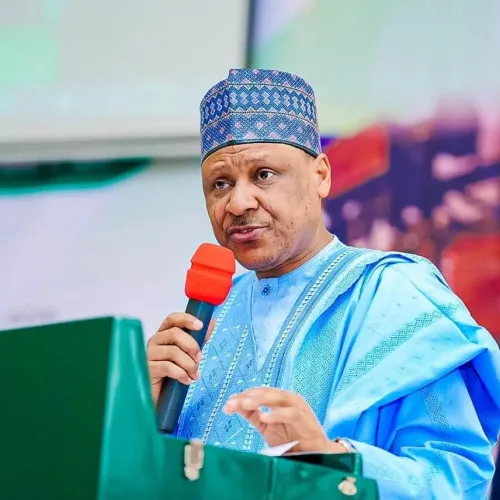
Mohammed Idris, FNIPR is the Honourable Minister of Information and National Orientation
Comments
Start the conversation about this story.