





Nigeria is digitising procurement, but transparency remains uneven. However, having an e-procurement portal is not the same as having transparent procurement. One may ask themselves: what makes it difficult to publish procurement records in Nigeria? In the last three years, the e-procurement portal has been the lowest-ranked indicator of fiscal transparency in BudgIT’s States’ Fiscal Transparency League Table.
BudgIT’s States Fiscal Transparency League (SFTL) Initiative is designed to sustain the gains of the World Bank’s States Fiscal Transparency, Accountability, and Sustainability Program (SFTAS) by tracking how well States continue to maintain fiscal transparency, accountability, accessibility, and effective public finance management even after the programme’s financial incentives have ended. An assessment of states’ e-procurement systems between 2023 and 2025 reveals that progress has been inconsistent.
Some states have made stronger progress in providing e-procurement platforms, including Adamawa, Ekiti, Jigawa, Ebonyi, Benue and Anambra. However, most states still struggle to provide procurement information through their portals consistently. At the same time, a few remain in the red zone, with no available portal or portals in constant maintenance mode.
Three Years of Uneven Progress
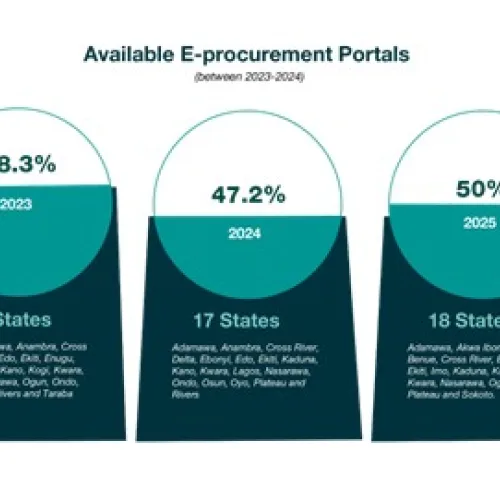
The annual availability of the e-Procurement portal indicator shows a slight decline, followed by a marginal improvement over the three years. Our assessment shows that in 2023, e-procurement portals were available in 21 states; representing 58.3% of all states. These states include Abia, Adamawa, Anambra, Cross River, Delta, Edo, Ekiti, Enugu, Imo, Jigawa, Kano, Kogi, Kwara, Lagos, Nasarawa, Ogun, Ondo, Osun, Oyo, Rivers and Taraba, indicating relatively high compliance among states in providing e-procurement platforms.
This figure dropped to 47.2% in 2024, with e-procurement portals available in 17 states. These states include Adamawa, Anambra, Cross River, Delta, Ebonyi, Edo, Ekiti, Kaduna, Kano, Kwara, Lagos, Nasarawa, Ondo, Osun, Oyo, Plateau and Rivers, reflecting reduced availability and suggesting inconsistencies in the maintenance and updating of e-procurement platforms.
In 2025, availability increased slightly to 50% from 47.2% in 2024, with e-procurement portals available in 18 states. These states include Adamawa, Akwa Ibom, Anambra, Benue, Cross River, Ebonyi, Edo, Ekiti, Imo, Kaduna, Katsina, Kogi, Kwara, Nasarawa, Ogun, Osun, Plateau and Sokoto, indicating a modest recovery. Looking at the overall trend, e-procurement availability has fluctuated over the three years, remaining below its 2023 level and highlighting the need for more consistent implementation across states.
When a Portal Is Not Enough
Procurement covers the process of sourcing and acquiring goods, services and works, from identifying a need to delivery and payment. E-procurement digitises this process, enabling activities such as e-sourcing, e-tendering, e-auctioning, e-ordering and e-invoicing to be conducted through digital platforms. A functional e-procurement system should be accessible and easy to navigate; the portal should include data such as bid submissions, the publication of procurement opportunities, the contacting entity and contractors’ details, project amount, timeline and description. A portal that merely publishes tenders is not equivalent to a fully functional e-procurement system.
The Information Gap Behind the Portal
The real challenge is not simply having an e-procurement portal but ensuring that it is functional, regularly updated, and provides meaningful procurement information. Can citizens access awarded contract details, project values, and other relevant records? Our research identifies factors such as limited management support, inadequate IT infrastructure, technical capacity gaps and resistance to change as barriers to effective e-procurement implementation.
When properly implemented, e-procurement can reduce leakages, lower administrative costs, improve transparency and promote more competitive public spending. Public procurement is increasingly recognised as a strategic governance tool for promoting inclusive and sustainable growth and to ensure value for money. In OECD countries, it accounts for approximately 12% of GDP and 29% of total government expenditure, underscoring the scale and potential impact of effective procurement systems. Public procurement in African economies constitutes a substantial engine of economic activity, often ranging between 15 to 30 percent of national Gross Domestic Product (GDP) and, in some instances, exceeding 50 percent of national budgetary expenditurexii.
For Nigeria, this economic leverage is particularly pronounced, with public procurement estimated to account for a significant 10-30% of its GDP and a substantial portion of national budgetary expenditure. This makes the digitisation of public procurement more than a technological reform, as it is an opportunity to strengthen transparency, reduce leakages and improve value for money significant[3].
Public procurement is governed by rules designed to ensure fairness, transparency and value for money. Strengthening e-procurement therefore requires more than creating digital platforms. The Nigerian state governments and FG must improve legal frameworks, digital capacity, infrastructure, cybersecurity and audit trails while making procurement more accessible to SMEs and local suppliers.
Nigeria does not need more procurement portals simply for the sake of having more portals. It needs procurement systems that work. The next phase of reform must shift from digital presence to digital performance by allowing citizens and businesses to follow public procurement from planning to payment and implementation.
Oluwatimilehin Olugbemi is a Program Officer in the Open Government & Institutional Partnerships department, at BudgIT.


Comments
Start the conversation about this story.